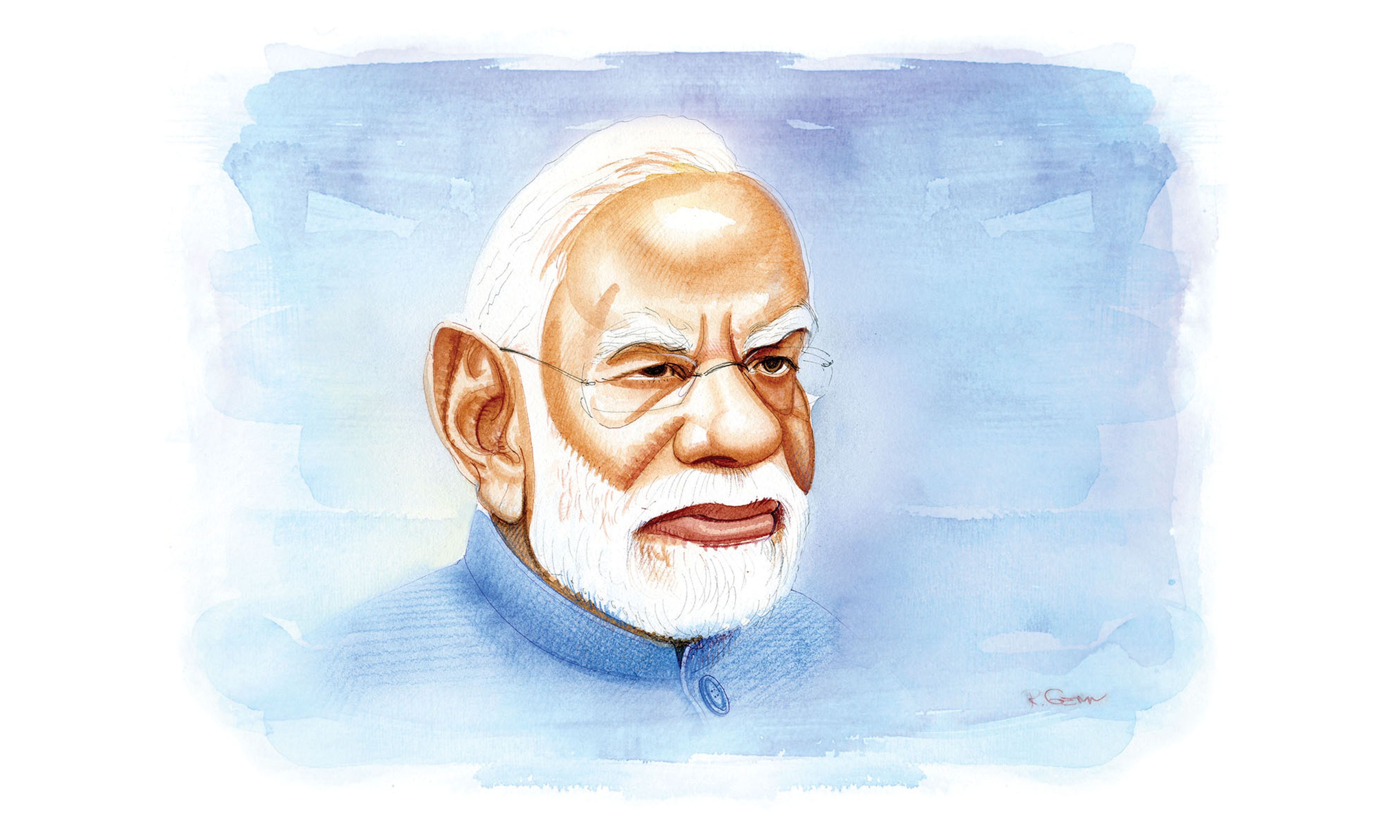
The largest and most complex election in human history is upon us. From April 19 to June 1, roughly a billion voters speaking 22 officially recognized languages and dozens of others will cast ballots in 28 states and eight federal territories to decide the next leadership of India. For a sense of the scale of this enterprise, consider that the next-largest electorate is that of the European Union, and its parliamentary election later in June has fewer than half as many voters. India recently surpassed China as the world’s most populous country, and it is increasingly consequential in global affairs. The Bharatiya Janata Party (BJP) is at the center of this change.
The upcoming election is causing as much consternation as celebration. To many, 2024 looks like a tragedy for India. The ruling BJP, which is the heavy favorite to form its third government in a row and perhaps even expand its parliamentary majority, has become the largest political party in the world on the strength of a Hindu-nationalist agenda that fires the imaginations of hundreds of millions of Indians but also alarms many of their countrymen and outside observers. The BJP aims to make India a superpower, and its fortunes could determine the future of Asia and of the global balance of power.
For much of its history, India has had little impact on international affairs. It is the motherland of several important world religions, including Hinduism and Buddhism, that have affected the spiritual lives of billions of people, from the Mongols to the Beatles. For millennia, the country’s riches have played an important role in the global economy. Pliny the Elder complained that Rome’s voracious appetite for Indian wares made the subcontinent “the sink of the world’s most precious metals,” and Elihu Yale made his fortune in the East India Company before bequeathing it to the university that still bears his name. Other foreigners, from Alexander the Great to Queen Victoria, have tried to acquire India’s wealth through conquest. But apart from fleeting moments of unity, India has been too politically fragmented to take full advantage of its resources.
Jawaharlal Nehru, India’s first prime minister after its independence from Britain, relied on secularism, socialism, and nonalignment to move the country past colonization, but progress was slow. Each component of the Nehruvian agenda had its downsides: The state’s tight control over the economy kept the country weak and poor, eventually forcing New Delhi to ask the International Monetary Fund for bailouts that culminated in 1991. In practice, nonalignment tilted heavily toward the Soviet Union, which initially stood by when China attacked India in 1962 and, until it imploded in 1991, provided fewer benefits than the United States offered its partners. And secularism is a noble goal, but some of the most notable actions of Nehru’s successors in the Indian National Congress party, such as passing laws that lowered divorce requirements for Muslim men and exempted them from paying alimony, were not secular and infuriated the Hindu majority. The party’s championing of Muslims and devotion to expanding “reservations,” a type of affirmative action for low-caste Hindus and tribal groups, looked to its critics like a form of identity politics that would undermine Indian unity.
The BJP leadership believes that the Nehruvian approach is not sufficient to unify and strengthen India so that it may thrive in the rough-and-tumble world of great-power politics. In these leaders’ minds, India’s deep civilizational roots and the religious fervor of its people are the only foundations firm enough to make India great.
They think that, for the country to prosper, the average Indian needs to make a psychological shift. As they see it, Hindus are unduly meek and subservient because of a millennium of foreign domination. Many Americans lamented Britain’s rule over India and cheered on Mohandas Gandhi and his fellow laborers as they sought independence. They and much of India’s elite saw Britain as the only colonizing power in India, but the BJP and its ideological allies also feel keenly the effects of rule by the Mughal Dynasty and earlier waves of Muslim invaders from Afghanistan and Iran. Early in his tenure, Prime Minister Narendra Modi lamented that “the slave mentality of 1,200 years is troubling us.” “Often, when we meet a person of high stature,” he said, “we fail to muster strength to speak up.” Modi, who is from a low caste and used to sell tea in a train station, embodies the more assertive India he would like to see.
Dispelling this “slave mentality” is one of the BJP’s priorities, and it is fueling a Hindu revival in northern India. The party rocketed to prominence four decades ago when senior members of an Indian National Congress–led government restarted a controversy around the Babri Masjid, a mosque in Ayodhya that many Indians believe was built by the Mughals on the ruins of a Hindu temple that had marked the birthplace of one of the most important figures in Hinduism, Lord Ram. These officials appear to have been triangulating politically after the Muslim-divorce bill infuriated so many Indians, but the move backfired when a mob destroyed the mosque and set off a round of nationwide rioting in 1992 that killed thousands of Indians, most of whom were Muslim. In 2019, India’s supreme court ruled that a Hindu temple should be built on the disputed site. Prime Minister Modi, who early in his political career had accompanied L. K. Advani, then leader of the BJP, on a series of political rallies about the temple issue, participated in its inauguration this January. Last year, he also oversaw the opening of a new parliament building that is part of a larger project to replace New Delhi’s colonial-era government buildings.
High-profile construction projects are only one part of the economic-development strategy that catapulted Modi into office. India’s inadequate infrastructure has long stunted the country’s growth: For example, shipping goods to New Delhi from Bombay, an important port and economic hub on the west coast, takes about 14 days. Moving goods faster with planes, trains, and automobiles is a priority for Modi’s government. A new rail line under construction will cut the transit time to about 14 hours. Over the past decade, India has doubled its number of airports and increased the length of its highways from 49,000 to 90,000 miles. Not content with terrestrial travel, India also landed its first spacecraft on the Moon in August 2023. The Chandrayaan-3 cost less than Christopher Nolan’s space saga Interstellar.
Modi has also made some progress on his pledge of “minimum government, maximum governance.” In 2017, the parliament passed his proposed reform to simplify rates for the national goods-and-services tax and reduce levies on many products, and although Modi has not gone as far as many had hoped, he has passed other pro-business reforms. He has also continued a digitalization drive, started by the previous, Indian National Congress government, to ensure that state benefits reach their intended recipients — and to bypass the middlemen who used to dominate India’s machine politics. India surpassed Britain to become the fifth-largest economy in 2022 and is on pace to outgrow Germany and Japan by 2030. Modi’s fortunes have soared with India’s: His approval rating in February was 75 percent.
* * *
India’s success matters tremendously for Americans and Asians alike. A wealthier India would be a better economic partner to the United States, and both countries would benefit from greater trade with and investment in each other. From a purely economic perspective, the promise of China’s consumer market has not been borne out, and American companies are increasingly hesitant to make new investments to cater to that audience. The pandemic showed that an overreliance on China for manufactured goods was unwise, and American firms are building plants in other countries to address that vulnerability. Some, such as Apple, have picked India. The more businesses follow Apple’s lead, the better off both countries will be.
Even more important, a stronger India would severely complicate the Chinese Communist Party’s regional ambitions. Although India is gaining ground on China, its economy is still roughly one-fifth the size of China’s, and Beijing spends about three times as much on its military as New Delhi does. In the short term, a richer India that can afford a larger defense budget would pull Beijing’s attention away from its projects to dominate Taiwan and to fracture the American alliance system in the region. Further down the road, China would have less reason to challenge the United States and threaten its allies if Asia thrived and became too strong for any one country to dominate.
Foreign and domestic critics lay out two major concerns about the BJP. The first is that the party’s success might lead the country down a dark path. The BJP’s legislation on foreign funding has crippled many NGOs, and critical journalists often face tax audits and other forms of government pressure. Last year, the Indian National Congress’s de facto leader, Rahul Gandhi, was sentenced to two years in prison and disqualified from the parliament because of a defamation conviction that an American court would dismiss immediately. (The Indian supreme court later stayed the conviction, and the parliament then readmitted him.) In March, another opposition leader was arrested on corruption charges. Even more troubling, many religious minorities fear they will be harassed, or even that their calls to the police will go unanswered if a mob descends on their neighborhoods. Mass “communal,” or religiously motivated, violence is declining, but there are still hundreds of such riots each year.
A more self-confident India may also make poor choices abroad. Last year, Canadian prime minister Justin Trudeau publicly accused the Indian government of assassinating an activist in British Columbia who agitated for Sikh secession from India and the carving out of a new Sikh country, “Khalistan.” In December, federal U.S. prosecutors indicted an Indian for attempting to kill another Khalistani activist in New York, allegedly on the orders of an Indian official.
In short, many observers see a nationalist movement built on grievances against religious minorities and given to harassing its internal opponents, and they note that such movements usually end in tears. Some of the BJP’s more feverish critics compare the party, and the National Volunteer Organization (RSS) that forms the party’s ideological core, to Nazis.
But if the BJP and the RSS are Nazis, they are shockingly bad at it. For a century, Hindu nationalists have compared their movement to Zionism, since both movements, in their minds, comprise multilingual people from various ethnic backgrounds who do not have much history of shared governance but are recognizably a distinct nation. The RSS has usually defined Hinduness as a cultural phenomenon that is not strictly religious, much as many Zionist leaders have thought about Jewishness. Mohan Bhagwat, the current leader of the RSS, says that people of Indian ancestry who participate in Indian culture are essentially Hindus and that religious minorities should feel no need to convert. The BJP is in the business of winning elections, so it has formed coalition governments with Muslims in Kashmir and Christians in India’s northeastern states.
The other concern that some foreign and domestic observers express is that the BJP will fail. India previously attempted a “leapfrog” strategy to transform its agrarian economy to a tech- and services-dominated one without first industrializing. This did not work, and neighboring Bangladesh has surpassed India in GDP per capita by following the “Asian tiger” strategy of manufacturing light consumer goods for industrialized countries. Modi has partly undone that mistake with his “Make in India” manufacturing drive, but manufacturing as a share of the economy has declined since he first came to power in 2014. Much of India’s industrial policy now focuses on difficult tasks, such as building electronics, semiconductors, and jet engines. Hindu nationalism as an ideology has few core economic principles, and as businessmen and opportunists swell the party’s ranks, the temptation to cut sweetheart deals with favored businesses and freeze out their competitors will grow. If that happened, India’s economic growth would be in jeopardy.
Indians could also balk at the BJP’s version of nationalism. The Nehruvian vision held India together, but it underperformed in many respects. Modern India was born amid horrific violence during the 1947 partition with Pakistan, and it has had its share of internal problems since. The mountain people in the northeast have been carrying out a decades-long insurgency, as has the Maoist Naxalite movement in the southeast, the Khalistanis in the northwest, and Muslims in Kashmir. Hindu nationalism could turbocharge each of these groups and alienate southern India, which tends to be more economically dynamic and welcoming toward Muslims than the north is.
Or India could crumble under external pressure. India has a long border with China, and since Modi came into office, the People’s Liberation Army has repeatedly attempted to make encroachments, even killing 20 Indian troops in 2020. Thanks in part to American assistance, the Indian army has since stopped other Chinese incursions without bloodshed, but victory in a potential larger conflict with China is not assured. India has repeatedly fought Pakistan since the partition, and the nuclear standoff between the two countries is uneasy. Pakistan is becoming increasingly dependent on China, and Chinese inroads into other countries in the region, such as Bangladesh and Sri Lanka, could leave India encircled. Hindu nationalists have been wary of China for decades, and they have deepened cooperation with the United States to address the threat emanating from the other side of the Himalayas.
The BJP is betting that it can muster broad-based economic growth that will relieve many of India’s internal pressures and that its vision of a Hindu India is strong enough to bind the country together but flexible enough to accommodate its diversity. A healthier India would make for a more peaceful world. Whoever can deliver that deserves our goodwill.












Comments