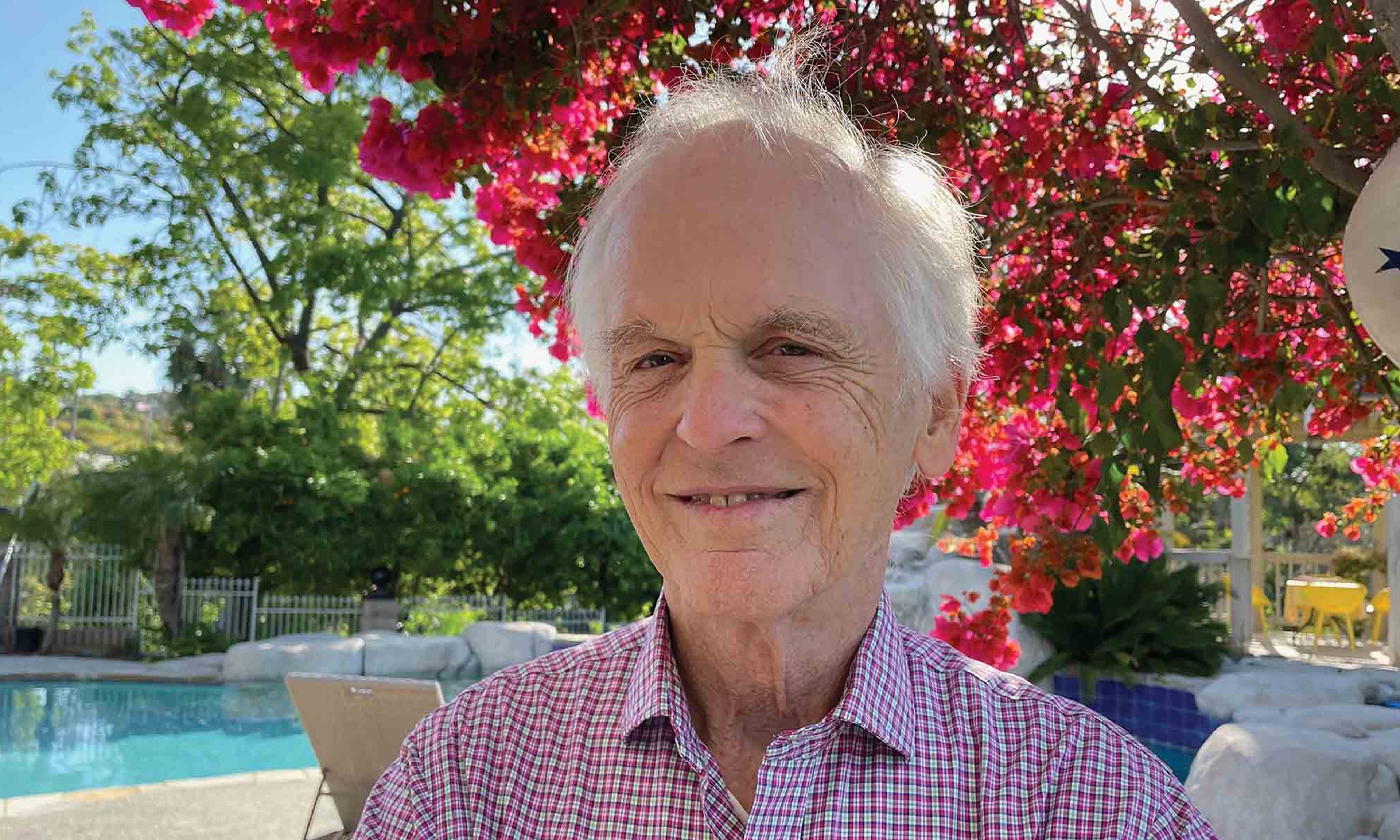
‘I have no enemies, and no hatred.” So wrote Liu Xiaobo in December 2009, shortly before he was sentenced. Perry Link and Wu Dazhi have written a new biography of him: I Have No Enemies. Link is a leading American China scholar; Wu Dazhi was a longtime friend of Liu Xiaobo. And Liu Xiaobo, you will remember, was a Chinese democracy leader, and therefore a political prisoner. He was awarded the Nobel Peace Prize in 2010, while a prisoner. He died in 2017, still a prisoner.
His statement in December 2009 continued,
Hatred is corrosive of a person’s wisdom and conscience. The mentality of enmity can poison a nation’s spirit, instigate brutal life-and-death struggles, destroy a society’s tolerance and humanity, and block a nation’s progress to freedom and democracy.
That is what Liu Xiaobo wanted: freedom and democracy. After he was sentenced — to eleven years — he said, “I believe that my work has been just, and that someday China will be a free and democratic country.”
Liu Xiaobo was a great man. He is not as famous, worldwide, as, say, Nelson Mandela or Václav Havel. Perry Link makes this point to me in a conversation. Mandela emerged from prison to be president of his country; Havel did the same. Liu Xiaobo died in prison, like so many others in dictatorships all over the world. He was great all the same.
In this new biography, you can see him in his many and extraordinary layers.
Liu Xiaobo was born in 1955. His father, Liu Ling, was a member of the Communist Party and fiercely loyal. He and his wife, Zhang Suqin, had five children, all boys. Liu Xiaobo was in the middle, the third. During the Great Chinese Famine (1959–61), the father got the best food available — he alone got it. The six others in the family got poorer food. This offended the moral sense of young Liu Xiaobo. He and his father were always at odds.
Because Andrei Sakharov was such a great dissident — a moral hero — you can forget that he was also a great scientist (a physicist). Same with Aleksandr Solzhenitsyn: a great writer (and Nobel laureate in literature).
Stick with Russia a moment. Boris Nemtsov was destined to be a great physicist, or seemed to be. He earned his Ph.D. at 25. His mentor was Vitaly Ginzburg, a Nobel laureate. But Nemtsov felt a kind of calling to enter politics. He wanted to help establish a free and democratic Russia. Ginzburg told him that he was sacrificing a great scientific career. In the end, Nemtsov sacrificed more than that: He was murdered in 2015 within sight of the Kremlin.
Liu Xiaobo was a great literary scholar, and a deep philosopher. He was one of the outstanding academics in the whole of vast China. He would have left a mark if he had not spent one moment in dissidence. His friend Ding Zilin used to chide him for spending so much time on political work, when he had these immense scholarly gifts. She is a professor of philosophy (retired). She also understood Liu Xiaobo very, very well.
Ding Zilin is the leader of the Tiananmen Mothers group. Her son, Jiang Jielian, was killed in the massacre, age 17.
Liu Xiaobo was at Tiananmen Square. He was one of the “elder” leaders who brokered a deal between the students and the military. This allowed thousands of students to leave the square in relative peace. Otherwise, the massacre would have been bloodier than it was. The body count would have been much higher.
Václav Havel, the Czech, meant a lot to dissidents such as Liu Xiaobo. They admired his example. They read his writings, including “The Power of the Powerless.” Havel said that ordinary citizens could “live in truth” and thereby shake the state, which counted on their cooperation in lies.
In 1977, Havel and his friends issued “Charter 77,” calling for human rights in their country. In 2008, Liu Xiaobo and his friends issued “Charter 08.” They did so on December 10, the 60th anniversary of the Universal Declaration of Human Rights. Liu Xiaobo was arrested and imprisoned for what turned out to be the final time. (He had been arrested and imprisoned three times before, starting in 1989, after the massacre.)
Havel was a key part of the campaign to get Liu Xiaobo the Nobel Peace Prize. The prize did not spare him — though it shot his name, and his cause, around the world. He died on July 13, 2017, of liver cancer. Some people say, “They killed him.” Did they? The authorities withheld medical treatment for a very long time, says Perry Link. In saving this prisoner — this thorn in their side, this rebuke to them — they had no interest.
Professor Link is a legend in Chinese-dissident circles, and in China studies, though he will not stand for any such suggestion. “From my experience, Link is modest, but others are immodest in his behalf.” I wrote this in 2012, in a piece called “Scholars with Spine.” Link did not especially want me to write about him then, and he did not especially want me to write about him now. Like a commissar, I gave him no choice.
He is an authority on the Chinese language and its literature. He is also steeped in Chinese popular culture. He has taken the trouble to know the “other China,” apart from “official China.” The China of the back alleys and byways. His facility with language, including dialects, has opened many doors to him.
Years ago, I spoke with Eugene D. Genovese, the U.S. historian. He was telling me about his education and mentioned Frank Tannenbaum, a professor at Columbia, who was a Latin Americanist. “He knew the inner life of Mexico, the inner life of Peru, to an extraordinary degree,” said Genovese. The same may be said of Perry Link and China.
What’s more, Link is a friend to dissidents — a “scholar with spine” indeed. One story may suffice, particularly as it is a dramatic one. In 1989, Link was working in Beijing. The day after the massacre, when things were excruciatingly tense, he took Fang Lizhi and his wife, Li Shuxian, to the U.S. embassy. Fang Lizhi (an astrophysicist, as well as a democracy campaigner) was No. 1 on the government’s Most Wanted list.
Link wound up on the government’s blacklist — he is banned from China. When he related the news to Liu Binyan, the eminent dissident writer, who was exiled in the United States, Liu Binyan responded, “Congratulations. Now you are an honorary Chinese.”
As Link tells it, there are good things and bad things about life on the blacklist. To start with the bad: You are denied a physical presence in China, a country you love. Worse, though, you are a tool of the Chinese government. To put it another way, you are a cautionary tale. The government says to foreign scholars, in so many words, “You don’t want to wind up like Perry Link, do you? You want to keep coming here, don’t you? You better mind your p’s and q’s.”
(And, typically, they do, often to their shame.)
Well, what could be good about being on the blacklist? You may be admired for it. You may enjoy a certain notoriety — as illustrated by the following story. One day, Link was walking across his campus in California when a kid on a skateboard pulled up in front of him. “Professor Link!” he said. “Yes?” said the professor. “I hear you’re on the Chinese-government blacklist!” “Yes, that’s right.” “Dude!” With that, the student gave a thumbs-up and skateboarded off.
The best thing about being on the blacklist, however, is this: You lose your fear of being put on the blacklist. You speak and act more freely than ever. Link cites an old proverb from Chinese farmers: “A dead pig is not afraid of boiling water.” Link and other such scholars are “dead pigs,” unafraid, not hedging their bets.
Perry Link was born in 1944. As a youth, he moved around a lot and had various adventures. The family lived in India for two separate years: Perry’s fifth-grade year and his tenth-grade year. He learned to play the mridangam. He learned many things.
His father, Eugene, was a professor of history. As Perry explains in his memoirs — which he is drafting even now, and of which he has given me a preview — his father was a peculiar social and political animal: “During the Cultural Revolution he wore a Mao badge on his cap even as he proudly drove a Mercedes.” His mother, Beulah, was a schoolteacher, and a woman of exceptional warmth. “Many people believe their mother is the best in the world,” writes Perry, “but in my case it was true.”
Young Link went to Harvard, where he took Chinese but majored in philosophy. One of his professors was John Rawls. When it came time to defend his senior thesis, Link was disappointed to learn that he would not be examined by illustrious full professors but by young unknowns: Ronald Dworkin and Robert Nozick (soon to be titans).
After graduation, what to do? Link thought he would pursue graduate studies in philosophy or go to law school. He was accepted by Harvard’s law school. First, however, he took advantage of a “traveling fellowship” and went to Hong Kong. He spent a year there. He never looked back. China and Chinese, it had to be. He returned to Harvard, earning a Ph.D. in East Asian languages and civilizations. He would teach at Princeton, UCLA, Princeton again, and the University of California at Riverside, where he has been since 2008.
A word about Hong Kong. “Even five years ago,” Link tells me, “the city was a bustling, freewheeling, vital, and even optimistic place. And now it’s crushed.” That is a painful thing to contemplate, and a much more painful thing to endure, for the people of Hong Kong.
After that final sentencing in 2009, Liu Xiaobo said that “someday China will be a free and democratic country.” No man knoweth the hour, says Perry Link. It could happen “tomorrow, next year, next decade — I don’t know.” But the regime may be more fragile than many think. Link cites Ding Zilin, the retired philosophy professor, the old friend of Liu Xiaobo. She is now 86 and lives alone. When she goes out to buy vegetables, she is followed by two plainclothes policemen, every time.
Think of it, says Link: Xi Jinping is in charge of the largest standing army in the world and the second-largest economy, and his police agents have to follow Ding Zilin on her vegetable runs? Is that a government confident of its stability?
What China needs, says Link, is “the disappearance of this Communist one-party system.” He knows the phrase “regime change” is radioactive and verboten, at least in certain quarters. “But in the end,” he says, “regime change is the only way out, and there’s no way to compromise.”
In the long, long history of China, few foreigners must have loved this country as much as Perry Link has. And he loves it enough to want it to throw off its chains.












Comments