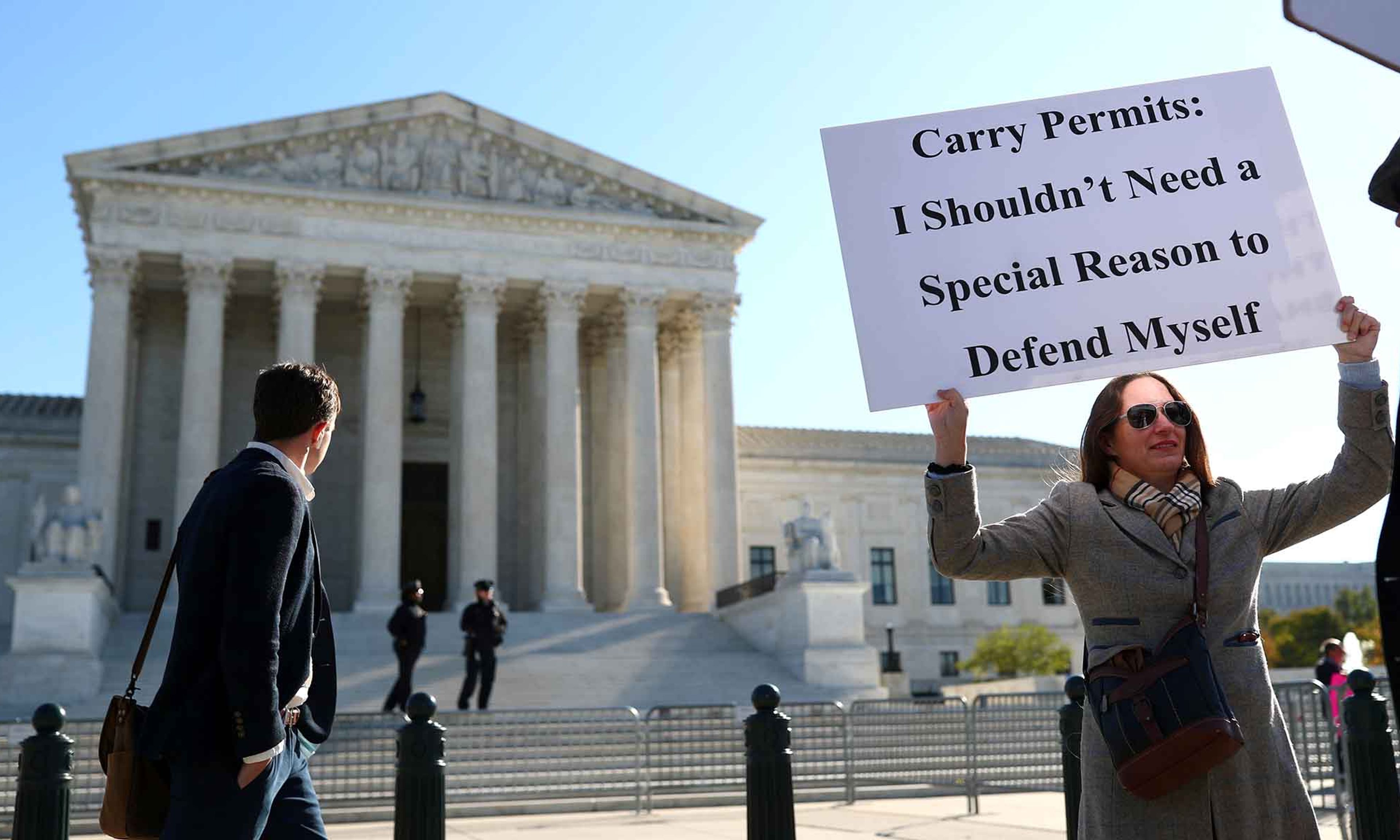
One year ago, on June 23, the Supreme Court decided New York State Rifle & Pistol Association v. Bruen. Justice Clarence Thomas’s majority opinion invalidated a New York law requiring applicants for concealed-carry permits to show “proper cause” — a special need to carry a gun, above and beyond a basic desire for self-defense.
Striking down the law made sense enough. The Court had already noted, in 2008’s Heller v. District of Columbia, that the right to “bear” arms meant the right to carry them. Further, New York banned the open carry of firearms entirely — meaning a concealed-carry permit was the only way to carry a gun. The good-cause requirement thus made it impossible for not just many but most individuals to bear arms, subject to the whims of government officials. That’s not how a right works.
The Court also took the opportunity of Bruen, however, to lay out a new test by which courts would evaluate gun laws in general.
Since Heller, which recognized a Second Amendment right to keep a handgun in one’s home, and 2010’s McDonald v. Chicago, which confirmed that this right applies against states and localities in addition to the federal government (via the 14th Amendment), appeals courts had been developing their own rules and generally converged on a two-part test. The first question was whether a law burdened the right protected by the Second Amendment, as revealed by its text and history; the second was whether the law could survive the “tiers of scrutiny” that courts have used since the mid 1900s in working out the gray areas of other constitutional rights, especially free speech and equal protection.
Under tiers of scrutiny, the closer a law comes to interfering with the fundamental purpose of a right, the higher the level of scrutiny it receives. Gun laws typically got either intermediate scrutiny (meaning the law had to advance an important governmental interest using means substantially related to that interest) or strict scrutiny (meaning the law had to be narrowly tailored to achieve a compelling governmental interest). Gun-rights advocates thought courts were too eager to uphold gun regulations in the period between Heller and Bruen, though both D.C. and Illinois lost their sweeping gun-carry restrictions to appeals-court rulings.
Thomas’s opinion provided a new framework and eliminated tiers of scrutiny from the equation. Now, judges start by asking whether the plain text of the amendment applies — basically, whether the law affects the “keeping” or “bearing” of “arms” by one of “the people.” Then the only remaining question is whether the law is part of the nation’s historical tradition of gun regulation — to be answered, specifically, according to whether there are American laws from the eras of the Second and perhaps 14th Amendments that are “analogous.”
If the new law seeks to address a problem that also existed in those earlier eras, the analogues must be “distinctly similar.” If the new law deals with “unprecedented societal concerns or dramatic technological changes,” a “more nuanced” comparison is called for, involving questions of “whether modern and historical regulations impose a comparable burden on the right of armed self-defense and whether that burden is comparably justified.”
Perhaps predictably, the new test has proven difficult to implement.
The first problem with Bruen is a logical leap.
Historical practice can undoubtedly shed light on the meaning of a constitutional provision. Sometimes it can even be dispositive. Say a constitutional amendment was enacted in Year One, and then in Year Two many of the same legislators and political constituencies enacted a statute and no one accused them of inconsistency. This would be powerful evidence that the constitutional provision was not originally understood to conflict with the statute. The historical record is also quite compelling if the statute existed when the constitutional provision was enacted and continued to exist afterward, with no sign that anyone saw a conflict.
But say a certain type of statute didn’t exist when the constitutional provision came into being and, indeed, first entered the historical record many decades later. It’s hard to read much into that: Maybe legislators of the earlier time thought the constitutional amendment forbade the statute — but maybe they just didn’t want to pass it, didn’t think of it, or had more pressing things to deal with. We can’t assume that legislators always walk right up to the line of violating the Constitution and that any type of law they happened not to pass was considered unconstitutional. Yet for gun laws and the Second Amendment, that’s more or less the Bruen test.
The problems multiply when we enter the practical realm, with its murky evidence and countless levels of generality to choose from in making comparisons.
Many old laws and the debates surrounding them, especially from local governments, are without surviving records. Relatedly, there’s the question of how many laws one needs to demonstrate a pattern: Thomas admitted that a few historical laws were similar to New York’s but dismissed them as outliers or otherwise irrelevant.
There’s also an inherent difficulty in deciding whether an old law is similar enough to a new one — is it sufficient if both laws disarm dangerous people, or do the categories of dangerous people have to match too? — and whether new laws respond to new or to old problems, which dictates how strong the comparison must be. Violence is as old as time, and gun violence is older than America, but drive-by shootings with semiautomatic handguns are much more recent, and the nationwide epidemic of public mass shootings of random victims is newer still. Which problem is the target of, say, an age restriction, a background-check requirement, or an assault-weapon ban?
Beyond its subjectivity, which to some extent will plague any test meant to sort out constitutional edge cases, the Bruen standard coexists uneasily with some explicit assurances the Supreme Court has made. Most of America’s gun-control regime — even the parts that are, dare I say it, “commonsense” and “reasonable” — is of fairly recent vintage, and the conservative justices have generally been quick to tell Americans that these laws are not under threat. If nothing else, failing to make good on those assurances could prove politically disastrous to both originalism and gun rights. Yet, as numerous Bruen critics have pointed out, conservative justices have not explained how these measures actually pass the Bruen test.
In Heller, the late Antonin Scalia’s majority opinion declared that “nothing in our opinion should be taken to cast doubt on longstanding prohibitions on the possession of firearms by felons and the mentally ill, or laws forbidding the carrying of firearms in sensitive places such as schools and government buildings, or laws imposing conditions and qualifications on the commercial sale of arms.” In McDonald, Justice Samuel Alito’s majority opinion “repeat[ed] those assurances.” In Bruen, Thomas stated in a footnote that “nothing in our analysis should be interpreted” to affect the “shall-issue” licensing regimes many states employ — in which a permit is needed to carry a gun, but officials are required to issue permits to everyone who meets certain requirements, such as getting training and passing a background check. A concurrence from Brett Kavanaugh reiterated both Scalia’s reassurances and Thomas’s.
Yet there are plausible arguments that many of these policies flunk the Bruen test. Before joining the High Court, to take just one example, Amy Coney Barrett argued in a 2019 dissent that the blanket disarmament of felons — including those convicted of crimes that do not involve or predict violence — was not rooted in historical practice, which supported disarming only groups considered dangerous. The current statute disarming felons, specifically, traces back only to the 1930s, and at first it applied only to certain violent felons; not until 1961 were felons writ large prohibited from gun ownership. Historically, nonviolent felons in America have been sent to prison, forbidden to vote, and sometimes even put to death, but apparently not too often stripped of their gun rights for extended periods after serving their time.
This brings us to the question of how challenges to gun laws are playing out post-Bruen, early as it still may be a year later.
A few months back, Pepperdine law professor Jacob D. Charles compiled some numbers. About 15 percent of Second Amendment claims have been successful in the federal courts, with some variation depending on the type of claim being made. Many prohibitions have been challenged only a handful of times, but commercial regulations seem pretty safe — zero out of 14 claims succeeded — while results are more mixed for categories such as “sensitive place” restrictions and assault-weapon bans.
A few cases in particular have made the news, such as that of Hunter Biden, who, before negotiating a plea deal, looked to Bruen to undermine the prohibition for unlawful drug users. Biden, of course, was accused of having lied on a federal form to buy a gun by claiming not to be a drug user when he was. In another case regarding the same prohibition, a court requested briefing on the history of gun restrictions for “intoxicated or impaired individuals.” In other words, it’s an open question whether Bruen allows the government to keep guns away from drug addicts.
A more sympathetic plaintiff seeks to narrow the felon-disarmament statute in Range v. Garland.
These days, the difference between a misdemeanor and a felony is generally whether the crime is punishable by more than a year of incarceration. The federal disarmament statute kicks in at the one-year mark — but with an exception for crimes that are punishable by up to two years when states label them “misdemeanors.”
The crime in Range, unfortunately for the plaintiff, was a misdemeanor punishable by up to five years and thus counted as a felony even though the state of Pennsylvania didn’t consider it one. No lawyer could ask for a better test case: In the mid 1990s, a man’s family lived below the poverty line, but evidently they didn’t fully qualify for food stamps, as he understated his income on a benefits application and was caught. Despite the potential five-year punishment for his deception, he received only probation and some financial penalties. But the firearm prohibition hinges on whether a misdemeanor is punishable by more than two years, not on how it’s actually punished, and Pennsylvania rarely expunges records. So, nearly three decades later, the guy still can’t buy a hunting rifle.
One can argue that, so long as they provide due process of law and stop short of imposing “cruel and unusual” punishments, governments should have broad authority to criminalize bad behavior and mete out consequences, including the long-term loss of gun rights, to protect the public. Yet it’s hard to conclude that the plaintiff in Range is likely to threaten violence, and the Third Circuit recently sided with him.
In other cases, though, judges have reached alarming conclusions regarding the constitutionality of popular and straightforward prohibitions. As Charles summarized, post-Bruen cases “have generated divergent rulings on . . . whether individuals under felony indictment can be barred from acquiring new firearms, whether those subject to domestic violence restraining orders can be disarmed, and whether the Second Amendment guarantees the right to a firearm with an obliterated serial number.”
Most strikingly, a district court in Texas has observed that “glaringly absent from the historical record — from colonial times until 1994 — are consistent examples of the government removing firearms from someone accused (or even convicted) of domestic violence.” Current federal domestic-violence prohibitions, beyond the felon ban in general, apply to those under certain restraining orders — there must be a hearing, for instance — and those convicted of misdemeanors.
Some of the more lenient judges are clearly Bruen opponents trolling the High Court with what Brannon P. Denning and Glenn Harlan Reynolds have termed “uncivil obedience,” applying the ruling in a reductio ad absurdum fashion; others appear sincere.
After Heller and McDonald, the Supreme Court took an extended leave of absence from the gun issue, allowing the appeals courts more than a decade to work out the details. Given that Bruen wiped out all that effort and new disagreements rapidly emerged, the Supremes may more readily guide the lower courts this time. Indeed, the Court already agreed to hear Rahimi v. U.S., which should settle the constitutionality of the federal ban for those under domestic-violence restraining orders.
In an ideal world, the Supreme Court would ditch the Bruen test and replace it with something more logically sound and easier to administer, as Randy E. Barnett and Nelson Lund have advocated. They suggest that judges “require the government to prove that a challenged restriction of the right to keep or bear arms does not vitiate the ability of Americans to use firearms to defend themselves against violent threats that the government cannot or will not prevent.” Others have floated the “undue burden” test that was once used for abortion regulations.
For all its flaws, the system that appeals courts were using before Bruen — first looking at text and history to see whether they dictate an outcome and then resorting to the “tiers of scrutiny” developed in the context of other rights — might not be the worst option. Conservatives have often decried the treatment of the Second Amendment as a “second class” right, and there’s something to be said for putting gun rights on equal footing with other protections even if, since judges are more likely to disdain guns than to disdain, say, free speech, stricter Supreme Court oversight will be required in this area. In other words, perhaps the High Court’s failure to take gun cases, not the test the lower courts were using, was the biggest problem with the status quo ante.
At any rate, once we clear out the obvious violations — such as D.C.’s total ban on functional firearms in the home (Heller) and New York’s prohibition of the vast majority of its population from bearing arms (Bruen) — judges are going to have to start making highly subjective decisions. A familiar framework could be easier to apply than Thomas’s scavenger-hunt-for-really-old-laws approach.
Realistically, though, the Court is unlikely to call a mulligan anytime soon, meaning judges must work with the test already laid down. The more aggressive rulings will almost certainly be curtailed through appeals and future Supreme Court cases, but Bruen must be refined to make that happen.
The test’s subjectivity is perhaps an asset when it comes to upholding regulations that Americans are unlikely to tolerate the end of: Historical restrictions targeting dangerous groups, for example, could conceivably serve as analogues for just about all our current laws that disarm specific individuals for misconduct. In many other cases, judges could lean heavily on Bruen’s looser standard for laws that address new problems. Of course, as the rules evolve to accommodate key federal laws, it’s unclear what will happen to more-controversial restrictions, such as state assault-weapon bans, which hardly make it impossible to defend oneself but do prohibit many commonly owned guns.
With Heller, McDonald, and Bruen, the Supreme Court has confirmed that the Second Amendment means what it says: Governments may not stop the people from keeping or bearing arms. Now we need to figure out what happens when the government burdens those rights to lesser degrees.












Comments