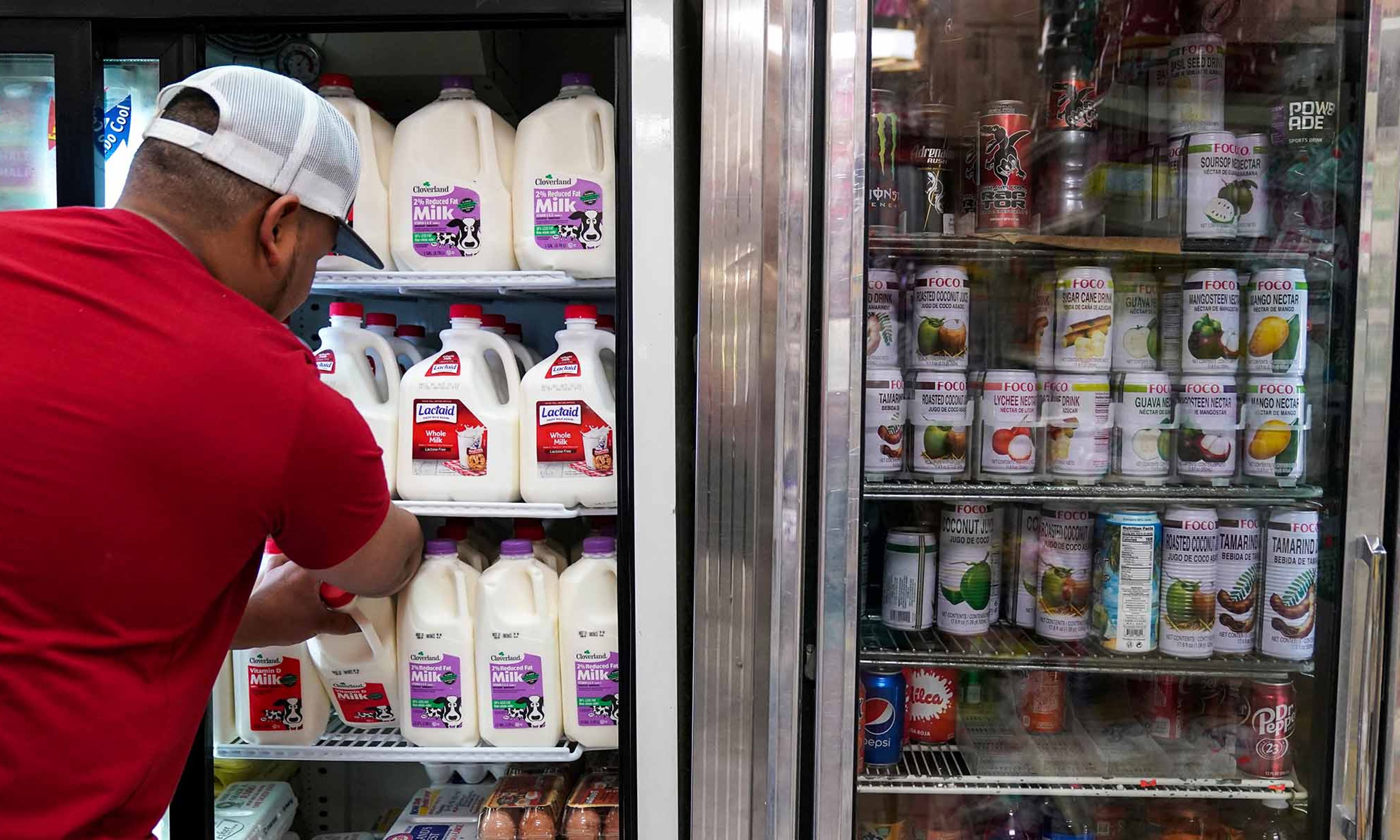
As 2023 turned to 2024, people who speculate about such things became ever more hopeful that the U.S. economy was experiencing a “soft landing.” The inflation rate was coming down without a recession or even a marked increase in unemployment. Many of those same people had doubted such a thing was possible.
Americans remained, and remain, unhappy about the economy. While commentators differed about why, the mood seems understandable. Inflation had been low for many years when President Biden took office (contrary to a recent talking point of his). Then it rose to its highest level in decades. That inflation has come down a bit means that prices are still rising, and from an elevated level, even if they are not rising as fast as they were. Grocery shoppers didn’t line the aisles to applaud. Prices have risen 20 percent under Biden. And that doesn’t include higher interest rates, which don’t count in measurements of inflation but raise the cost of living as voters experience it.
Discontent, then, is justifiable. Still, a soft landing would be a gargantuan achievement. Economists typically point to one instance of its happening in the U.S.: in 1994, when the Federal Reserve raised rates to bring inflation down while the era’s boom continued. The monetary economist Scott Sumner uses a more stringent definition of “soft landing” — a period when the labor market has fully recovered from a recession and then enjoys three years of growth without high inflation — and finds that we have never had one.
The optimistic commentary at the start of the year notwithstanding, 2024 is looking like no exception to the rule. The monthly inflation rate, measured in changes to the Consumer Price Index, ticked back up in January, rose again in February, and stayed elevated in March. Inflation is proving stubbornly persistent. Advocates of a dovish monetary policy are suggesting that the Fed redefine success: accept a 3 or even 4 percent inflation rate instead of trying to get inflation down to the 2 percent rate that the institution formally set as its goal a dozen years ago.
But while this period of high inflation is ongoing, it is not too early to draw some lessons about it.
We don’t have a good early-warning system for inflation. The existence of a market for Treasury bonds that are indexed for inflation had seemed to be an advantage modern policy-makers had over those of the 1970s. The difference between the yields of those bonds and the yields of bonds that aren’t indexed to inflation would be an implied market prediction of future inflation. In our first big burst of inflation since the 1970s, though, those markets did not provide actionable intelligence. The implied market prediction rose only after the actual inflation rate did. Attempts to derive a better implied estimate by correcting for liquidity problems in the markets did not work, either.
There were of course some reasons to think inflation would rise, which is why some economists — including Olivier Blanchard, Michael R. Strain, and Lawrence Summers — predicted that it would. Both the money supply and federal spending had been increasing rapidly. But both had also risen rapidly a decade earlier, and led to predictions of high inflation, without causing prices to take off.
Some increase in inflation even seemed potentially beneficial, a way of bringing the price level back to the trend line it had been on before Covid came and brought deflation with it. Just after Covid hit — although in response to a yearslong review of monetary policy that the Federal Reserve had undertaken — the Fed had adopted “flexible average inflation targeting” (FAIT). The Fed would aim for 2 percent annual inflation but would follow periods of inflation below that target with periods of inflation above it. In theory, such a policy would make the long-term path of prices more predictable. And it would also tend to keep inflation from falling below the target in the first place, which had become a preoccupation of policy-makers during the previous decade.
When inflation began to rise in spring 2021, the most common explanation pointed to the fits and starts of the reopening of global commerce after Covid. Supply chains needed to be rebuilt, and shortages were only natural in the interim. The shelf life of that argument was extended in February 2022, when Russia invaded Ukraine. Optimists presented that burst of inflation as “transitory.”
The “transitory” debate was unhelpful. Most onlookers, understandably, took the claim that inflation would be transitory as a prediction that it would in short order decline to normal levels. But participants in the debate used the term in several other ways, sometimes without clarifying which. Paul Krugman, to take a prominent example, has said that he meant only that inflation would fall once the economy worked through supply-chain disruptions, even if it took “years rather than months” for that to happen. In December 2023, he claimed vindication for the “transitory” view and declared, “Soft landing achieved.”
The theory of inflation most popular on the left explains nothing. Democratic senators Elizabeth Warren (Mass.) and Robert Casey Jr. (Pa.) have argued that corporate greed is the root cause of rising prices. Presumably, though, businesses have always wanted to set prices at the level that generated the most profits for them. Did their greediness increase much more in 2021 than it had in 2019, and, if so, why? Some progressives try to get around this difficulty by arguing that markets have gotten more concentrated and thus companies have gained more power over prices. But this is another nonexplanation — unless we posit that market concentration declined from the early 1980s through the 2010s, when inflation kept trending lower, and then spiked right after Covid.
President Biden has faulted companies for “shrinkflation”: holding prices constant while reducing the size of products. But that’s a corporate response to inflation. While calculations of the inflation rate attempt to account for such product changes, to the extent that they fail it makes the rate look lower than it actually is — which means that when Biden boasts of having brought inflation down, he is in part taking credit for the shrinkflation he decries.
“Inflation is always and everywhere a monetary phenomenon.” This was Milton Friedman’s famous claim, and it has a lot more explanatory power than the Left’s theory of corporate greed. Friedman’s statement seems, on its face, to deny the possibility that inflation could be driven by supply shortages. But even in his earliest elaboration of the proposition, Friedman makes it clear that he is talking about a “steady and sustained rise in prices.” Shortages could cause temporary price spikes, but unless they themselves grew worse in a steady and sustained way, they would not cause the type of inflation he had in mind.
The current inflation in the U.S. has conformed to Friedman’s claim. Think of inflation as “too much money chasing too few goods,” or a bit more precisely as too much spending (excess demand) chasing too few goods and services (deficient supply). Since 2019, the price level has increased by twelve percentage points more than if the 2 percent annual goal had been achieved. During the same period, spending has grown by twelve percentage points more than normal. The extra inflation has, in short, been entirely a matter of too much money.
FAIT failed. When the Fed adopted the new FAIT framework, it left a key detail in the fine print: The Fed was committing to correct for missing its inflation target from below, but not for missing it from above. It was not, that is, saying that it would follow a period of above–2 percent inflation with a period below it. That was in keeping with the then-dominant view that “lowflation” was the Fed’s big problem. But this asymmetry both undermined the goal of a predictable price level and created an inflationary bias.
FAIT was not the only reason the Fed was slow and hesitant to change course as inflation continued. Confusion about the cause of the inflation contributed, too, as did the fighting-the-last-war tendency to worry about lowflation. The early phases of the inflation also coincided with a campaign by the left wing of the Democratic Party to keep Biden from reappointing Jerome Powell as Federal Reserve chairman in 2021. Randal Quarles, who was a Fed official at the time, has said that uncertainty about the central bank’s leadership stayed its hand.
Disinflation does not require a recession. As the Fed was belatedly preparing to raise interest rates to bring inflation back down, Senator Warren, who had led the charge against Powell, accused him of wanting to throw millions of Americans out of work. If he did, he has not succeeded. The unemployment rate in February 2022, right before the first hike in interest rates, was 3.8 percent. In April 2024 — the latest month for which we have data as this article goes to press — it was 3.9 percent. The employment-to-population ratio has risen a bit during this period.
In Warren’s defense, some advocates of tighter money had suggested that much higher unemployment would be needed to bring inflation down. They thought it would be worth that cost because the alternative would be to let inflation get further out of control, necessitating a more severe recession later. But inflation has come down without job loss. That may be because inflation had been under control for so long that the recent increase did not become a settled expectation that would have been harder to wring out of the economy. It may instead, or also, be because the disinflation has been so mild. Prices in March 2024, as measured in the Consumer Price Index, were 3.5 percent higher than a year earlier. Inflation is still running at nearly twice the target rate.
Monetary policy has stayed looser than is generally understood. From March 2022 through July 2023, the Federal Reserve raised its target federal-funds rate by 500 basis points in eleven increments. Each time it has commonly been said to be tightening money. Yet total spending has continued to increase, and not slowly. In the last two quarters, spending grew at an annualized rate of 6.5 and 6.3 percent. We had not had two successive quarters with that much expansion in the decade prior to Covid.
The Federal Reserve now has three options. The first is to hope that inflation will decline further without its having to take any drastic action. A few months ago, markets were expecting multiple reductions in interest rates as a celebratory coda to the soft landing we were supposed to be experiencing. Perhaps merely putting off those reductions will suffice to signal that the Fed is serious about putting a lid on future spending levels, which in turn will tend to dampen current spending. This is the course the Fed is most likely to take, at least until the point where it can no longer sustain it.
The second option is to accept a higher inflation rate and call it a victory. The choice of a 2 percent target was somewhat arbitrary; reasonably prosperous economies have had higher inflation rates. The danger, though, is that the Fed would have flinched from fighting inflation before the fight had inflicted any real pain — and then its willingness to keep inflation from creeping even higher than 3.5 percent would come into question. Something like this process played out from the mid 1960s through the late 1970s, painfully, which is why the Fed has not entertained this idea in public.
The third option is to jolt markets, at least a little, with unexpected tightening — such as another interest-rate increase. Tightening further would involve the risk of higher unemployment and even recession. But there are other reasons the Fed will want to avoid this course. The Fed generally fears surprising markets; another increase would be another implicit admission of past error; and the nearness of the presidential election will add to its reluctance. The party in power never likes higher interest rates: Donald Trump, when he was president, hated them so much that he called Powell a greater enemy of the U.S. than Xi Jinping. (Biden has followed the more common presidential practice of refraining from public comment about the wisdom of Fed policies.)
But it’s the sticker shock during his presidency that is Biden’s chief political liability. He would probably be better off if Powell and his colleagues had tightened further, faster, and earlier. The rest of us would be too. Instead of a soft landing, we may have a bumpy ride ahead.








Comments