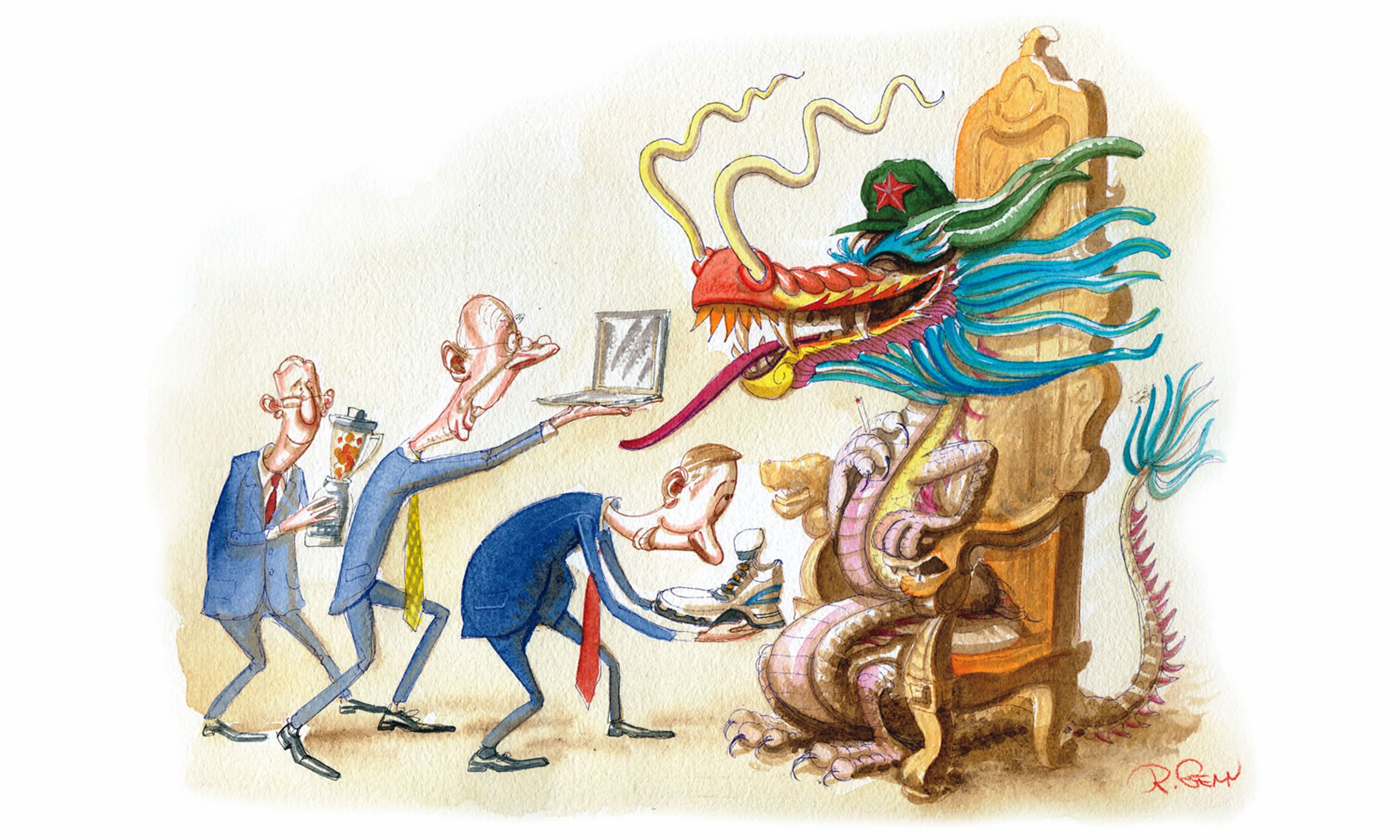
Corporate America may have embraced critical-race-theory-infused employee-training modules and repeated progressive talking points on everything from election law to police misconduct, but its social ethics end abruptly at the water’s edge.
U.S. firms’ capitulation to the Chinese Communist Party’s demands is evident in Apple’s decision (as reported by the New York Times) to effectively yield access to its Chinese iCloud servers to the Chinese government; Wall Street’s inclusion of Chinese firms in index funds (assisting Beijing’s military–civil fusion campaign); airlines’ and Hollywood studios’ extreme accommodation of the Chinese Communist Party’s political sensibilities; and much more.
Then there’s the matter of Xinjiang, the far-west region of China where the Party is committing crimes against humanity targeting Turkic-minority peoples to clear the path for a Han ethno-state. It’s where the NBA operated a training camp, McKinsey hosted a global conference four miles from a concentration camp, and Disney colluded with Party security officials to shoot scenes for its live-action remake of Mulan — and then thanked them in the credits at the end of the film. Many firms that have not been implicated in such activities have remained silent about the abuses. When The Wire, an upstart China-focused online publication, sought comment about the human-rights abuses from 48 major U.S. companies with operations in China, 31 didn’t respond, and only Dell expressed concern.
The Wire’s nonrespondents included Delta, whose CEO, Ed Bastian, later called Georgia’s new voting law “unacceptable,” and Disney, which in the last year began instructing employees that the United States had a “long history of systemic racism and transphobia,” according to reporting by City Journal’s Christopher Rufo. Apple did reply, claiming that it didn’t source materials from Xinjiang, but it was undercut by a report in The Information two months later revealing that the iPhone manufacturer worked with seven firms implicated in Uyghur forced-labor abuses, including one that operates in Xinjiang.
Though these scandals looked bruising, bad headlines don’t shape corporate behavior as effectively as does political pressure, and there has been little of that. Republican legislators send letters and conservative outlets call attention to the hypocrisy, but everyone else moves on. Corporate leaders can rest easy knowing that there will be no riots in American cities about their collusion with an entity that is not only carrying out a genocide recognized as such by the U.S. government and the parliaments of several other countries but is also in the midst of a military buildup meant to develop the capacity to invade a democracy on its doorstep (Taiwan).
That said, public outcry can defang some of woke capitalism’s domestic excesses. As Dan McLaughlin recently detailed at National Review Online, such criticism hit its mark when Coca-Cola backed down from its most blistering statements about the Georgia voting law after facing conservative pushback. Among other things, woke capital’s critics pointed out that Coke had lobbied to water down federal legislation to address Uyghur forced labor. Still, not all firms that espouse certain progressive political principles boost China (though many do), and not every firm tied up in Communist China’s abuses is American. (Japan’s Muji and Uniqlo, which have each touted their Xinjiang-cotton products, come to mind.)
Forcing an end to corporate tolerance of the Leninist party-state in Beijing thus partially overlaps with the goal of stunting corporate America’s woke turn, in that the ill-founded premises of the latter provide a chance to advance the former. The resulting policy changes must be designed to shift the incentives for businesses away from accommodating Beijing, because every large U.S. company with operations in China currently has more to lose by standing up to the Party than it has to gain by doing the right thing.
Nike, which built a woke ad campaign around Colin Kaepernick’s activism, makes for a worthwhile illustration of the costs incurred by firms that even softly rebuke the Party line. After the Australian Strategic Policy Institute published a report that the brand had worked with suppliers reliant on Uyghur forced labor, Nike issued a statement pledging to investigate the claims, and then, one year later, a second statement expressing “concern.” But even that statement, which followed the U.S. government’s official determination that the abuses meet the legal thresholds for crimes against humanity and genocide, fell far short of an acceptable response condemning Beijing’s atrocities — and short of CEO John Donahoe’s exhortation, during the summer 2020 demonstrations and riots, to “understand the enormous suffering and senseless tragedy racial bigotry creates.”
Members of Congress and other policy-makers eager to help him understand the deficiency of that response must grasp that their threats are dwarfed by the fury of nationalistic Chinese consumers. After that tepid Nike statement on Xinjiang went live in March, Chinese netizens pilloried the sneaker company, and celebrities in the country ended their promotional contracts with it. Nike still fared better than Sweden’s H&M, which issued its own statement around that time and was essentially erased from most major Chinese e-commerce platforms.
America’s largest firms, caught between the likely anger of China’s government and consumers and the regrettable optics in the U.S. of yielding to the Party’s sensitivities, gather that they have more to lose by distancing themselves from China. Some have proclaimed a false neutrality while in fact appeasing the Chinese authorities. In 2019, former Disney CEO Bob Iger declined to answer a question about the protest movement in Hong Kong, calling the issue “complicated.” He then made a different motivation explicit: “To take a position that could harm our company in some form would be a big mistake.”
As Iger surely knew, to refuse to speak up is in effect to take Beijing’s side. Even when some executives reject neutrality, as Mark Zuckerberg did in 2020, telling a House panel that Facebook is a “proudly American company” and drawing a contrast with China’s efforts to construct “its own version of the Internet,” they’re playing fast and loose with the facts. With antitrust regulators circling and concerns about TikTok’s deference to Chinese officials at their apex, Zuckerberg’s comments made for a convincing argument — that is, unless you were aware that, following complaints by Chinese-born employees, Facebook had considered, then trashed, plans to speak in support of the Hong Kong protesters.
“The internal debate felt like people were actually more anti–Hong Kong than pro–Hong Kong,” said Peter Thiel, the tech magnate and Facebook board member, at an April session of the Nixon Seminar. Despite some modest labeling of Chinese state-affiliated accounts and the occasional crackdown on state-sponsored troll-account activity, Facebook, like Twitter, YouTube, and other tech platforms, has neglected to ban official Chinese party-state accounts engaged in genocide-denial propaganda campaigns. Facebook is banned in China, but that hasn’t stopped the company from selling over $5 billion in advertising space to Chinese firms and government agencies every year.
With this deeply entrenched corporate deference to China in mind, some might see repudiating the status quo as an insurmountable task. There’s been some recent progress, though. Toward the end of the Trump administration, top officials warned executives about their complicity in Beijing’s human-rights abuses and military buildup, in a nascent campaign to bring these firms’ activities to heel. An inter-agency statement in July declared that companies that have operations in Xinjiang “or engage with entities that use labor from Xinjiang elsewhere in China should be aware of reputational, economic, and, in certain instances, legal, risks associated with” their activities. In a speech the following month, then attorney general Bill Barr intoned that companies doing Beijing favors ought to register under the Foreign Agents Registration Act, the Nazi-era law designed to shine a light on those who lobby for foreign regimes.
All of which came amid officials’ efforts to build obstacles to doing business with Chinese entities that compromise U.S. national security and render American consumers complicit in severe human-rights abuses — efforts that, among other things, prohibit transactions with Chinese firms involved in manufacturing mass-surveillance and military technology and severely restrict imports from Xinjiang. Congress also passed a law to prevent the listing of fraudulent, and often Party-aligned, firms on U.S. stock exchanges, bucking the trend toward entrenchment of U.S. capital in Chinese markets.
But whatever impact these efforts have had, they are just the stirrings of an emergent legal and regulatory overhaul to prevent businesses from political manipulation by Beijing. Thankfully, the evident hypocrisy of executives who go along with woke political priorities in the U.S. makes it easier to expose the sheer lunacy, and the danger, of their capitulation to the Chinese party-state.












Comments