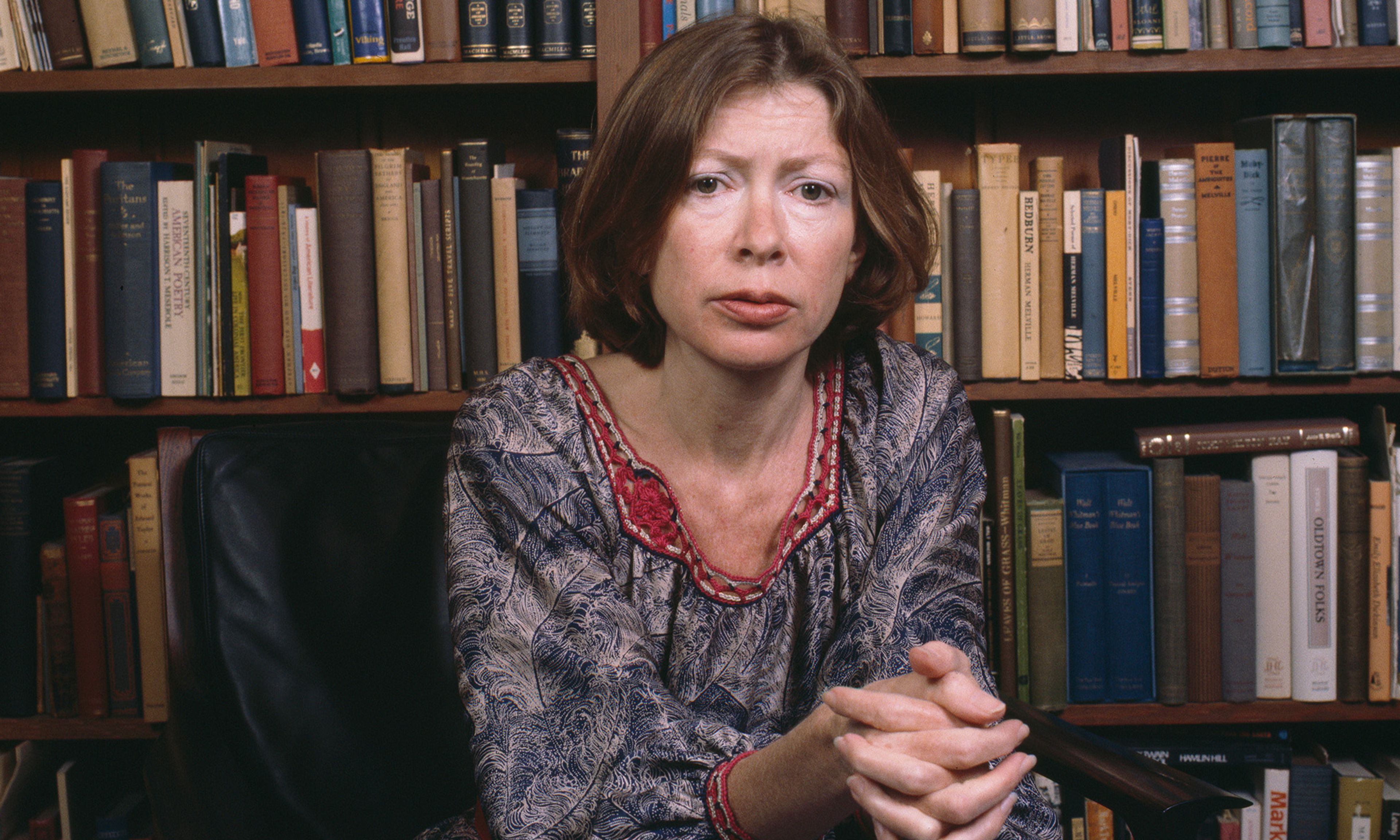
Joan Didion mattered. There really isn’t much more to say, although the nation’s magazines and journals were filled with the attempt after her death on December 23 at the age of 87. The New Yorker, the Los Angeles Times, Harper’s Bazaar, The Chronicle of Higher Education: thousands of words of obituary prose, like one last spasm of the sad zombie heart of American literary culture.
Certain themes, certain tropes, appeared over and over in the valedictions. Her prose was always said to be precise and biting. Her voice astringent. Her observations bracing. Her legacy secure. California’s governor, Gavin Newsom, declared that Didion’s “ability to put the tapestry of California and the times into words made her a treasure for her generation and generations to come.”
“A treasure for her generation and generations to come” — it’s the kind of empty phrase that would have made Joan Didion gag, except that she didn’t exactly gag on the silly platitudes and self-congratulatory feel-goodisms of bad American discourse. She heard them, and they seemed actually to hurt her.
Oh, she would try for irony when she reproduced them, the cool tone of the untouched observer of the human comedy. Slouching towards Bethlehem, the 1968 collection of essays that made her a New Journalism star, carries as one of its epigraphs the singer Peggy Lee’s cringeworthy pronouncement, “I learned courage from Buddha, Jesus, Lincoln, Einstein, and Cary Grant.” And the reader is expected to nod in shared recognition of the stupidity and the distinctively middlebrow American sense that good things fit easily together.
Or in “Bureaucrats” — an essay in the 1979 collection The White Album, and perhaps the most conservative piece she ever wrote (even more conservative than the early-1960s work she did for National Review) — Didion quotes a California official about the beginnings of freeway diamond lanes: “All this project requires is a certain rearrangement of people’s daily planning. That’s really all we want.” And she wryly adds, “A certain rearrangement of people’s daily planning might seem, in less rarefied air, . . . rather a great deal to want, but so impenetrable was the sense of higher social purpose . . . that I did not express this reservation.”
But more often, Didion would transcribe these overheard lines in a kind of anxious neuroticism, as though what was significant was not the statement itself but her own inability to understand how people could say these things. She measured her distance from other Americans, other people, by the emptiness she felt in their words. Her account of Joan Baez’s 1960s “Institute for the Study of Nonviolence,” for example, is actually painful to read — re-creating the author’s pain from the heartfelt vacuity of everyone involved. An essay on the 1970s women’s movement quotes the line: “It is the right of the oppressed to organize around their oppression as they see and define it.” And she makes us share her embarrassment at this transformation of politics into emotion — a transformation now, 50 years on, so complete that it seems almost absurd, a blast from an alien past, to point it out.
The literary question of Joan Didion is why this high-strung and high-maintenance woman — with a constant sense of her own impending collapse and a hypersensitive awareness of the discontinuities of experience — should ever have been thought important. How did her observations of herself adrift in America come to seem an account of America itself? How did her personal problems come to seem the problems of the age?
One obvious answer is that she became a genuine American figure simply because she wrote so well. But, yes, luck was involved: Lightning strikes where it will, after all, and lightning certainly struck her. For that matter, she was helped by the fact that she was one of the few women among the new writing stars of the 1960s and 1970s. Add it all up, and the recent newspaper and magazine obituaries were mostly correct to take Joan Didion’s significance as read. What they were less clear about is why she mattered — or even why her mattering itself matters these days for American public life.
She was the author of five novels, after all, even if her fiction was less influential than her other writings. The author of six screenplays, including A Star Is Born (1976) and True Confessions (1981), written with her husband, John Gregory Dunne. The author of twelve nonfiction books — one of which, The Year of Magical Thinking, an account of her husband’s death and daughter’s illness, won nearly every literary prize when it appeared in 2005.
Still, the obituaries looked back primarily to her first two collections. And the obituaries were mostly right about this, too. The New York Review of Books–style essays collected in Salvador (1983) and Miami (1987), like the political essays in After Henry (1992) and Fixed Ideas (2003), were gradually growing one-dimensional, as Didion became more of a doctrinaire leftist. Even at their best, these were not essays that meant a great deal in themselves. They were merely intelligent. The fact of the author mattered more than what she had to say.
In an essay in The Atlantic, Caitlin Flanagan — perhaps the current writer most determinedly influenced by Didion — captured all this in an account of a 2006 debate about The Year of Magical Thinking. Two young female appreciators found themselves struggling to answer a young male reader’s catalogue of the book’s flaws. They were struggling, that is, until they suddenly began speaking of Didion’s description of the smell of jasmine and her visit to the Royal Hawaiian Hotel “in lieu of getting a divorce.” And the male critic was lost — for these were scenes from Slouching towards Bethlehem and The White Album, which had appeared decades before The Year of Magical Thinking, the debate’s ostensible subject.
Born in Sacramento in 1934, Didion graduated from UC Berkeley in 1956. She won a Vogue-sponsored essay contest during her senior year and after graduation moved to New York, where she worked at the magazine till 1964. Along the way, she finished her first novel and began writing regularly in publications from Mademoiselle to The American Scholar. Steady appearances in The Saturday Evening Post stabilized the finances of both Didion and Dunne, whom she married in 1964.
To read her early writing, prior to the Saturday Evening Post work, is to be impressed by how successfully she had completed her apprenticeship at Vogue. She wrote cleanly and cleverly, intent on choosing the right word and the telling detail. In a 1960 National Review essay on John Wayne, for example, she writes of “the purr of an American plane — always distinguishable from Axis planes, which had engines that whined — coming in overhead just as the rations run out in a World War II movie.”
But something came into her prose in the mid 1960s and lasted through the 1970s. This was the 15-year run that defined her place in American letters. Tom Wolfe had a comparable run with the essays in The Kandy-Kolored Tangerine-Flake Streamline Baby (1963) and The Pump House Gang (1968), while Fear and Loathing in Las Vegas (1971) remains Hunter S. Thompson’s signature volume. It is not a coincidence that the early masterwork of all three writers took for its central topic the weirdness of America, as limned by the collapse of the 1960s countercultures.
Add in Truman Capote’s In Cold Blood (1966) and Norman Mailer’s The Armies of the Night (1968), and the shape of what came to be known as the New Journalism can be discerned. It had a highly voiced prose, used novelistic techniques in nonfiction, and often introduced the authors as narrative figures. (The ongoing influence of the True Crime genre is visible, as well, in such essays as the one Didion selected to begin her first collection.)
But among all these writers, Didion was the most relentlessly personal. She wrote of events that had caught her eye — often simply because they were assigned to her as she banged out magazine pieces for money. And she wrote of her emotions — often apparently unrelated to the topic, driven by the condition of her marriage, the state of her personal anxieties, and the feelings created by the places in which she found herself.
And yet, somehow, the subjects of her reporting, her emotional fragility, and the physical settings combined to suggest a unity. America itself, she seemed to be saying, had been revealed. She was better at gesturing toward the existence of a deep connection than she was at saying exactly what the connection was, but to read her on the immorality of the Donner party, or the fecklessness of Bishop Pike, or the migraine-inducing Newport mansions of the robber barons is to feel that a complete picture of America lies just beyond the horizon of her prose.
The biographical details helped as well, and to her female readers she seemed to be offering permanent lessons in how to be a young woman, moving from adolescence to adulthood. She describes precisely, for example, how she dressed for her forays into Haight-Ashbury so she could blend with both the hippies and their straitlaced opponents. She writes of how she would “talk long-distance to the boy I already knew I would never marry in the spring,” and the detail comes across as both intimate and universal — the experience of all young people come to the big city: “I would stay in New York, I told him, just six months, and I could see the Brooklyn Bridge from my window. As it turned out the bridge was the Triborough, and I stayed eight years.”
But there was also a sharp edge to her prose. It’s easy to remember her description of a New York apartment that, in a period of inactivity and anhedonia, she couldn’t bring herself to furnish. “All I ever did to that apartment was hang fifty yards of yellow theatrical silk across the bedroom windows,” she writes, “because I had some idea that the gold light would make me feel better,” and the apartment sounds almost magical. What her admirers tend to forget is the unsentimental description she adds of the wind whipping the ends of the curtains out the windows, where the rain and airborne smudge of Manhattan stained and ruined them.
Or, for another example, she quotes testimony about a hospital nurse demanding to know if Huey Newton was “a Kaiser,” a member of the Kaiser medical group, and he shouts, “Can’t you see I’m bleeding? I’ve been shot.” Didion observes that she kept a copy pinned to her office wall, “on the theory that it illustrated” a classic “collision of cultures” — till, in her hard-edged turn, she discovered that the Black Panther had been, in fact, a Kaiser, enrolled in the insurance plan, and the ironies collapsed on her.
And that, perhaps, is why Joan Didion really did matter in those early books. She had a sense of America as weak and strong, weird and conforming, broken and whole. And she refused the simple platitudes and empty phrases deployed by the self-congratulating and the self-deceived, the politically driven and the ideologically shaped. She rejected the language of everyone who wanted the easy explanation and the easy way out.












Comments