
Americans are routinely told that they live in an era of “mass incarceration” in which millions of offenders are herded behind barbed wire and prison bars, often for minor or first offenses. Critics have compared America’s use of prisons to slavery and to Stalin’s Gulag. This mass-incarceration narrative, promoted by academics, activists, and politicians, tells a compelling story: Before the 1970s, America’s incarceration rate was low, but then came the War on Drugs and the War on Crime, with harshly punitive policies such as mandatory minimum sentences, three-strike laws, and harsher guidelines for discretionary sentencing. America is said to have transformed into a “carceral state” with the largest prison population in the world. But hope is not lost — if America can just ditch its “punisher brain,” end the War on Drugs, and go back to the benign sentencing policies of the 1960s, the sin of mass incarceration can be erased.
There is just one problem with this story: It’s a myth. While there is nothing mythical about the increase in America’s prison population since the Sixties, the mass-incarceration narrative is startlingly comprehensive in its misunderstanding of both who goes to prison and why America’s prison population has grown so much. Prisons are not filled with individuals convicted of drug possession and other minor nonviolent offenses. Perhaps even more surprising, changes in sentencing policies over the last half century have had little impact on how much time prisoners spend behind bars. And in cases in which punishments have increased — such as for rape, murder, and domestic violence — they are clearly more just.
But if increasingly harsh sentencing is not behind America’s prison-population rise, what is? The two most important causes are an increase in crime and an increase in the justice system’s effectiveness in catching and convicting criminals. The key to reducing America’s prison population, therefore, is not to return to the sentencing policies of the 1960s. In fact, the solution doesn’t lie in reduced punishments at all, because increased incarceration wasn’t caused by over-punishment and because the systematic lessening of punishments is a political nonstarter (Americans are more likely to see current sentencing norms as unjustly lenient than as unjustly punitive). The solution instead lies in crafting punishments other than prison that can deliver the same punitive bite without the societal and fiscal costs of incarceration.
Contrary to popular misperceptions, America’s prison population has been falling for 15 years. In 2022, the last year for which official data were released, America had a prison population of 1.2 million, or about 350 per 100,000 U.S. residents, down from a peak of 1.6 million, or 504 per 100,000, in 2009 — a 25 percent decline in real terms and a 30 percent decline per capita. Still, America’s incarceration rate is significantly higher than it was in the 1960s. (“Incarceration rate” refers to the per capita prison population.) In 1960, America’s prison population was 212,000, or 117 per 100,000 U.S. residents — only a third of today’s 350 per 100,000. What explains the increase of nearly 200 percent?
Contrary to the mass-incarceration narrative, prison is not a place where pot smokers mingle with shoplifters and first-time burglars. Drug offenders, most of them traffickers, constitute just 17 percent of the total prison population. Only 3 percent of the total prison population has been sentenced for drug possession. The prison population is largely made up of those sentenced for violent crimes or serious recidivism. For example, a 1996 study examining a representative sample of 711,000 inmates found that “fully 94% of state prisoners had either committed one or more violent crimes (62%) or been convicted more than once in the past for nonviolent crimes (32%).” More-recent data confirm this picture. In 2021, 62 percent of state prisoners were convicted of a violent crime — up from 41 percent in 1960. Almost no one goes to prison for a first-time nonviolent offense. Ironically, one would be more likely to meet a nonviolent offender in prison before the era of “mass incarceration” than today.
The misunderstandings do not stop there. The mass-incarceration narrative also claims that today’s higher incarceration rate is due to sentencing policies that are more punitive than in the 1960s. This claim is considered so self-evident that few bother checking the history, which tells a very different story.
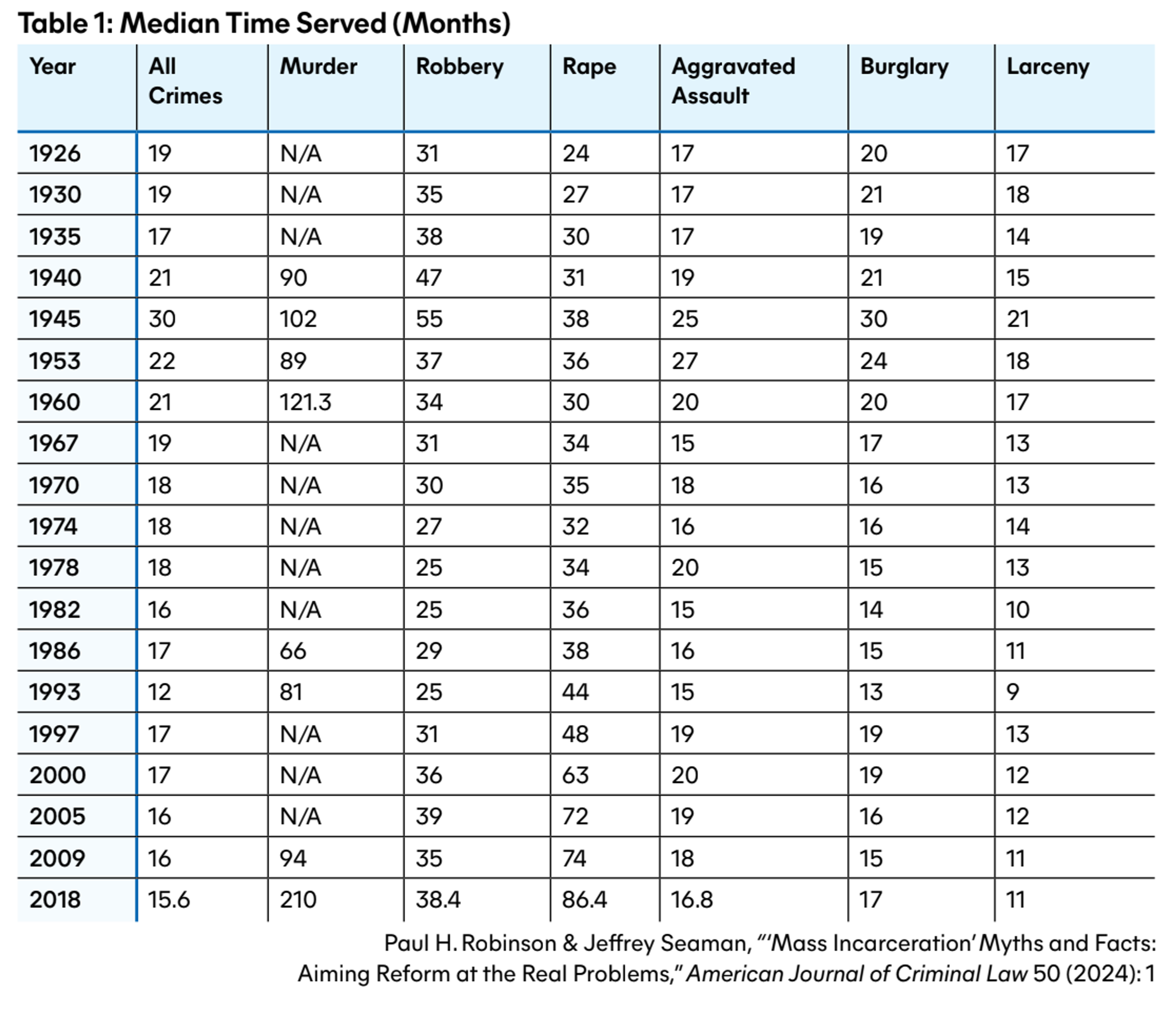
If sentencing policy is to blame, one might expect criminals to spend more time behind bars today than they did before the 1970s. But, with some important exceptions, they are spending less time. As shown in Table 1 (above), the median time served by all state prisoners in 1960 was 21 months, compared with 15.6 months in 2018 — a decrease of more than 25 percent. The data are remarkably consistent across that entire period and show that there was no surge in median time served between the 1970s and the early 2000s, even as the prison population increased.
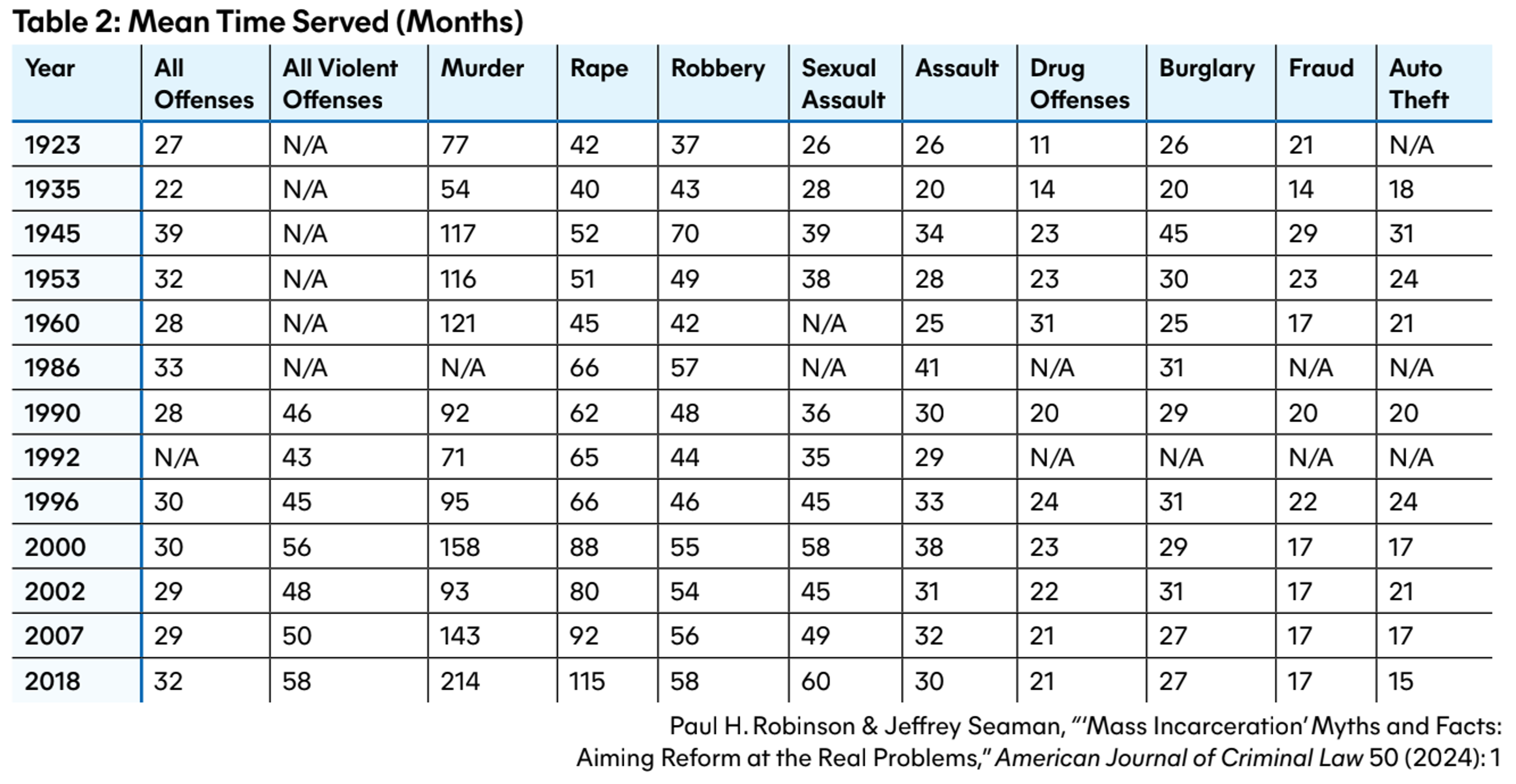
One might reasonably argue that the mean time served would be a better statistic since it can detect changes at the extreme end of the sentencing distribution (where the imposition of life sentences by such policies as three-strike laws would be most likely to show up). But the data on mean time served reveal a similar picture.
Table 2 (right) shows mean time served in state prison for a number of years between 1923 and 2018. The numbers are striking. The mean time served for all offenders in 2018 was 32 months — the same length as in 1953, long before mass incarceration was a concern. Moreover, the mean was only four months longer in 2018 than in 1960. Even as the prison population surged between 1960 and 1990, the mean time served by state prisoners stayed the same, at 28 months. The supposedly draconian sentencing laws passed in the 1970s and later appear to have barely affected time served. One possible explanation is that when faced with a mandatory-minimum sentence for one offense, criminals strategically plead guilty to another offense that does not have a mandatory minimum.
To be clear, the mean time served for certain crimes of violence (murder, rape, sexual assault, and robbery) has increased since 1960. Most dramatically, the mean time served for rape has jumped from 3.75 years to 9.58 years. But this is not a cause for hand-wringing about injustice. In 1960, the median imprisoned rapist received less punishment (2.5 years) than the median imprisoned robber (2.8 years). Few people today would feel comfortable with a justice system that punished stealing the cash register from a store clerk more harshly than raping the clerk. The fact that the median imprisoned rapist in 2018 spent 7.2 years behind bars while the robber spent only 3.2 is a testament to progress in the American justice system. The same is true for murder, for which mean time served increased from ten years in 1960 to 17.8 years in 2018. We believe a punishment of 17.8 years in prison better reflects the serious nature of willfully ending another’s life, and most Americans are likely to agree, especially since a majority still supports the death penalty for murder — a much harsher punishment.
But even to the extent that time served has increased for certain serious offenders, not all of this increase is due to tougher sentencing laws. While it is almost never mentioned by the mass-incarceration narrative, offenders have worse criminal records today than in the past because of some combination of changes in offender behavior and improvements in national record-keeping that allow sentencing judges to see an offender’s complete rap sheet.
For example, in 1990, 64 percent of felony defendants had no prior felony conviction, while 36 percent did have one. Only 4 percent had five to nine prior felony convictions, and only 1 percent had ten or more. By 2009, the percentage of felony defendants without prior felony convictions had dropped to 40 percent. Even worse, 15 percent now had five to nine previous felony convictions, and a stunning 14 percent had ten or more. Longer criminal records have always led to longer prison sentences, and criminal records today tend to be longer.
Proponents of the mass-incarceration narrative sometimes argue that the increase in the incarceration rate is due not to the imposition of longer prison sentences but to judges sentencing a higher proportion of convicted offenders to prison today than they did in the past. If judges sent 50 percent of felons to prison in the past but now send 90 percent, for example, that would clearly have increased the per capita prison population.
But, once again, this does not appear to be the case. Frustratingly, published national data on prison-sentencing rates are available only for the years between 1986 and 2006, but there is little reason to think the percentage of convicted offenders sentenced to prison has grown since then, given the steady decline in incarceration rates since 2009. The period of 1986 to 2006 represents the height of “tough on crime” sentencing laws, so, if the mass-incarceration narrative was correct, one would expect to see a substantial rise during those years in the percentage of convicted defendants who received a prison sentence. In fact, there was barely any change at all. In 1986, 46 percent of felons convicted in state courts received a prison sentence, 21 percent received a jail sentence (jail is typically used when the sentence is less than a year), and 33 percent received punishments other than incarceration (usually probation). In 2006, 41 percent received prison sentences, 28 percent received jail sentences, and 31 percent received sentences other than incarceration. Even as the prison population surged over this 20-year period, the chance of a felon receiving a prison sentence declined. Factors other than changes to sentencing policy must have been at play.
If harsher sentencing is not responsible for the increased per capita prison population, what is? As noted above, the two most important factors are higher crime rates and increased criminal-justice-system effectiveness. Put simply, there is more crime today than in 1960, and criminals are more likely to be convicted of it.
The mass-incarceration narrative conveniently omits the enormous crime surge that began in the late 1960s. Between 1960 and 1990, the per capita violent-crime rate increased by more than 350 percent. It peaked in the 1990s but remains significantly higher today than in 1960. In 2019 (before the more recent violent-crime surge beginning in 2020), the reported rate was 379.4 per 100,000 people, compared with 160.9 in 1960 — an increase of more than 135 percent. Property crime (which is less likely to lead to a prison sentence) was also higher, at 2,110 property crimes per 100,000 reported in 2019 compared with 1,726 in 1960 — an increase of more than 22 percent.
To get a rough sense of how increased crime could affect incarceration rates, let us assume (as was approximately the case) that 55 percent of the 1960 prison population was sentenced for property offenses and 40 percent for violent offenses. (The other 5 percent was sentenced for drug offenses.) If the per capita violent-offense rate increased by 135 percent and the property-offense rate increased by 22 percent, we would expect an overall per capita prison-population increase of 66 percent, assuming no changes in sentence severity or justice-system effectiveness. In other words, the crime increase by itself already explains a large portion of the 200 percent increase in the per capita prison population since 1960.
This calculation does not even consider drug crimes. The massive spike in drug use beginning in the 1960s would have guaranteed a higher drug-offender prison population even if no changes in drug sentencing had occurred. In 1960, less than 5 percent of the U.S. population had ever tried an illicit drug. By 2020, that number was 50 percent. It seems likely that the rate of illicit-drug use (and therefore drug crimes) increased by 400–900 percent between 1960 and 2020. If we assume, conservatively, that the rate of drug crimes only quintupled over this period, then we should expect a 20 percent increase in the per capita prison population even if enforcement and sentencing remained the same. If the drug-crime rate increased nearly tenfold, we should expect a 45 percent increase. To repeat, these increases would be expected even if the criminal-justice system punished drug offenders at the same rate and in the same way as before the War on Drugs. With all other factors held constant, therefore, increases in drug-, property-, and violent-crime rates since 1960 would be expected to cause at least an 86 percent increase in the per capita prison population.
Now consider the effect of increased justice-system effectiveness, which is something to celebrate, not bemoan. If police and prosecutors became twice as effective at catching and convicting felons tomorrow, the prison population would double without any change in sentencing practices. Such an outcome would be more just, not less, because fewer crimes would go unpunished.
Statistics show that the justice system today is indeed better at turning reported crimes (which exclude drug crimes) into convictions and sentences. In 1960, according to the FBI, 3,384,200 crimes were reported to police. That same year, there were approximately 90,600 new prison admissions resulting from reported crimes, meaning that 2.6 percent of reported crimes led to the imprisonment of an offender. FBI statistics for 2018 showed 8,402,881 total reported crimes, with approximately 3.9 percent leading to an offender’s imprisonment — a 50 percent increase in the rate at which reported crime led to imprisonment. Contrary to the mass-incarceration narrative, most of the increase does not appear to have come from judges sending a greater percentage of convicted offenders to prison. For example, between 1986 and 2006, the percentage of reported crimes that led to imprisonment rose (indicating greater justice-system effectiveness) even as the percentage of convicted offenders who received prison sentences fell.
The main cause of this increased effectiveness is better prosecution. A criminal is not much more likely to be arrested for a crime today than he would have been in 1960, but, once arrested, he is more likely to be convicted. There are numerous possible explanations for this change, including better police investigations, more-accurate arrests, and increased prosecution resources. Whatever the cause, the result is clear — and positive.
It is worth noting that the increase in criminal-justice-system effectiveness after 1960 was not linear and did not apply to all crimes. The devastating crime wave that started in the late 1960s caught the system unprepared, underfunded, and understaffed. The result was a steep drop in effectiveness — criminals got away with crimes at higher rates, which led, in a vicious cycle, to more crime. But significantly increased funding and personnel, as well as more-effective policing and prosecution, allowed the justice system to catch up. As the crime wave abated beginning in the 1990s, system effectiveness continued to increase as crime rates fell, creating a virtuous cycle. Unfortunately, the justice system did not get better at punishing all crimes, as murder-clearance rates remain well below their 1960s average. Worse, the last decade has seen a stagnation or decline in system effectiveness — perhaps partly because of anti-punishment policies pushed by some reformers who seek to combat “mass incarceration.” The fact that most serious crime goes unpunished in America is a terrible problem that receives little attention, in part because of the mass-incarceration narrative.
Taken together, higher crime rates and greater justice-system effectiveness mostly explain why America has a larger per capita prison population than in 1960. If higher nondrug crime rates would be expected to cause a 66 percent per capita incarceration-rate increase, and the justice system is 50 percent more effective at turning crime into imprisonments, then we would expect today’s per capita prison population to be 150 percent larger than in 1960. This already explains three-quarters of the 200 percent increase from 1960 to the present. Add in the expected 20–45 percent increase in incarceration from the higher rate of drug crimes and almost the entire 200 percent increase is accounted for. Longer sentences for serious crimes are a tiny part of the story, not the central explanation.
Besides increased crime and justice-system effectiveness, several noteworthy trends also contributed to the prison-population rise (often through influencing those two factors). For example, the post-1960 period saw the codification of new crimes and the stricter enforcement of laws against existing ones such as domestic violence, rape, and child sexual abuse. Many such changes were clearly desirable even if they did contribute to a higher prison population. Domestic violence, for example, was not treated seriously as a criminal matter in the 1960s, but societal views have shifted dramatically, and the system now intervenes more forcefully in such cases. A significant number of those currently prosecuted and imprisoned for aggravated assault committed their crime in the context of domestic violence. One study found that a third of those charged with felony assault in several large counties were charged with “family violence.” These prosecutions would likely not have occurred in the past.
Similarly, states have moved to expand the criminalization of sex offenses and to tighten their enforcement. As strange as it may seem to our consciences today, marital rape was not considered rape 50 years ago and could be prosecuted only under assault laws. It was only in 1976 that the first state (Nebraska) defined marital rape as a sex crime. Today, all states do. And it was only in 1975 that Congress passed “rape shield” laws to change the federal rules of evidence to prevent victims’ sexual history from being used in court to undermine or humiliate them — a deterrent to their seeking justice. In addition, technological advances have created new possibilities of sexual abuse, resulting in new types of crime. For example, most states have now enacted revenge-porn laws against the distribution of sexually explicit images of a person without his or her consent.
Consider, also, the tightened enforcement of child-sexual-abuse laws. The first laws requiring mandatory reporting of potential child abuse were passed only in 1974, and laws targeting child pornography came even later. The resulting increase in imprisonments was substantial. By 2021, there were an estimated 127,282 individuals incarcerated for “sex offenses involving children” at the state level and another 12,850 at the federal level. They constitute roughly 11 percent of America’s 1.2 million prison inmates. Many, perhaps most, of these offenders would never have been punished in the 1960s.
The fact that many domestic and sexual abusers escaped punishment in the era before “mass incarceration” likely resulted in lower prison populations, but that reflects a problem with past, not current, practice. As Stanford researcher Keith Humphreys has noted, “that low rate was in part a function of not taking rape, spousal abuse, and other male violence against women seriously — and we should not seek to go back there.”
Furthermore, new laws against stalking, human-trafficking, weapons offenses, and environmental and financial crimes were passed after 1960. Most of these changes are entirely uncontroversial today and represent progress in society even though they increased incarceration rates.
Another contributing factor was the shuttering of many institutions for the mentally ill as medical and social norms changed and court rulings restricted civil confinement. In 1955 — at its peak — the population of state mental hospitals was almost 560,000. By 2015, despite the near-doubling of the U.S. population, that number had fallen to around 35,000, a decrease of nearly 94 percent. While many deinstitutionalized mentally ill patients posed no criminal threat to the community, some did. Quantification is difficult, but a nontrivial proportion of current prisoners would have been institutionalized in mental hospitals in the past. Prisons are full of mentally ill offenders. By one count, 14 percent of state prisoners meet the standards for “serious psychological distress,” and 43 percent have a history of mental-health problems. Studies suggest that, had they lived in 1960, between 4 and 14 percent of currently incarcerated offenders might have been confined in mental institutions.
Harsher sentencing did not cause America’s incarceration rate to increase, but there is one more part of the mass-incarceration myth worth addressing: the claim that America’s prison population is unjustly large compared with those of foreign countries. It is true that America has one of the highest incarceration rates in the world (although it has neither the largest per capita prison population nor the most prisoners). This is said to show that Americans are more punitive than the comparatively enlightened citizens of other countries. But such cross-national comparisons rarely consider differences between countries in crime rates and justice-system effectiveness. The fact that many developing countries have lower incarceration rates does not redound to their credit or showcase some enlightened sentencing leniency — it simply shows how ineffective their systems are. For example, in Mexico, less than 1 percent of crimes lead to any punishment. Mexico lacks mass incarceration and yet desperately needs to lock up more criminals.
When its prison population is compared with those of other developed countries, however, such as those in Europe, America does have a higher incarceration rate that cannot be explained by vastly different crime rates or by differences in justice-system effectiveness (although studies examining the latter possibility are lacking). Studies suggest that America uses prison more often and for longer than some other developed countries do. But this criticism cuts both ways. While America could certainly make greater use of non-prison punishments (as is more common in other developed countries), other countries also need to better consider the demands of justice.
Most Europeans are chronically dissatisfied with how lax their justice systems are. A 2023 survey by the House of Commons Justice Committee found that 71 percent of respondents in England and Wales thought that criminal sentencing was too lenient, including 38 percent who thought it was “much too lenient.” By contrast, only 3 percent thought sentencing was too tough. A study published in 2013 measuring Swedish public opinion found that 69 percent of respondents believed that sanctions were “too mild” while only 2 percent thought they were too severe. A 2022 poll showed that 65 percent of French respondents, and majorities from both the political right and the left, believed that criminal punishments were not strict enough. A Eurobarometer survey in 2015 found that 58 percent of respondents across the EU “totally agreed” with the statement “Criminals should be punished more severely” and another 28 percent “tended to agree,” meaning that 86 percent of the European public wanted tougher criminal punishments.
A glance at sentencing data explains why so many Europeans are upset with their countries’ criminal-punishment practices. The most common average prison sentence for intentional homicide across many European countries is five to ten years. Some countries are even more lenient — the average in the Netherlands is one to two years. Worse, this is the average sentence imposed — early-release policies mean that time served may be even shorter. A one- or two-year sentence for rapists is common. Such sentences are — and should be — shocking to Americans, just as they are unacceptable to many Europeans. Moreover, while America has the higher homicide rate, Europe considered as a whole has both higher violent- and property-crime rates. As America’s crime rate stopped rising and started declining in the 1990s, Europe’s kept rising, and studies have found that part of the reason is Europe’s lax incarceration policies.
There is little truth to the popular mass-incarceration narrative. But if it gets one thing right, it is the need for reform. “Correctional” institutions cost America $100 billion a year but do very little correcting: Almost 70 percent of released prisoners are rearrested within three years. Something needs to change.
The key to justly reducing the prison population while not letting more crimes go unpunished is to recognize that prison is not the only possible punishment: There are equally punitive, less expensive options that are also likely to be more effective. Studies show that ordinary people and criminals alike think that a combination of the right non-prison sanctions can match the punitive bite of many prison sentences.
Modern technology would allow us to build an “electronic-prison system” in which offenders were monitored via location trackers and body cameras. This would allow authorities to restrict an offender’s liberties, as in a physical prison, and to enforce additional sanctions such as mandatory treatment, training, and community service.
Some might worry about the public-safety consequences of such reforms, but if suitably designed and tested, they would probably increase public safety and reduce crime. First, an electronic-prison sentence would presumably need to be significantly longer than a physical-prison sentence to be equally punitive, which would allow authorities to monitor offenders for longer. Second, most offenders would be rational enough not to reoffend if they knew that detection and punishment would be almost certain and that the punishment for violating electronic-prison conditions would be a physical-prison sentence. Third, electronic-prison sentences would not be given to the most severe or potentially dangerous offenders (such as murderers or any offenders judged to be too irrational to respond to its incentives). Fourth, by keeping prisoners out of the prison environment and allowing them to continue living with their families and working, such a system would likely reduce recidivism considerably.
A final advantage is that an electronic-prison sentence would be much cheaper. While physically imprisoning one offender costs around $40,000 per year, research shows that an electronic prison system is likely to cost less than $10,000 per offender per year — and potentially much less when introduced at scale. Saving on incarceration expenses would allow the state to invest more in the justice system and social programs, further reducing crime rates. To prevent a “soft on crime” erosion of punishment and allay public concerns, an electronic-prison board, created to oversee this new program, should be required to conduct and publish regular survey research when constructing an equivalency table showing the electronic-prison sentences that the public deems comparable to corresponding physical-prison sentences. Judges could then make use of the table in sentencing convicted felons. While such a system would never lead to prison abolition, it likely could more than halve America’s prison population if implemented at scale — potentially saving taxpayers tens of billions of dollars a year and reducing recidivism without sacrificing just punishment.
But so long as the mass-incarceration narrative dominates reform discussions, there is unlikely to be much progress in reducing America’s prison population. If reformers, inspired by a misunderstanding of what has increased incarceration in the first place, continue to push for reducing punishments, they will simply provoke a justice-seeking backlash. Instead, they need to recognize that the public’s desire for just punishment isn’t the problem. The solution isn’t a return to mythically enlightened 1960s sentencing norms or an embrace of unjust foreign sentencing models. The solution is cheaper, more effective, and comparably punitive non-prison sentences that the public considers just. If reformers wish to end “mass incarceration,” that is the just and politically feasible way to do it.
Paul H. Robinson is the Colin S. Diver Professor of Law at the University of Pennsylvania. He is the co-author, with Jeffrey Seaman and Muhammad Sarahne, of Confronting Failures of Justice: Getting Away with Murder and Rape. Jeffrey Seaman is a Levy Scholar at the University of Pennsylvania Law School. He is the co-author, with Paul H. Robinson and Muhammad Sarahne, of Confronting Failures of Justice: Getting Away with Murder and Rape.













Comments