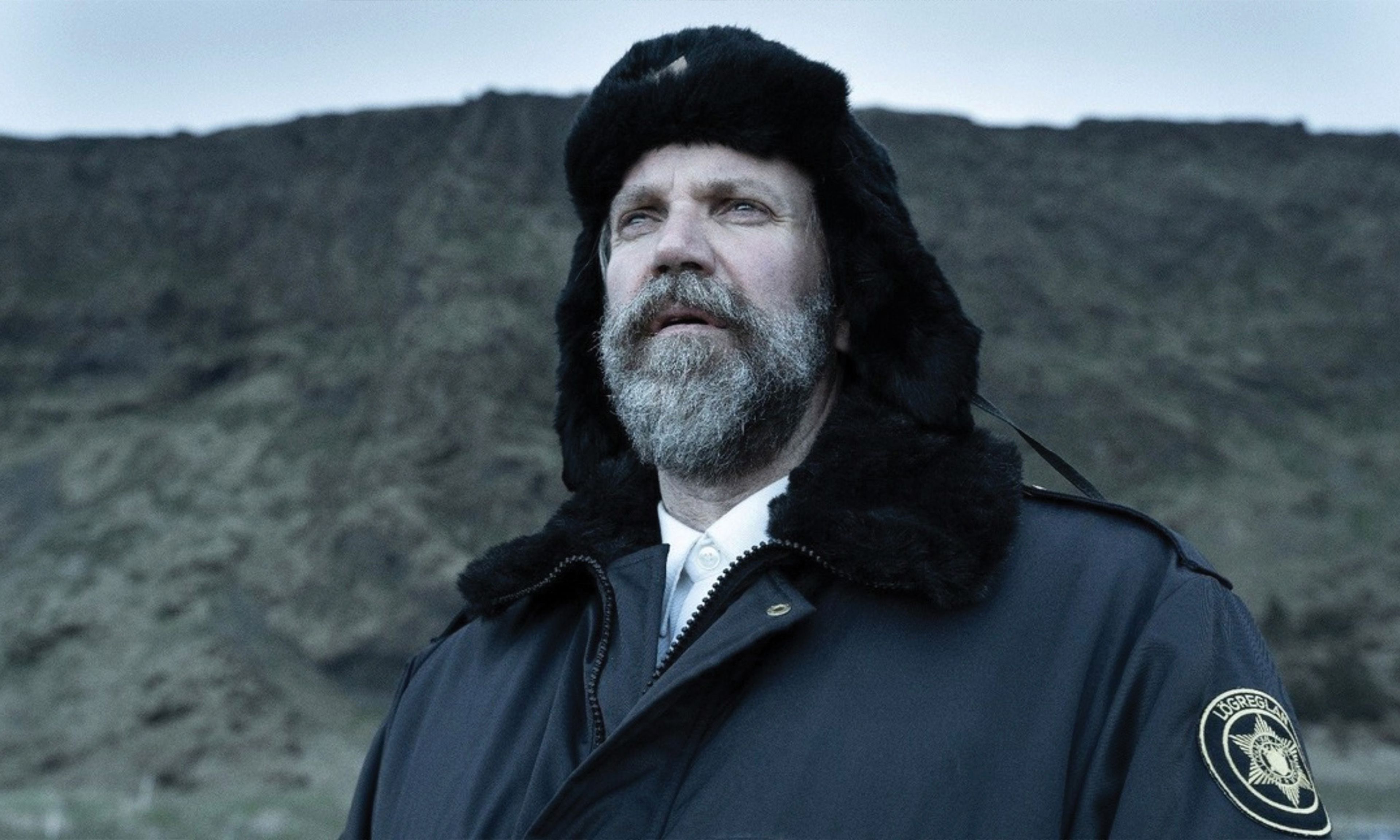
When the Icelandic series Katla first showed up on my Netflix page, I assumed it was another blip in the unending stream of “postapocalyptic” dramas. The AI gremlins at Netflix register every time I open one of these, but not every time I close one. That is because their job is to count clicks, not opinions. Nine times out of ten, instead of being truly imaginative, shows in this genre rely on old formulas. I stayed with Katla because it is one out of ten.
Named after one of the largest volcanoes in Iceland, Katla was created by Baltasar Kormákur, the director of Everest and The Deep, and a fellow Icelandic filmmaker, Sigurjón Kjartansson. The eight episodes of this limited series debuted in 2021, and they were lucky in their timing, because while Katla is currently quiescent, another of Iceland’s 30 volcanoes, Fagradalsfjall, has been erupting for the past three years. Not only that, but the erupting fissures are flanked by higher mountains that afford a safe view, allowing Fagradalsfjall to produce a steady flow not just of red-hot lava but of camera-toting visitors.
If too much information about an ending is a spoiler, what do we call too little information at a start? A beguiler, perhaps. Katla is not easy to get into. The characters speak Icelandic and inhabit a landscape — the real village of Vík í Mýrdal (Vík for short) — that is actually quite lovely but has been digitally transformed into a grim, grey, depopulated place. So here are a couple of de-beguilers.
The characters belong to three groups. First are the Vík natives, who have lived in the region for many generations. Most of the villagers fled a year ago when the eruption began, but two families remain. One is the family of a mechanic named Thor (Ingvar Sigurðsson), whose daughter Gríma (GDRN, a stage name) is estranged from her husband Kjarten (Baltasar Breki Samper). The other is the family of the local constable, Gísli (Þorsteinn Bachmann), who lives with his dying wife, Magnea (Sólveig Arnarsdóttir), and his son Einar (Haraldur Stefánsson).
The second group are the scientists who have come to Vík to study the volcano. Their leader is the geologist Darri (Björn Thors), involved in a painful divorce from his wife, Rakel (Birgitta Birgisdóttir), because neither can handle the trauma of having witnessed their young son Mikael (Hlynur Harðarson) being run over by a car in front of their Reykjavik home.
The third group are five mysterious individuals who emerge from the melting glacier with their nude bodies coated with black ash. Assumed to be tourists who lost their way, they are taken in by the villagers. But when the coating is removed, they become eerily recognizable. Two are deceased family members: Gríma’s older sister Ása (Íris Tanja Flygenring), and Darri and Rakel’s son Mikael. Another two are younger versions of people still living: Gunhild (Aliette Opheim), an old flame of Thor’s from Sweden; and Magnea, the dying wife of Gísli. The fifth, even more weirdly, is an exact replica of Gríma.
The foregoing is offered as an introduction to who the main characters are. The question is what the ash-coated ones are, and on that I will leave the reader in suspense. It’s worth noting that the suspense in Katla is not the simple kind that leads up to a surprise ending, after which the story falls away like an empty husk. Instead, the suspense in Katla is like the soul-searching apprehension that accompanies waiting for life-changing news.
And while the story clearly ends with the eighth episode, it is not a surprise ending. The mystery of the ash-coated visitors is treated as such, with different characters pondering it from different angles. Out of that pondering come two partial answers, one from Darri the geologist and the other from Bergrún, a local woman in her 60s who is the proprietor of the tiny Hotel Vík, the only place in town where outsiders can stay. Neither is decisive.
Despite a bewitching performance by Guðrún Gísladóttir, Bergrún could be mistaken for a minor character. (Indeed, when Wikipedia set up the Katla page, they forgot to include her in the cast.) When two young scientists make fun of Bergrún for believing in old legends and folktales, she replies mildly that there are more things in heaven and earth than can be measured by their fancy equipment.
This does not make Bergrún a credulous peasant. For one thing, no credulous peasant would ever put it that way. For another, Bergrún is simultaneously the most widely traveled character in Vík and the most deeply rooted. Just as the fissures in a volcano reach down to the magma chambers beneath the Earth’s crust, so does her cultural memory reach profoundly into the past.
As for the ash-covered people: They are not the denizens of a postapocalyptic world. And neither are the family members who welcome them but then doubt their own sanity for doing so. The Greek word apokálypsis means “uncovering, disclosure, revelation,” and its use in monotheistic religions refers to an end-time when God will pass final judgment on humankind, redeeming the righteous while destroying the unrighteous. In today’s postapocalyptic stories, the judgment tends to come from Mother Nature, who lowers the boom on humanity for abusing her bounty.
But to think of a volcanic eruption as a final judgment, whether by God or by Nature, makes no sense. Katla’s last serious eruption in 1918 lasted only a month, but that was long enough to smother the whole region with ash and set off a biblical flood called a jökulhlaup. Today, Katla is starting to grumble, so it is bound to erupt again, just as it has 20 times in the recorded history of Iceland. Because that country perches on the Mid-Atlantic Ridge in the North Atlantic, where the Eurasian and North American tectonic plates are diverging roughly one inch a year, this sort of thing is bound to continue. So a better way to see this series is as a family saga.
The families are not happy. Thor’s daughters, Gríma and Ása, never recovered from watching helplessly as their mother ended her life by walking into the sea. And now Gríma feels so guilty about having lost track of Ása in a blinding snowstorm, she allows her own marriage to Kjarten to grow cold. As for Thor, he is discombobulated to see Gunhild, his lover from 20 years ago, emerge from the ash without having aged.
Then there’s the constable, Gísli, the only professing Christian in the village, who is so weary of caring for his suffering wife that he half-wishes she would die. And when her younger self appears out of nowhere, he tells himself that God wants him to act on that wish — which enrages his son Einar.
Finally there is Darri, who has been coping with the death of his son the same way he coped with the boy’s troubled life: by leaving it all to his wife and burying himself in his work. Of all the ash-coated returnees, the son of this quarreling couple is the most disturbed — and disturbing.
As a rule, the characters in postapocalyptic dramas are a photogenically diverse group of individuals whose ties to one another are never those of family. At best, they are friendly acquaintances engaged in a common project of survival; at worst, they are strangers joined in wars with gangs of other strangers. If any character has a backstory involving his or her family, it is kept strictly discontinuous with the events dramatized in the plot.
This is the real reason I stayed with Katla. Instead of the usual attenuated relationships, the bonds between these characters are rich, lifelong, and (when the ash-coated people arrive) life-transcending. A very engrossing exception to the rule.











Comments