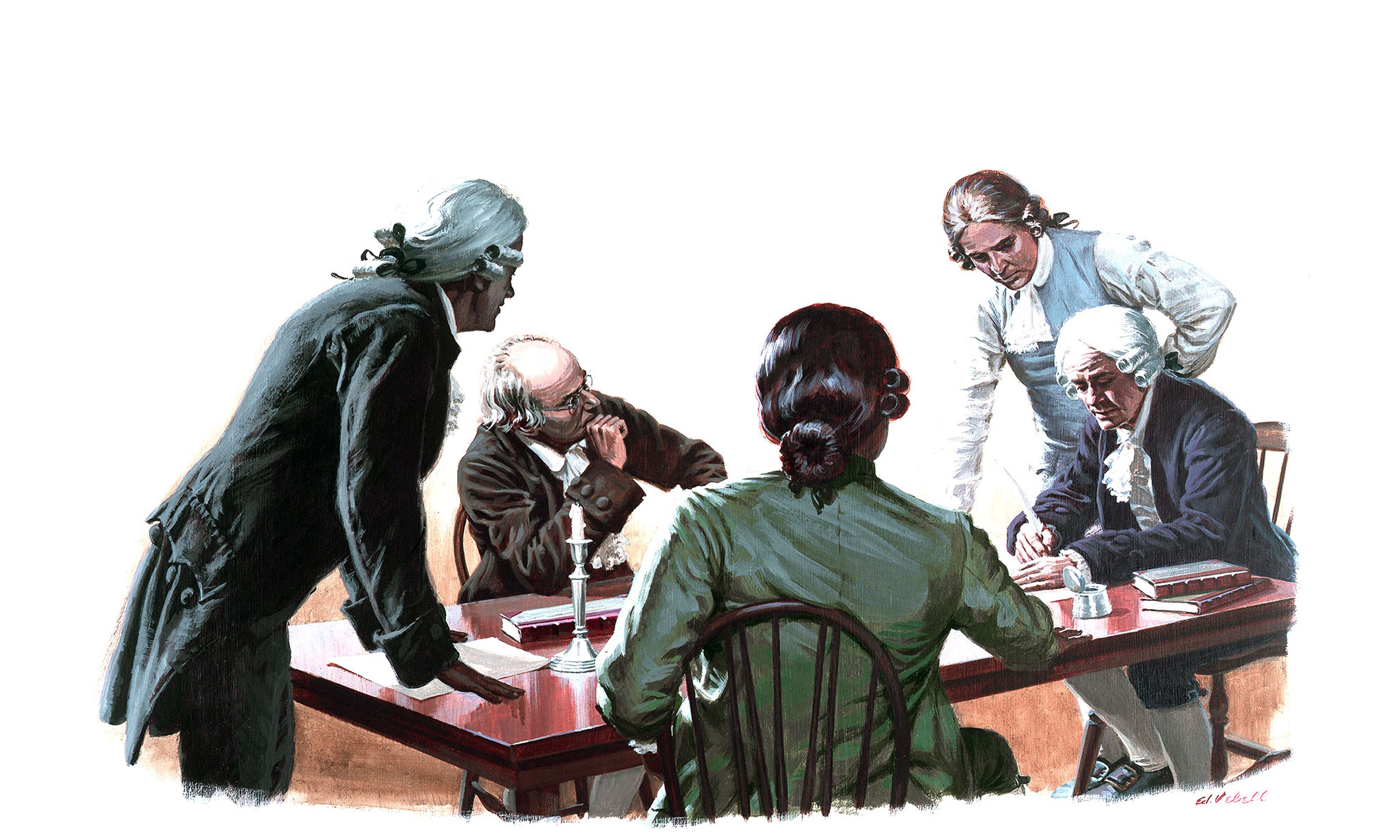
The United States Constitution could use better press. It has a lot of enemies these days, and too few friends. There is a surprising dearth of modern books defending it. Jay Cost is out to change that.
Political and legal bookshelves groan with volumes attacking our constitutional system of government, mainly from the left. Cost argues that, “too often, the conservative response to the progressive critique can be boiled down to tough luck.” Conservatives who like the system tend to pen books that focus on particular rights or provisions or aim to restore lost aspects of the original structure. For well-known volumes defending the system as a whole, a reader must typically go back two centuries or more to John Adams (who wrote a three-volume defense of Founding-era state constitutions in the 1780s), the Federalist Papers, or Alexis de Tocqueville’s Democracy in America.
The only recent volume attempting a broad-ranging defense was Robert Singh’s 2019 book In Defense of the United States Constitution. Singh, a British academic obscure in the United States, made his case for the American system’s success story largely in the survey-data language of social scientists.
Cost came prepared to present a more philosophical argument grounded in the thinking of the Framers. He brings a background as a political scientist, columnist, senior fellow at the American Enterprise Institute, a co-host of the National Review podcast Constitutionally Speaking, and the author of two recent books on James Madison and on the conflicting visions of Madison and Alexander Hamilton. While this latest title recaps some of the Madison–Hamilton debates, it is organized around the broad concept of the federal government that united the Framers.
Democracy or Republic? The People and the Constitution is a slender volume without charts or data, and with only scattered engagement with opposing views. Cost cautions up front that his book “is not intended as a top-to-bottom defense of the Constitution” in all its detail. It is, instead, focused on the constitutional design and what it was intended to accomplish. While there are some discussions of American history since the 1791 ratification of the Bill of Rights, Cost’s main aim is to explain what the Framers at Philadelphia in 1787 thought the Constitution would accomplish — and why their design is still needed in today’s world.
In Cost’s view, the overall philosophy of the Framers can be summarized in one word: consensus. “Consensus is the underlying principle of the republic,” he writes. The Framers designed a system of separated federal powers, each of which had — as Madison explained in Federalist No. 51 — both the necessary ambition to defend its own prerogatives and adequate tools with which to do so. We tend to discuss separated powers as a protection for minority rights and a check on tyranny, a method of imposing deliberation to slow down hasty, transient majorities. All of that is true, but the ultimate goal, Cost argues, is consensus decision-making.
The Framers were acutely aware of the Roman Republic’s rise and fall. The Federalist pseudonym “Publius,” for example, was the name of one of the founders of that republic, which was established after the overthrow of the Etruscan monarchy. The Framers read Polybius, a Greek historian who wrote at the republic’s peak about how it built upon Aristotle’s view of the “mixed constitution.” Such a constitution balanced the one (the king), the few (the aristocracy), and the many (the people), giving each a voice and a stake in the system so that none would predominate. That equilibrium was unsettled by wars, producing standing armies that were funded by, and therefore loyal to, the generals rather than the Roman senate.
Montesquieu, who for the Framers was probably the single most influential theorist, touted the British model of separated powers as superior to the French, but the revolutionary generation had good cause to feel that the British didn’t go far enough. In the 1780s, the king still predominated because he could use patronage to buy off a decisive segment of Parliament. When royal patronage was sharply constricted by the same generation of Britons that had lost America, the throne’s influence atrophied, and the aristocracy essentially consolidated complete control for half a century. At each turn, there was a struggle for mastery rather than the achievement of consensus.
As Cost notes, while there were many disputes at Philadelphia about how best to devise a separation of powers, the principle of checks and balances was accepted by the assemblage almost unanimously. The main source of contention on that score was the demand of small states such as Delaware to preserve the equality of the states that had existed under the Articles of Confederation, a matter finessed by dividing the legislature into the Senate (which maintained that equality) and the House (which discarded it). Cost observes that one of the geniuses of the new system was that it could immediately give new states the same rights in the Senate as the original states had, while the balance of power in the House stayed where the population was. As a result, “the putative rebellion of the West is the proverbial dog that never barked in American history.”
Madison’s theory of an extended republic was that self-government would work better in a large, diverse nation than in a small city-state (the locus of most prior republics) because no single faction would predominate. A nationwide consensus could be formed only by compromises among multiple factions. Cost argues that, today, the size and diversity of the nation requires a system that compels consensus:
In a free society, obedience to the state depends on the consent of the governed, which requires that people feel they have meaningful participation in the regime. By forcing coalitions to be larger, broader, and more considered, consensus can offer that kind of public buy-in. . . . America is not Sweden. Ours is a continent-spanning republic whose people defy any uniform classification. Loyalty to our regime can only be produced in one way — a broad-based conviction that meaningfully reflects each faction’s own unique preferences and beliefs. That requires consensus.
Madison failed to foresee that the nation would soon divide into two parties that would often act as nationwide factions. Indeed, he could not even see it happening as he was helping found one of those parties, convincing himself that Hamilton and his supporters were a faction but the Jeffersonian Republicans were a kind of anti-factional coalition. That fallacy endures.
The Framers expected that decisions reached by this consensus-building process would be more durable than laws passed by one momentarily victorious faction and then repealed in turn by the next faction. Madison and Hamilton shared a concern that unchecked democracy would produce frequent and jarring changes to laws. In the states, which had more cohesive polities and fewer checks on factional power, Tocqueville complained that Americans changed their laws too frequently.
The Framers didn’t expect their system to produce gridlock — or, rather, they expected temporary gridlock to lead to bargaining. The House and Senate would compromise because neither could act alone. The executive (unlike the Roman generals) would come to the table because Congress could withhold funds and prevent him from doing his job. The courts would, Madison hoped, accept the consensus of the political branches on what was constitutional (on this, Hamilton disagreed, and Hamilton’s vision of an independent-minded judiciary won).
But what happens when consensus can’t be reached? The 1850s, which ended in civil war, are the worst-case scenario. Cost argues that it would be “catastrophic” for a momentarily victorious faction to impose major change, and the 1854 Kansas-Nebraska Act, which blew up three decades of compromise after one good election cycle for Democrats, fills that bill. It helps explain the intransigence of both sides for the rest of the decade. Cost also gives more than a fair hearing to the critics of judicial review (including Madison, Jefferson, and Lincoln) in light of the capacity of nationwide Supreme Court fiats to short-circuit the system’s features for gradually building consensus.
Cost fails, however, to fully address what happens during long periods of gridlock. The positive case is federalism. There are matters such as foreign affairs that require federal action. But on a great many questions of day-to-day governance of economic and social life, the system is designed so that the alternative to federal consensus is state diversity. If the Senate can’t agree on what to do, the answer is not to “do nothing” but that “each state does its own thing.” In the usual case, that’s good. It allows diverse governance within a unified whole.
As John C. Calhoun observed, American government is built on concurrent majorities: You are subject to local, state, and federal rule, and consensus is not truly unstoppable unless the majority at every level agrees. In many cases, however, you may find yourself in the minority at some levels and in the majority at others. Calhoun, motivated to defend slavery, went to the destructive extreme of wanting a state veto on a national consensus, on the theory that only a majority at every level is legitimate. A better understanding of the system is that your state or local majority is supposed to prevail unless and until some national consensus forms to override it.
The negative case is what we see too often today: The executive and the bureaucracy claim that gridlock entitles them to fill the void by imposing nationwide factional policies that could not pass Congress. This gets as far as the Supreme Court will allow it, with the power of the purse no longer exercised and the national legislature having no say in the matter. Cost suggests some useful reforms to make Congress run better, such as expanding the House and strengthening the parties, and some ill-considered reforms, such as proportional allocation of electors, but he doesn’t deal with bureaucratic evasion of consensus decision-making.
Cost also sometimes gives the system’s critics too much credit. He describes the Constitution as “undoubtedly a racist document.” He also concedes some points to Nikole Hannah-Jones’s 1619 Project, in spite of the demonstrable flaws in her historical analysis. This is unfair. Framing-era America undeniably had racist institutions, slavery being the predominant one. The Constitution reached compromises that accommodated them because it reflected the society it aimed to govern. But the Framers (even some slaveholding delegates, such as Madison) were careful to write a document that was silent on race, that declined to legitimate slavery by naming it, and that pointedly left room for current and future states to ban slavery (as New York and New Jersey did, and as twelve more states did at the time of admission before 1862). Nothing in the original Constitution was irreconcilable with a color-blind society in which there was no slavery.
Quibbles aside, it is good to see our Constitution defended. It would be better to rebuild the consensus in its favor.












Comments