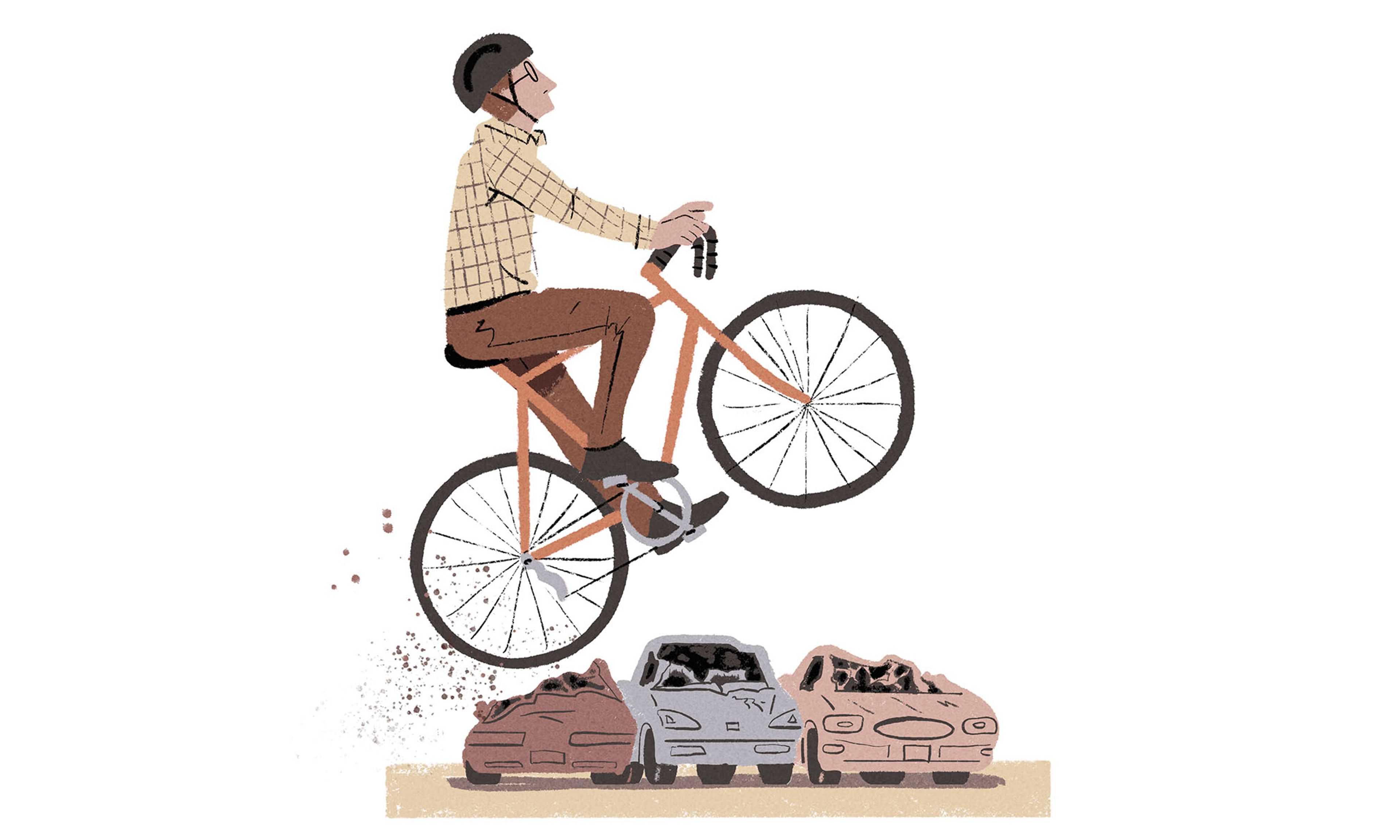
Advocates of degrowth, a category of environmentalism based on reorienting the global economy in the way that its name suggests, typically support the transition to electric vehicles. But they see it as only an interim step in a longer campaign to radically reduce the number of cars in circulation, however they are powered. EVs, after all, take their own toll on the environment.
Among the ways of achieving this, argues Jason Hickel, a leading degrowther, in his Less Is More (2020), would be to develop “publicly owned, app-based platforms” for car sharing “without the rentier intermediation that has made platforms like Uber and Airbnb so problematic.” Rentier intermediation! Deep green shades easily into red. Environmentalism, like socialism, is now an ideology of control, which is no small part of its appeal to many in today’s ruling class — or to those set on being a part of tomorrow’s. Hickel, an academic, is no outsider. Among other positions, he is a member of the Roundtable on Macroeconomics and Climate-Related Risks and Opportunities of the National Academy of Sciences.
When it comes to tackling cars, many of Hickel’s prescriptions — more public transport, more bicycles, fewer SUVs — are well within the climate policy mainstream, as, increasingly, are doubts over the notion that merely switching to EVs would suffice.
If a story from Estonia is any indication (and it is), carrots — more public transport and so on — won’t be enough to lure drivers away from their cars. In 2013, the authorities in Tallinn, the country’s capital, introduced free public transport for city residents. Nine years later, public transport’s share of commutes had fallen. The greatest decline was among those who would benefit the most from free travel: the poorest 25 percent of the population. This was due, in part, to higher car ownership and the move of manufacturing jobs to suburbs less well served by buses and trams, but the simplest explanation is the best. People like their cars.
Degrowthers, millenarians eager for humanity to be purged of its environmental sins, will relish recommending sticks to supplement carrots. Those sticks will inevitably include tough limits on automobile production and regulatory harassment of those who cling to their cars. Moreover, access to those conveniently state-controlled apps could easily be rationed or — Xi Jinping can lend a few hints — withheld from people who had behaved in ways otherwise displeasing to the government. As alarmist as that sounds, it’s more credible than the belief that degrowth and democracy can coexist.
And there are other strains of environmentalism where impatience with the ballot box is all too visible, including when it comes to cars. The Tyre Extinguishers are an activist group that goes around letting the air out of SUV tires. “If our spineless politicians won’t take meaningful action against emitters, then we will,” tweeted the deflators in November. Meanwhile, Europe’s censors have been on the case. Among the interventions of those in France is the requirement that all automobile advertisements must include a message encouraging alternatives to car use. This year, Edinburgh banned advertising of “high carbon” products — including all cars other than EVs or hydrogen-fueled cars, unless the latter two are SUVs — from city property.
SUVs play neatly — extra horsepower of the apocalypse — into a millenarian narrative in which hubris, greed, and extravagance are triggering a climate catastrophe. Under its mayor, Anne Hidalgo, a socialist consumed by her hatred of cars, Paris may ban SUVs altogether. They make a handy poster villain for politicians and innumerable activists battling cars in general, whether out of concerns over the environment (from a changing climate to the harms caused by the nitrogen dioxide emitted from the tailpipes of conventional vehicles) or over wider quality-of-life issues.
Thinking about the latter has been influenced by ideas reimagining cities in a supposedly more people-friendly fashion, most famously, perhaps, the “15-minute city.” This is the umbrella term for projects — Paris is said to have 50 — intended to make it easier for people to fulfill more of their daily needs close to home. With more shops, services, workplaces, and so on within a 15-minute walk or bike ride from where residents live, they will have less need — wait for it — to get in a car. In such schemes that option is often constrained by pedestrianization, coercion masquerading as convenience; that this is met with bien-pensant applause is a reliable indicator of failure ahead. Successful neighborhoods are normally organic, not planned.
The spread of a recent conspiracy theory out of England, that limitations would be placed on the freedom of movement of residents of 15-minute cities, was fueled by a misunderstanding over unrelated traffic rules in Oxford as well as by memories of the pandemic-era lockdowns. Nevertheless, it was an indication of the fears being stirred up by a war against cars that is all too real. Those fears will not be eased in the U.S. by Section 24220 of the Infrastructure Investment and Jobs Act, which contains wording mandating the installation in new vehicles of equipment to enable remote surveillance of cars and their drivers — and, arguably, possible activation of a kill switch. It’s understandable that this provision, intended (of course) to help fight drunk driving, has triggered concern about the uses to which such technologies might be put. Section 24220 was backed by some Republicans. The 2024 election has given them the opportunity to rethink that. They should take it.
The relentlessness of the war against cars is striking, and so is the zealotry, vaguely reminiscent of the Inquisition in the way it alights on even small sins, such as reversing out of parking spots, apparently a terrifying threat to public safety that caught the attention of Greens in Kiel, Germany. Making parking more onerous is a good way to discourage both car use and car ownership, as those waging the war against cars have realized. Parking fees have soared in various European cities. Sometimes disfavored types of car (such as SUVs or heavier EVs) are singled out. Sometimes not. And the supply of parking spaces is being squeezed — in Paris, naturally, but also, sadly, in the U.S., a paradise (well . . .) enhanced by its paved parking lots. Outside the densest conurbations, these asphalt expanses play a useful role in maintaining the impressive ease of getting around so many American cities and towns when compared with their European counterparts. And yet, here too, parking mandates (zoning rules) requiring developers of new buildings to provide sufficient off-street parking are being relaxed.
Speed limits have been cut in too many locations in Europe for safety to be a convincing excuse. In Wales (Wales!), a blanket 20-mph limit has been imposed in almost all built-up areas. That Wales pace is being decreed across London, without, it turns out, any comprehensive cost-benefit analysis, lest, presumably, it deliver an awkward result. The speed limit on Paris’s ring road, the Périphérique, has been slashed to just over 30 mph, far below those for the roads circling other European capitals.
And driving in numerous European cities has also gotten more complicated, mainly because more and more parts of them have been rendered less accessible or off-limits entirely. That can be appropriate. Narrow medieval or early-modern streets are not well suited for car traffic. There are also sites in some cities that would be drained of much of their delight by the presence of automobiles. Florence’s Piazza della Signoria is better without cars. But banning automobiles from too great a swath of a historic city center risks transforming it into an open-air museum, depopulated, emptied of most of its businesses (save for souvenir shops and tourist restaurants), and lifeless.
Something similar can occur even when the aesthetic stakes are lower. City life can undoubtedly be enhanced by modest, undogmatic pedestrianization. But anything more risks creating stretches of desolation, particularly in winter, where few will want to go or to live. There will be only so many Amsterdams. And then there is the added congestion in those areas still open to cars. Congestion is bad, no?
Drivers stop-starting along busy streets are traveling in the way that — traffic jams notwithstanding — makes sense to them. They are a sign that the web of connections that make a city so much more than a sum of its parts is functioning as it should. Putting permanent barriers in the way of mobility and, by extension, convenience would steadily undermine a city’s effectiveness as a place to meet, to do business, to work, and to act as a cultural entrepôt, as would 15-minute enclaves intended to reduce the need to move about. Fostering parochialism (even balkanization) is the last thing that planners should do.
This loosening of the bonds that tie cities together will be accelerated by other measures that, taken together, will make it more difficult to drive in their streets. These also include Britain’s controversial “low-traffic neighborhoods” where through traffic is heavily restricted, a concept that Hidalgo has recently applied to central Paris (examples can be found elsewhere). And then there are those proliferating bike lanes. While there are exceptions, the route-narrowing (for cars) that bike lanes entail mostly slows down traffic. And that — shhh — is really the point. Bike lanes may win fewer converts to urban cycling than their proselytizers hope, but the slower journeys they produce ought to shove more motorists onto public transport.
The same may be true of the ever higher costs attached to car use — from congestion taxes to pollution-related charges, such as those levied on the drivers of (more polluting) older cars if they enter London’s ultra-low-emission zone (ULEZ), which now — the ratchet is forever ratcheting — covers the entire city. The number of (less stringent) low-emission zones worldwide runs into the hundreds, and a couple are, or will be, tested in the U.S. Given the right political conditions, similar regimes could be used to “encourage” motorists to adopt EVs, although that wouldn’t save them from congestion taxes (such as those in New York City and, from December 2025, London), parking fees, or one day, maybe, a tire tax, “justified” by the particulate matter spun off by turning tires. The heavier the car, the greater the quantity of particulates that fly. As a rule, EVs weigh more than traditional cars. What’s more, mileage taxes to replace the gas-tax revenues lost when people switch to EVs seem inevitable in Europe, where gas taxes are very high (and forms of mileage tax are already payable by truckers in some countries). But Americans will not escape them: Pilot programs are already in operation in some U.S. states. Such taxes could act in subtler ways to ration car travel, too, with rates rising, say, with the number of miles driven. Back in 2018 (an eon ago in Trump years), President Trump showed himself somewhat open to a mileage tax. I wouldn’t bet on it now.
Higher costs of driving will hit the least affluent motorists hardest (not least because they are the most likely to own older, dirtier cars), but that won’t bother climate policymakers, who tend toward authoritarianism with a strong paternalist streak. The masses need to shape up. It will do them good to get on their bikes and walk about more (too bad if they are old or disabled or have children in tow). It is a measure of the presumption of much of the West’s ruling class that arguing that exercise is none of the state’s business will be treated with contempt. It is a measure of their arrogance and, when it comes to the climate, fanaticism that they have persisted with the war against cars, despite what it might mean for the health of the disturbingly fragile auto industry on both sides of the Atlantic.
The next stage of Europe’s coerced transition to EVs will add to the price pressure on its motorists — a turn of the ratchet that Americans will avoid if the incoming Trump administration can reverse the course taken by its predecessor and its co-conspirators in the blue states. EVs are still costly, and the price of used traditional cars, on the back of shortages of new models once their supply is reduced by tightening regulations and ultimately prohibited, can be expected to go up. Policymakers would regard pricing drivers off the road as a feature not a bug. They will likely feel much the same about those city dwellers who, lacking the facilities to charge their EVs at home (as a lot of them will) and unexcited by the prospect of driving around increasingly unwelcoming streets to find a charging station, simply give up on car ownership.
The war against cars is an authoritarian crusade against liberty and technological advance. It is part of a broader campaign using environmentalism and, more specifically, climate apocalypticism to create a malleable, controlled, collectivist society, with citizens quietly living inside green boundaries set by those who know best. Those who know best understand that car ownership enables individuals to accelerate away from the crowd, to hit the road where and when they want, free, if they choose, from the presence of other people, from the constraints of timetables and predetermined routes.
The war won’t be called off in Europe without a major political revolt. But Donald Trump and the new Republican Congress must wind down at least the part of it connected to the EV transition in the U.S. That task is made trickier by the fact that American auto companies have sunk billions into EV production and are not in the best of shape. Nevertheless, Trump should start by repealing federal regulations aimed at forcing the transition to EVs, and it seems that he will. To be truly effective, though, this deregulation must be repeated in the states, above all California. That will be a fight, but Trump seems prepared to take it on. For its part, Congress must end tax incentives for the purchase of EVs. That too will be a fight, but it’s one that must not be dodged. Americans must be left to choose for themselves what cars to buy, and companies need to relearn how to make and sell them.












Comments