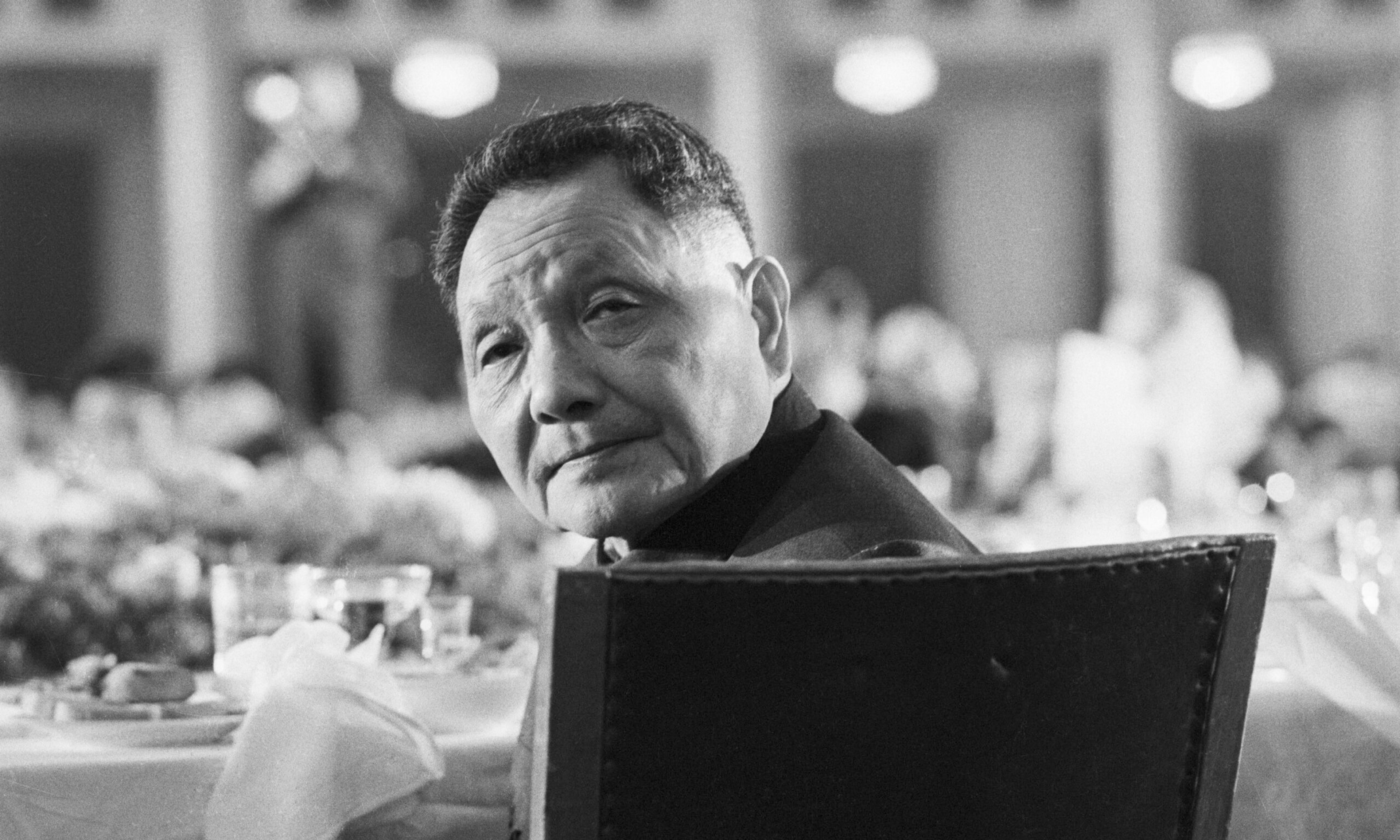
“Everyone here is scared — the youth, even more the elderly. That is precisely why our technology is so far behind.” — Deng Xiaoping, early 1970s
“There is no risk-free innovation in the world. Very often, eliminating risk entirely is the biggest risk itself.” — Jack Ma, 2020
Deng Xiaoping saw the ideological uniformity of Maoist China as an insurmountable barrier to national progress. In his telling, the country would remain an economic and technological backwater so long as it was roiled by continuous revolution. Deng’s vocal calls for reform in the lead-up to Mao Zedong’s 1976 death landed him in exile — the second in his career. In the disarray that followed Mao’s death, however, Deng used his connections in the Chinese Communist Party (CCP) and the army to claw his way back to power.
His ascent in 1978 marked the emergence of today’s China, the “modern socialist” state. Deng scrapped the heady philosophical debates of the Maoist era in favor of a practical approach that prioritized economic growth and technological progress. Internally, the party hardliners who opposed Deng saw him as a bourgeois capitalist; externally, Western economists doubted that a centrally planned economy could truly modernize.
But Deng’s “reform and opening” has been an unqualified success, achieving 30 years of roughly 10 percent GDP growth and lifting 800 million Chinese out of poverty.
The first leg — reform — involved introducing market dynamics to the communist country: rolling back the collectivization of agriculture, relaxing price controls, and opening up space for private entrepreneurship. Managers of state-owned enterprises gained greater leeway in choosing suppliers, customers, and employees, and in turn faced tighter budget constraints and more accountability from the national government.
The “opening” brought in foreign capital to fund new projects. By the mid 1990s, foreign direct investment totaled 3.4 percent of Chinese GDP, up from approximately zero at the time of Mao’s death. Foreign funds came with technology and management practices — facilitating China’s gradual technological “catch up” to the rest of the world.
Market economists were of two minds in assessing China’s reforms. The optimists saw economic liberalization as a natural precursor to political liberalization. As living standards improved, the people would clamor for greater freedom, and the virtuous circle that had played out in, say, South Korea would turn China into a modern, capitalist country.
The pessimists believed that China’s economy would be held back by central planning. Friedrich Hayek summed up the belief in 1982, arguing that “the mere idea that the planning authority” could ever yield the efficiency of a market system was “a somewhat comic fiction.” As the Japanese financial crisis of the early 1990s demonstrated, state economies can post astronomical GDP numbers by investing heavily in physical capital and exporting goods. But bureaucrats have a hard time redirecting investment to new industries as their economies mature. Again and again, the state-capitalist model has proven unsustainable in the long run.
Beijing has defied the predictions of both the optimists and the pessimists. Forty years into the reform era, China remains an authoritarian country with a centrally planned economy. The 1989 Tiananmen Square protests, coinciding with the fall of the Berlin Wall, engendered a belief among party leadership that the economy could be liberalized only to the extent that it did not threaten political stability. The CCP developed a social contract whereby the population would tolerate political repression in return for sustained improvements in living standards (measured by GDP growth). Now, a system of surveillance and social credit has shored up the party’s control over the everyday life of Chinese citizens.
Under the party’s direction, heavy investment in physical capital has made China the world’s largest trading nation. While growth has decelerated lately, China has not fallen victim to the kinds of spectacular collapses seen in the neighboring state-led economies of Southeast Asia — the kinds of collapses market economists would have expected. Thanks in large part to tight capital controls, fluctuations in international financing have barely left a mark on the Chinese economy.
The party cannot yet declare victory, though. At roughly $10,000 of GDP per capita, the country’s living standards remain modest. Meanwhile, its growth model is delivering diminishing returns. In the period between China’s ascension to the WTO and the 2008 financial crisis, each 100 yuan of new debt would return 90 yuan in GDP. Now, the return is below 30 yuan.
As a so-called authoritative person told the state-run People’s Daily in 2016, “High leverage will lead to high risk; if not well controlled, it will lead to systemic financial crisis and negative growth.” The party insider argued that Beijing would need to rebalance the economy, nurturing domestic consumption and reducing its reliance on capital-intensive industries. “For now, the most important thing, in this person’s view, is to push forward supply-side reforms,” read the 2016 article. The “authoritative person” story garnered much attention — a rare moment of self-criticism. While shedding light on the country’s precarious debt levels, the story also highlighted Chinese authorities’ awareness of their weaknesses. In the following years, the party rolled back social policies that inhibited consumption, such as the one-child policy, while making a push for “indigenous innovation” in emerging technologies. Beijing has since been working to transition from the capital-intensive, export-dependent model to an economy driven by domestic consumption and entrepreneurship.
It is no small task. Boosting domestic consumption would require increased freedoms for the Chinese middle class, freedoms that authorities are loath to cede. Cutting back capital investment to sclerotic state-owned enterprises would reduce the short-term economic-growth numbers on which Chinese authorities depend for legitimacy, and the emergence of wealthy business owners poses a challenge to party power.
Take the case of billionaire entrepreneur Jack Ma, who was summoned by authorities after publicly deriding Chinese regulators’ excessive risk aversion in November 2020. For weeks thereafter, his whereabouts were unclear. Though international news outlets have since located Ma, he has disappeared from the public eye. Ironically, Ma’s critique echoed Deng’s concerns about pervasive fear in the country. The saga was a clear demonstration that the repression that held back Maoist China continues to inhibit growth today.
The crackdown on the tech sector that followed Ma’s quasi-disappearance underscores the difficulty of centrally planned innovation. With the state towering over private CEOs, would-be entrepreneurs may think twice about starting a company in China. Moreover, many of the companies targeted by Chinese president Xi Jinping are consumer-lending platforms such as Alipay — precisely the kinds of firms that can fuel China’s much-needed consumption boost.
This raises the possibility that Hayek will be proven belatedly correct: that central planning will fail now that China has picked all the low-hanging fruit. As state-owned enterprises continue to flounder, returning a paltry 3.8 percent on assets, the country’s working-age population is shrinking, and trading partners are growing increasingly skeptical of the authoritarian state. Taken together, these forces could mean the end of the Chinese growth miracle. Because of the party’s economic authority, China is less likely to go out with a bang (a financial crisis akin to that of Japan in the early ’90s) than with a whimper: steadily decreasing growth, reduced entrepreneurship, and a reduced share of foreign trade.
This outcome is made more likely by increasing international skepticism of China. During the pandemic, Japan paid its firms to move operations out of China, and the U.K. reversed a decision that would have allowed Chinese telecom Huawei to build out part of its 5G network. The Biden administration has shown no indication that it will alter the course of the trade war started by President Trump. A less captive international market for capital and exports means even less potential for continued growth from the economic model of the past 40 years.
But an economic slowdown is by no means a foregone conclusion. The CCP weathered the 2008 financial crisis, intermittent meltdowns in its domestic financial markets, and, most recently, the COVID-19 pandemic. State investment in the burgeoning field of artificial intelligence raises the specter of a bureaucracy equipped with enough data-driven knowledge to re-create the spontaneous order of market economies. Free from the West’s ethical qualms over privacy, Beijing collects far more data than its economic competitors. Bulls see the potential for China to overcome demographic and structural headwinds by leapfrogging the West in AI, quantum computing, and biotechnology.
Meanwhile, Xi has made a concerted effort to develop the country’s domestic capital markets — a sine qua non for an advanced economy. The recent consolidation of CCP authority in Hong Kong gives Beijing control over a global financial center, and the much-anticipated rollout of a digital yuan threatens to erode the dollar’s status as the world reserve currency. Together with the recent Regional Comprehensive Economic Partnership between China and 14 Asian trading partners, Beijing’s moves suggest an effort to build an alternative ecosystem to Western finance and trade. For the state-capitalist model to continue generating growth, Beijing’s investments in emerging technologies will have to deliver godlike power to the party, equipping bureaucrats with the information and tools to allocate capital efficiently absent market mechanisms. And China’s sphere of influence will have to be large enough for it to deploy these technologies at scale.
Lofty hopes, to be sure. History suggests that China will go the way of Japan and the Asian tigers whose state-led economic models proved unsustainable, but post-Mao China has repeatedly defied expectations. The West would be foolish to dismiss its aspirations outright.










Comments