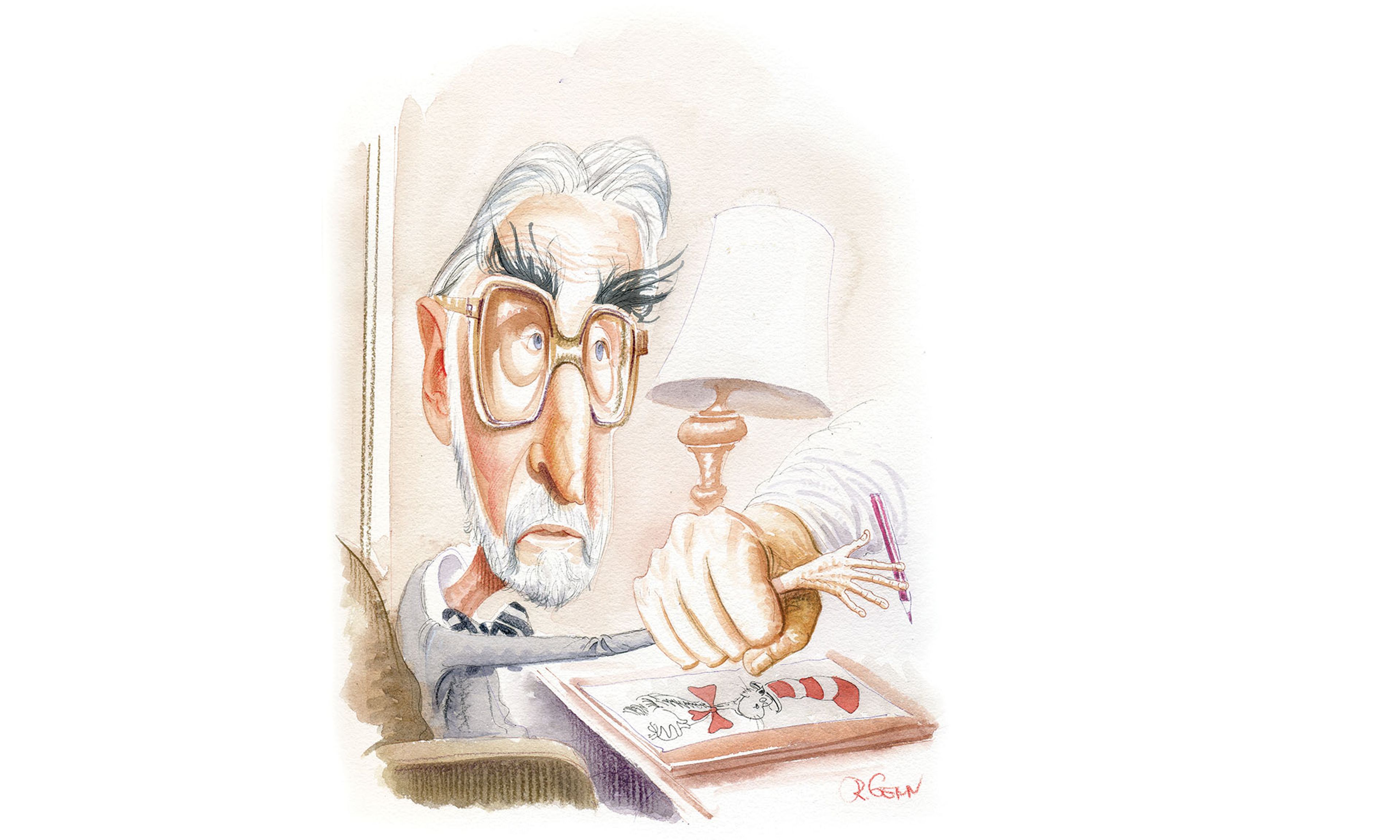
• Might we suggest the New York Times op-ed pages be as tough on Governor Cuomo as they are on Pepé Le Pew?
• President Biden’s speech on the one-year mark of the COVID epidemic reprised his post-election role of the grieving grandpa. This description is not entirely, or even mainly, sardonic. Biden has made virtues of his age and his long political experience, and of his experience of loss, both early and late in life. These give him a stance and a tone that Donald Trump was incapable of supplying, even had he understood the need. But Biden is also a politician — and one who is not remarkable for magnanimity or smarts. Thus he took too much credit for the vaccine rollout, which rests on the R&D incentives of the Trump administration, and he radically shrank the target of recovery (small family gatherings by July 4 — thanks a lot!). With Trump off the front pages and more and more arms getting jabbed, Biden’s persona will become increasingly irrelevant. He is unlikely to find another.
• No one in the party likes scandal-challenged Democratic governor Andrew Cuomo — and Republicans don’t like him either. So far, 13 of New York’s 16 Democratic congressmen and both of its Democratic senators have called for him to resign, joined vociferously by Cuomo’s longtime enemy Bill de Blasio, who covets his job. Therein lies the peril for New York State. De Blasio has been such a failure as mayor of New York that it boggles the mind to think of him stepping up to Albany. But can the Democrats find anyone better? Lieutenant Governor Kathy Hochul had some moderate credentials when she represented a western New York congressional district (she was endorsed by the NRA) but is little known. The party downstate is a hive of big spenders and actual socialists. The New York GOP is a wreck. Cuomo, harasser of women and scourge of the old, is not fit to remain in office, yet he acted at times as an emergency brake. In destroying himself, he risks ruining more.
• As Cuomo’s star has plummeted, Governor Ron DeSantis of Florida is beginning to get a welcome second look in the media. During much of the pandemic, the dominant narrative was that Cuomo was the adult in the room, in contrast to the Republican governor who was recklessly endangering the lives of Floridians by rejecting science and declining to order sweeping lockdowns. As it turns out, DeSantis took care to try to protect the most vulnerable Floridians in nursing homes while also taking account of economic and educational considerations in fighting the virus. The death rate in Florida is about the national average, while its unemployment rate is much lower than that of big states that locked down (4.8 percent, compared to 8.8 percent in New York and 9.0 percent in California), and its schools have been open since last August. The pandemic has been a challenge to all public officials and no one has gotten it completely right, but in constantly elevating Cuomo and disparaging DeSantis over the last year, the press got it backwards.
• Former president Donald Trump urged his supporters to give money to his groups rather than to the Republican Party’s official organizations, which he said would spend the money on “Republicans in name only.” His lawyers told these organizations to stop using his name and likeness to raise funds. He then backed down a bit: He supports those organizations, he said, and they in turn issued nice statements about him. Trump has millions of dedicated supporters, and his threat to turn them away from the Republican Party is a canny way of making it show him loyalty. It will also make it easier for Democrats to win in the 2022 elections, by focusing attention on him, and on Republican infighting rather than the Democrats’ agenda. And by helping the Democrats, it puts more of Trump’s achievements as president at risk. That’s a price he seems all too willing to pay.
• Xavier Becerra is taking the reins of the Department of Health and Human Services, which is very bad news for conscience rights and the sanctity of human life. Becerra, who served most recently as California’s attorney general, lacks any relevant public-health experience, but he does have plenty of experience using the power of the state to crush religious dissenters, pro-life pregnancy counselors, and independent journalists. At his confirmation hearing, he did nothing to ease concerns that he had been a left-wing zealot while serving as California attorney general. Nebraska senator Ben Sasse asked Becerra why he filed felony charges against undercover pro-life journalists for filming videos revealing Planned Parenthood’s gruesome practices — a heavy-handed move condemned by Mother Jones and the Los Angeles Times editorial board — but did not treat animal-rights activists the same way for doing the same thing. Becerra said he didn’t file charges against the animal-rights activists because they had shot their videos in 2015, before he was attorney general. The Planned Parenthood videos were filmed the exact same year. Moderate senators Joe Manchin and Susan Collins helped sink the nomination of Biden’s budget nominee Neera Tanden over some mean tweets, but they helped confirm a genuine extremist to a very powerful position.
• Democrats are continuing their effort to expand their slim House majority by removing a duly elected congresswoman from office. Mariannette Miller-Meeks of Iowa’s second congressional district won her November race by only six votes, but that margin was confirmed by bipartisan recount boards in every relevant county as well as by the state’s bipartisan canvassing board, which unanimously certified the results. House Administration Committee chairwoman Zoe Lofgren is nevertheless moving forward with an investigation, her clear intent being to replace Miller-Meeks with Democrat Rita Hart. Never mind that Hart herself didn’t bother to challenge the results in the Iowa court system, where she knew she would lose; she’s trying to leverage the Democrats’ advantage in the House into a position she didn’t earn. Republicans, stop this steal.
• The spending law Joe Biden just signed doles out $350 billion to state and local governments. Not only is this far more than would be needed to offset the damage that COVID-19 inflicted on these governments, but it comes with big strings attached — including that it may not, even “indirectly,” be used to finance tax cuts. This could amount to a far-reaching ban on tax cuts through 2024: The federal aid will free up cash in states’ budgets, and any subsequent tax cut will appear “indirectly” funded by the aid. This is an unacceptable overreach, and likely unconstitutional under Supreme Court doctrines that limit the extent to which the federal government may bribe state governments to change their policies. Democrats are for every possible form of “COVID relief,” as long as it doesn’t help taxpayers.
• H.R. 1, the For the People Act — not by the people, or of the people, natch — passed the House with one Democrat and every Republican dissenting. It would be an understatement to describe H.R. 1 as a radical assault on American democracy, federalism, and free speech. It is several radical left-wing wish lists stuffed into a single 884-page sausage casing. It would override hundreds of state laws, federalize control of voting and elections to a degree without precedent in American history, end two centuries of state power to draw congressional districts, turn the Federal Election Commission into a partisan weapon, and massively burden political speech against the government while offering handouts to congressional campaigns and campus activists. It trashes the work of major bipartisan federal election laws passed in 1993 and 2002. The bill mandates automatic, same-day, and online registration, bans voter ID, and makes felons eligible to vote. The “emergency” pandemic expansion of mail-in voting would be enshrined permanently in federal law. Federal taxpayers are required to pick up the tab for registration drives of young voters, traditionally a major expense for Democrats. New anti-speech laws, including requiring nonprofits to disclose major donors, would generate years of First Amendment litigation. Not since the Alien and Sedition Acts has one political party in Congress sought to bend the power of the federal government, on partisan lines, toward crushing political opposition to this extent. H.R. 1 is not merely a bad idea; it is a scandal.
• The House has passed the PRO Act, a sop to union bosses from a grateful Biden administration and its congressional allies. The bill seeks to preempt the right-to-work laws of the majority of states, laws that protect workers from extortion at the hands of the Teamsters et al. in the form of union dues that must be paid as a condition of employment. It would apply California’s so-called ABC test — used to reclassify independent contractors as employees — to the other 49 states, which could, among other things, simply reclassify independent owner-operators in the trucking industry out of business. It would violate the free-speech rights of employers arguing against unionization and could be used to dragoon freelancers into joining a union and paying dues to it. And it would prohibit employers from replacing union workers with non-union workers during a strike. The overall effect of the law would be to create vast new powers of coercion for a tiny handful of union bosses, giving them the power to extort not only employers but individual workers as well. Senate Republicans should do everything in their power to stop it.
• House Democrats passed the George Floyd Justice in Policing Act, legislation that would put pressure on law-enforcement officers to stop more women for “interviews, traffic stops, pedestrian stops, frisks and other types of body searches,” lest they give prosecutors prima facie evidence of their being guilty of profiling. No, really. This bill takes any disparities in the number of interactions officers have with people of different ethnicities, national origins, religions, sexes, gender identities, or sexual orientations as proof of profiling, rendering officers liable for disparities in crime rates that they are not responsible for creating. The result would be either an increase in manufactured stops of people who have done nothing wrong, or a rise in crime rates caused by law enforcement’s reluctance to stop suspects and violate this new form of socially enlightened policing. All this in addition to funneling money to progressive groups such as the ACLU and the NAACP to create pilot programs for departments around the country. Every American should be relieved that this assault on the principle of equal justice under the law is expected to die in the Senate.
• There are plenty of reasons to object to Elizabeth Warren’s proposed annual tax on large fortunes — it would be 2 percent starting at $50 million, and 3 percent above $1 billion. These range from simple equity (a great deal of this money has already been taxed) to the often dismal consequences of wealth taxes elsewhere. No less important is the way in which a wealth tax changes the relationship between the individual and the state. If the history of taxation is any guide, there will come a time when the wealth tax will be paid by far more than the very richest, and at higher rates, too. Even those who are beyond the reach of such a tax will be affected as, to a greater or lesser extent, they become required to prove that they are not liable to pay it, something that will involve their sharing in the lack of privacy that a wealth tax will have already inflicted on the rich. All those, rich or poor, alarmed by the continuing construction of our panopticon state ought to be very alarmed indeed: There is a sinister logic to the fact that Warren’s proposals include a massive increase in the IRS budget, an overwhelming proportion of it dedicated to enforcement.
• The U.S. Centers for Disease Control and Prevention took a while to publish guidance for vaccinated Americans, considering that the first vaccinations started in mid December. And when those guidelines arrived, they disappointed anyone eager to get back to normal. Fully vaccinated individuals can visit with other fully vaccinated people indoors without wearing masks. But vaccinated people are still supposed to “avoid medium- and large-sized in-person gatherings,” and Americans are still urged to “delay travel and stay home to protect yourself and others from COVID-19, even if you are vaccinated.” This seems too cautious, even timid. The available research indicates that vaccination dramatically reduces the likelihood of transmission and lowers the risk of death or serious illness further still. With 109 million doses in arms, and almost 2.4 million more shots being added each day, vast swaths of America’s elderly and immunocompromised have received at least one dose. And the unvaccinated are those at much lesser risk for a severe infection. Once we’ve dramatically reduced the odds of hospitalization or death, we’ve largely beaten this virus. These overprotective guidelines undersell the benefits of getting vaccinated, and might have the perverse consequence of discouraging people from doing so.
• While most Catholic leaders have expressed approval of the COVID vaccines, a few have misgivings. Those misgivings are understandable because all of the major vaccines were developed using cell lines that may ultimately have derived from an abortion in the 1970s. But most pro-life ethicists argue, persuasively, that using the vaccines does not constitute tacit support for abortion, does not encourage abortion, and does not disrespect any unborn child. There are good reasons to take them — protecting one’s own health and the health of one’s family and community — and no reasons for conscientious pro-lifers to have qualms about doing so. The debate over the issue is nonetheless salutary, reminding us as it does of the many ways the evil of abortion has insinuated itself throughout our society.
• In early March, Defense Secretary Lloyd Austin approved a Capitol Police request to extend the deployment of nearly 2,300 National Guard soldiers in Washington for an additional two months. This deployment — along with the “temporary” fencing that is in danger of growing permanent — is an overreaction to the riot of January 6. The deployment of National Guardsmen to secure the Capitol grounds in the days and weeks surrounding the inauguration was a prudent and necessary measure. Now, months later, it no longer is. The deployment is causing hardships to the Guardsmen and their families, affecting unit readiness, and adding to the perceived separation between the American people and their elected representatives. The Guard should go home, and soon, with the thanks of a grateful nation.
• Much of the press celebrated as uniformed servicemen and official Marine Corps Twitter slapped back at Tucker Carlson, the Fox News host, for his criticism of specialized “maternity flight suits” and the “feminization” of the Armed Forces. “What we absolutely won’t do is take personnel advice from a talk-show host,” Pentagon press secretary John Kirby thundered. “Come back when you’ve served and been pregnant,” the II Marine Expeditionary Force tweeted before, rightly, apologizing. Agree or disagree with Carlson, the Pentagon’s brass should take their apolitical tradition seriously and leave the politics to politicians and talk-show hosts.
• In a season of recriminations over election procedures, Florida and Georgia stand out for their relatively well-run elections. Neither state is content to rest on its laurels. Florida governor Ron DeSantis proposed a series of reforms to ban ballot-harvesting, prohibit mass-mailing of unrequested mail-in ballots, tighten signature requirements, and beef up the state’s already-impressive transparency regime. Georgia Republicans have likewise pursued salutary efforts to improve security and transparency, while backing off some of their party’s less defensible efforts to quash Sunday voting used regularly by black churches. Republicans should not be indiscriminately hostile to every effort to make voting easier, but neither should they be cowed by knee-jerk Democratic accusations of “voter suppression.” Florida offers a good blueprint for protecting the integrity of the vote and making the process more transparent without making voting unreasonably difficult. As in so many things recently, a good rule of thumb for policy-makers in other states is “Learn from Florida.”
• The pandemic has taken a heavy toll on New York. U.S. Postal Service data suggest at least 300,000 households left the city last year. As workers went remote, businesses went with them: Goldman Sachs, Blackstone, and Elliott Management are among the many large financial firms that moved some operations to Florida. Given that a mere 65,000 households pay half of the city’s income taxes, even a minor exodus poses a serious threat to New York’s finances. State lawmakers’ creative solution? Tax hikes. New York already collects more revenue per capita than any other state with an income tax, but legislators in Albany want to cement that rank with new taxes on wealth and on stock transfers. Coming in tandem with the Biden administration’s proposed increase in capital-gains taxes, the proposals could leave New Yorkers paying 70 percent on financial income. We’re not sure who would celebrate the tax hike more: Occupy Wall Street or the Florida Real Estate Commission.
• Popular evangelist Beth Moore has left the Southern Baptist Convention due to irreconcilable differences between her and other leaders in the denomination. Moore has spent the last several years being derided by many in the Church as “woke” for critiquing Donald Trump, most notably for his treatment of women. Still, Moore, a fierce pro-lifer, understood why so many Christians voted for and supported Trump. She objected only to those of them who formed a cult of personality around him. That she felt obligated to leave after decades of high-profile service suggests she may have been on to something.
• Amazon has announced its decision “not to sell books that frame LGBTQ+ identity as a mental illness,” a preposterously transparent after-the-fact rationalization for its decision to ban a particular book, Ryan Anderson’s When Harry Became Sally: Responding to the Transgender Moment, under pressure from transgender activists. Amazon did not come up with a guiding principle for excluding books — it simply knuckled under to demands to suppress a book with a point of view that is unpopular in some corners. While this episode is an inconvenience to Anderson, the real long-term problem is that Amazon’s gigantic footprint in bookselling means that a book that cannot be sold on Amazon probably will not be published in the first place. We are left in the perverse position in which our largest bookseller is also our largest book-banner.
• Two professors at Georgetown University have been forced to resign after one made allegedly racist comments on a leaked Zoom call and the other failed to challenge her. The two academics had stayed on the call to discuss their students after teaching a class together, unaware that they were still being recorded. Professor Sandra Sellers expressed her disappointment to colleague David Batson that many African-American students were “just plain at the bottom” of her class. Batson went quiet for a moment, then demurred, stressing that his “own unconscious biases” might impair his analysis of the situation. Sellers resigned in ignominy, as might be expected, publishing the now-boilerplate self-flagellating statement of apology on the way out. Remarkably, however, Batson also tendered his resignation, simply because he was present when the great thought crime was committed and failed to make a sufficiently ostentatious display of his objection. He, too, wrote to apologize for the “disturbing situation caused by the recorded Zoom conversation between Ms. Sellers and myself in which insensitive remarks were made regarding the performance of Black students at the Georgetown University Law Center.” If this culture of inquisition continues spreading across the republic at its present pace, the idea of the innocent bystander will soon be a relic of a bygone age.
• California’s department of education is set to vote on an “Ethnic Studies Model Curriculum” that will, if approved, become mandatory in all of the state’s K–12 schools. If the measure passes, students will be taught that white Christian settlers committed “theocide” against indigenous tribes when they arrived in the New World by murdering Native American gods and replacing them with Christianity. But all is not lost, we are told, because students will also learn that they have the power and the responsibility to build a social order defined by “countergenocide,” which will eventually supplant the last vestiges of colonial Christianity and pave the way for the “regeneration of indigenous epistemic and cultural futurity.” To help bring about this regeneration, teachers are encouraged to lead students in chants to the Aztec god Tezkatlipoka — traditionally worshipped with human sacrifice and cannibalism — praying for the power to be “warriors” for “social justice.” Our deepest sympathies at this time are with the staff writers at the Babylon Bee, whose Herculean task it is to satirize this dizzying pinnacle of woke insanity.
• Democratic legislators in California also introduced a bill that would prohibit large retailers from displaying children’s toys in separate sections for boys and girls. The fine for noncompliance would be $1,000. The idea is to make sure that stores are a “safe space” for children who are “figuring out their identities,” according to Assemblywoman Cristina Garcia, one of the bill’s authors. “This is an issue of children being able to express themselves without bias,” said Assemblyman Evan Low, her co-author. All right, then: Let’s have the children vote on it.
• The Trump administration revived the Quad grouping — a quasi-alliance of the U.S., Australia, India, and Japan — as a diplomatic bulwark against the Chinese Communist Party’s bid for global dominance. Building on that initiative, President Biden recently met the leaders of those countries for a virtual summit, during which they agreed to finance the production of, and distribute, over 1 billion Johnson & Johnson COVID-vaccine doses to Southeast Asian and Pacific Island countries. (This effort will come at the expense of not a single COVID vaccine procured by the U.S.) China and Russia have already gotten a head start on distributing their unreliable, and quite possibly unsafe, vaccines to curry influence with potential clients, and it’s about time that democracies got in the game. The Quad also promises further cooperation on technological standards, presumably to resist Beijing’s authoritarian designs on the Internet, and it already coordinates on maritime security and other defense issues. This group is quickly becoming a force key to resisting the CCP in the Indo-Pacific.
• China has a rubber-stamp parliament, which recently approved new laws saying that only “patriots” may participate in Hong Kong’s government. Who will determine their patriotism? A new vetting panel, composed of patriots, i.e., loyal servants to the Chinese Communist Party. Heretofore, according to state media, “anti-China, destabilizing forces and radical localists in Hong Kong have manipulated the electoral system to enter the governance structure.” In other words, there has been democracy. Responding to the new laws, the British foreign minister, Dominic Raab, said, “This is the latest step by Beijing to hollow out the space for democratic debate in Hong Kong, contrary to the promises made by China itself.” “The latest step” is exactly the way to put it.
• Dan Gertler is an Israeli billionaire who amassed his fortune via crooked dealings with the Congolese dictatorship. He and Joseph Kabila, the longtime dictator, were friends and partners in crime. In December 2017, the Trump administration imposed Magnitsky sanctions on Gertler. In the last days of the administration, it lifted those sanctions, after lobbying by Alan Dershowitz and others working for Gertler. The new administration has reimposed the sanctions — which is welcome.
• After a delay of many years, the European Union adopted a Magnitsky act last December. These acts allow countries — or, in this case, a union of countries — to impose sanctions on individual human-rights abusers. The sanctions, typically, are asset freezes and travel bans. Human-rights abusers like to park their gains in nice, stable countries, and vacation in those countries, too. The acts are named after Sergei Magnitsky, the Russian whistleblower who was murdered in 2009. For years, Hungary’s Viktor Orbán held up an EU Magnitsky act. When he acceded, it was in large part owing to pressure from a U.S. senator, Roger Wicker (R., Miss.). The EU has now issued a round of Magnitsky sanctions: targeting Chinese persecutors of the Uyghurs, for example. Omitted from the list, however, are those responsible for the murder of Magnitsky himself. The EU needs the consent of all of its members, and Orbán withheld his. But EU Magnitsky sanctions are off to a good start. Magnitsky sanctions, wherever they are available, are an inspired tool.
• “Iraq will always remain in my heart,” Pope Francis told the congregation of 10,000 at Mass in Erbil on March 7. “I ask all of you to work together for a future of peace and prosperity that excludes and discriminates against no one.” The first pope to visit Iraq, Francis accomplished several broad, related objectives. Throughout his four-day visit, he demonstrated solidarity with Middle Eastern Christians, who have long hoped for greater material, political, and moral support from their Western coreligionists. In the autonomous region in the north of Iraq, Francis thanked the Kurds under whose administration more than 140,000 Christians from the Nineveh Plains settled in recent years after fleeing ISIS. In meeting with Grand Ayatollah Ali al-Sistani, who is reputed to be, at least by the region’s standards, a moderate on the issue of religious tolerance, Francis affirmed the elements of Iraq’s Shia majority that have some stake in protecting minority rights while promoting national stability. The religious significance of the pilgrimage that Francis as bishop of Rome made to Ur, the birthplace of Abraham, the father of the faith for Jews, Christians, and Muslims alike, spoke for itself.
• The grave of Adam Smith, one of the great luminaries of the Scottish Enlightenment, has been included by Edinburgh’s city council on a list of sites and monuments associated with slavery and historic injustice. This even though Smith was an early and vocal opponent of slavery, lamenting what “miserable life the slaves must have led; their life and their property entirely at the mercy of another, and their liberty, if they could be said to have any, at his disposal also.” Smith’s inclusion on the list is supposedly justified on the ground that he “argued that slavery was ubiquitous and inevitable but that it was not as profitable as free labour.” This is not correct. It is true that Smith was a pessimist by nature, believing, against his own hopes, that slavery would probably persist indefinitely, but he argued against it anyway, and not just on economic grounds. Smith thought that the “invisible hand” of the market, which allows the consumption of the rich to redound to the benefit of the poor, is arrested in its movement by slave economies. As a result, wealth accrues to the rich alone, which is morally intolerable. Smith’s Lectures on Jurisprudence are particularly explicit and emphatic on this point. In their combination of censoriousness and sheer stupidity, today’s “woke” are easily the match of any of the Comstocks of old.
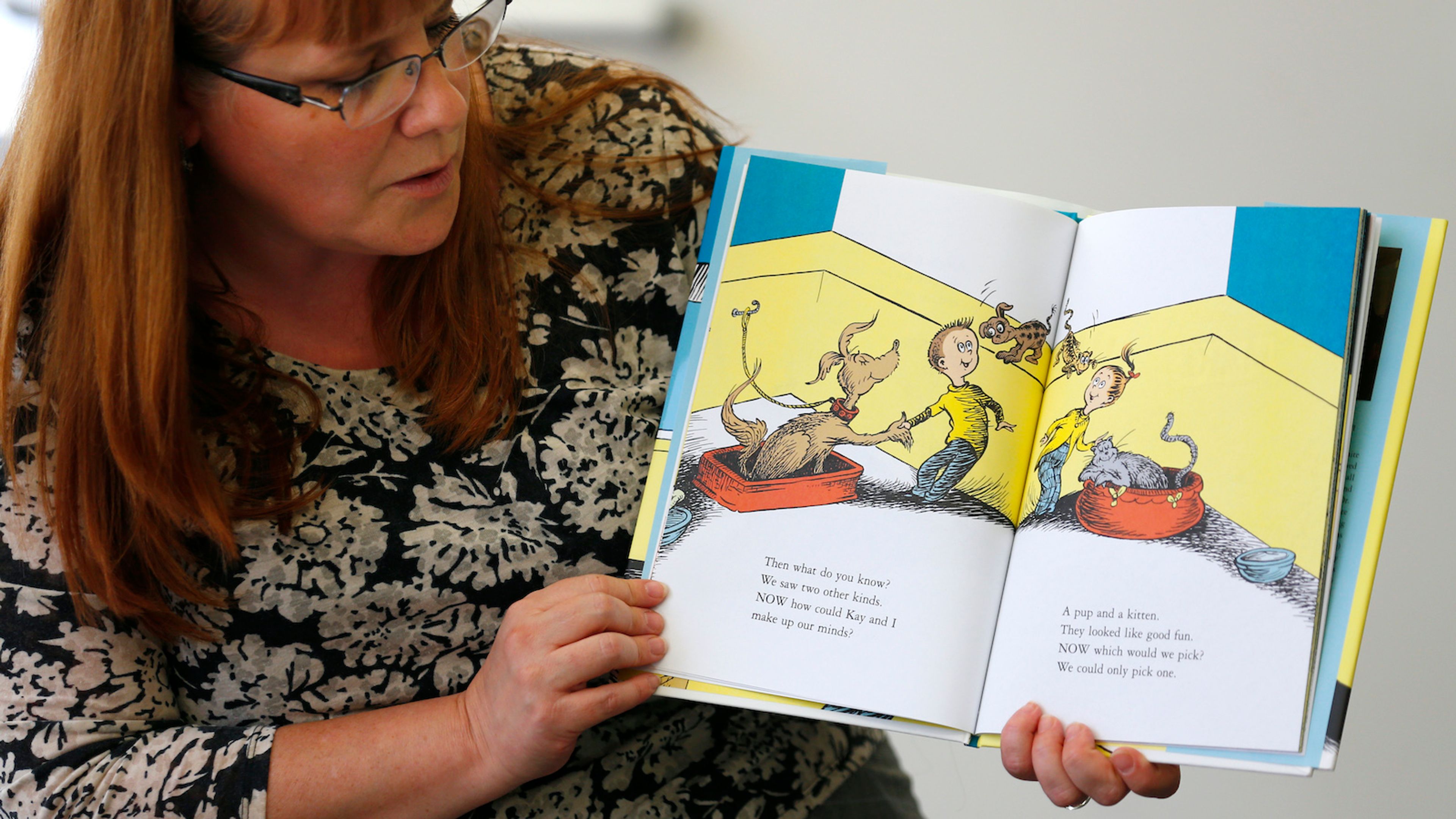
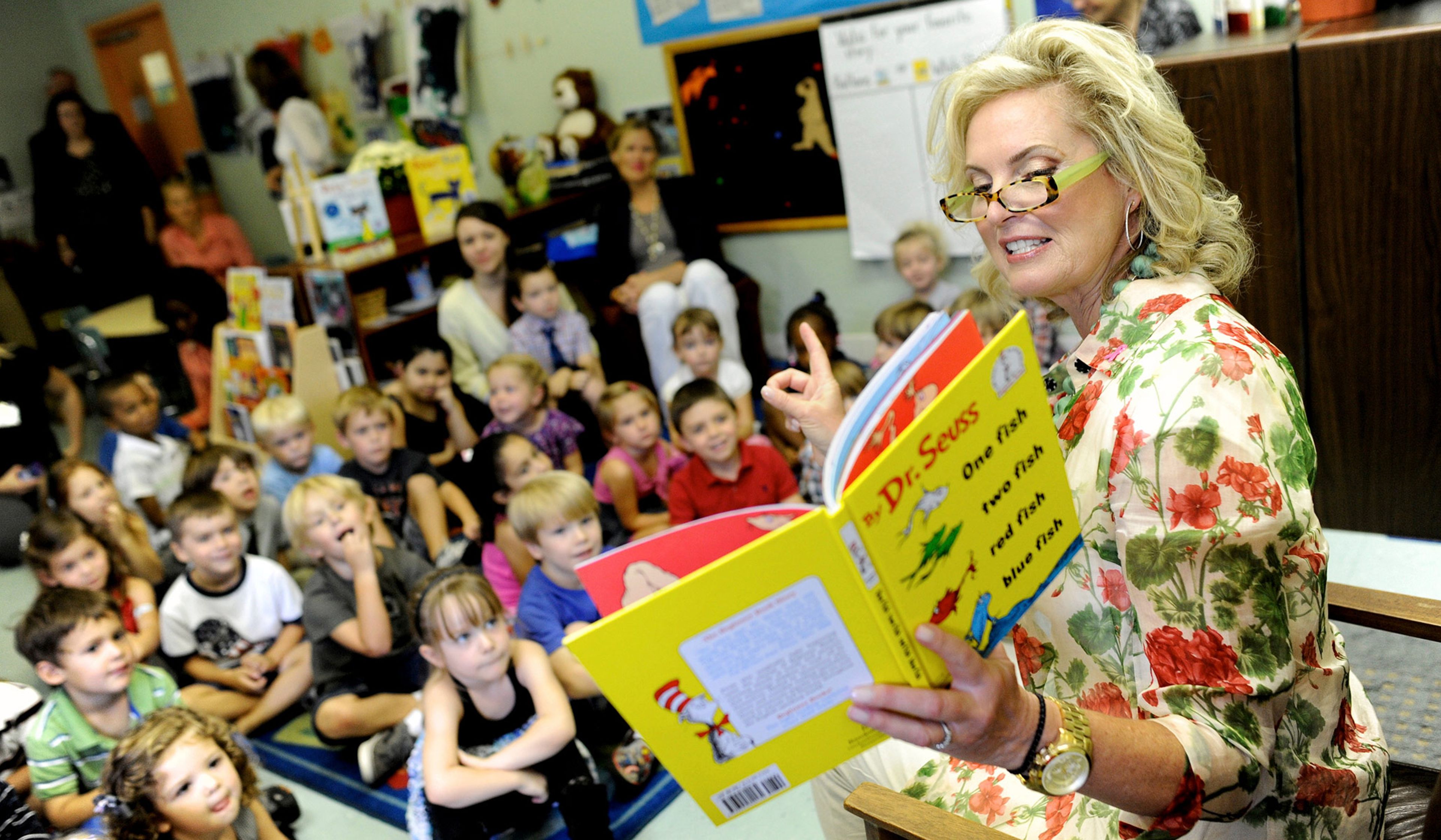
• On March 2, the 113th birthday of the late Theodor Seuss Geisel, better known as “Dr. Seuss,” the company that oversees his estate announced that it would no longer license six titles from his oeuvre of more than 60 children’s books. The publisher, Random House, has indicated its support of the decision. The problem was illustrations that stereotyped Asians and Africans, and other illustrations that, while less offensive, got lumped in with them. None of the books excised from the Seuss collection is among the most popular in it, although the axe fell on the earliest, And to Think That I Saw It on Mulberry Street (1937). Respectfulness and sensitivity are timeless virtues. Meanwhile, the common idiom of words and images we use to express ourselves is in constant flux. Honest readers try to discern the spirit in which the artist offered his creation. They don’t read into the ink on the page a statement on the moral standards of their own day, which was not his. Someday, though probably not soon, historical perspective will return to fashion. So will the art of informed interpretation. Let’s call them “Thing One” and “Thing Two.” These Things will not bite you.


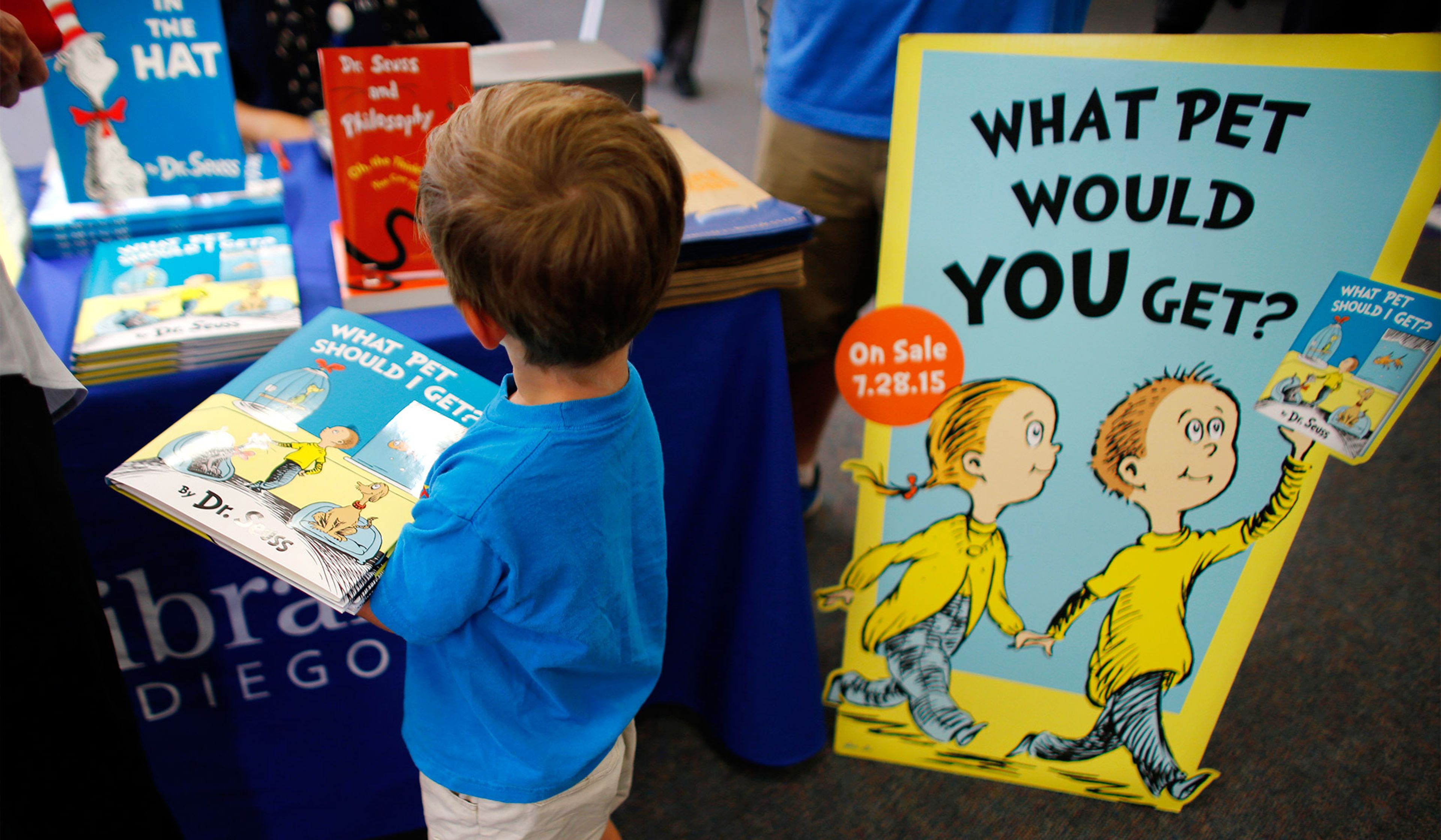

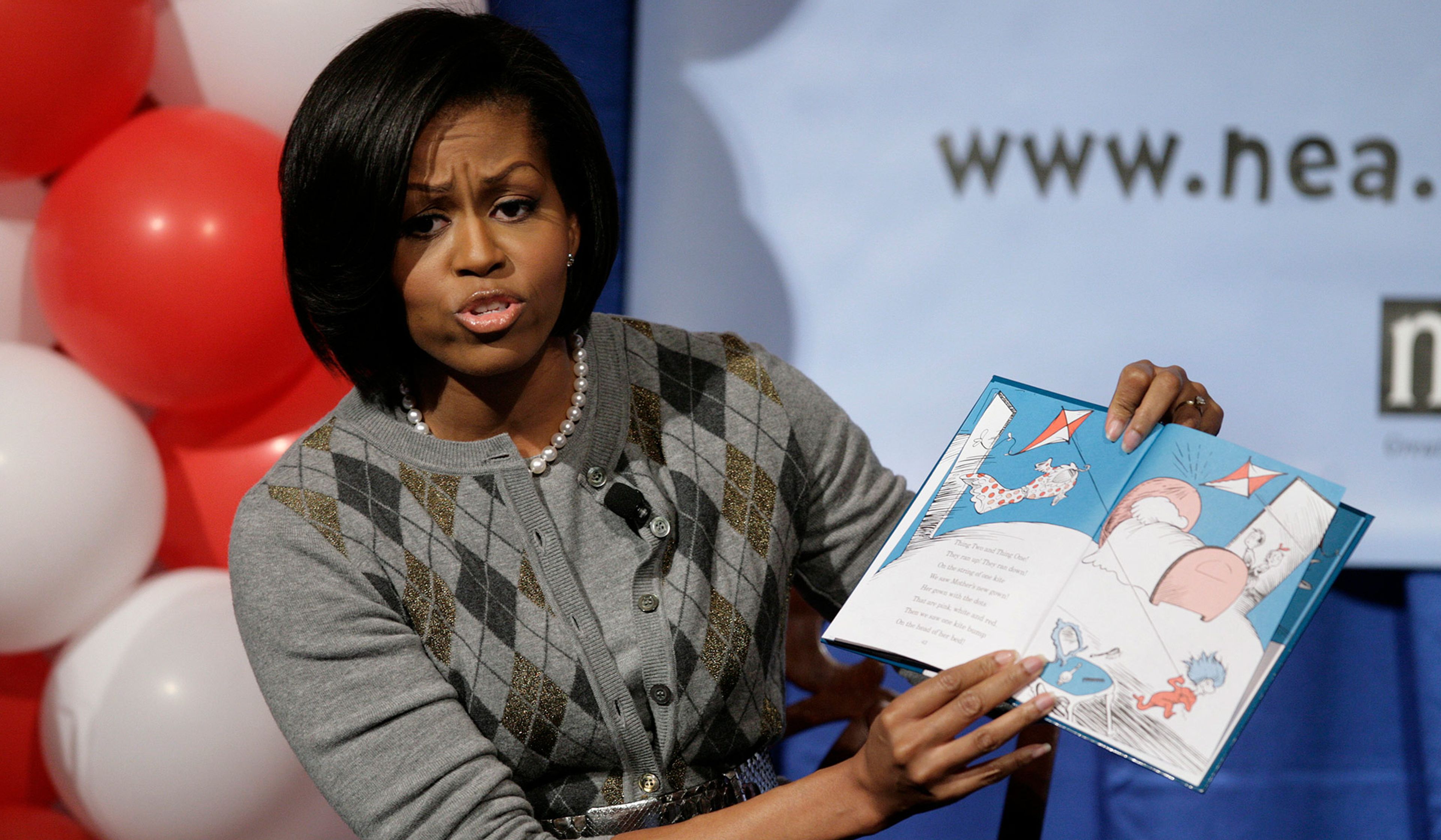



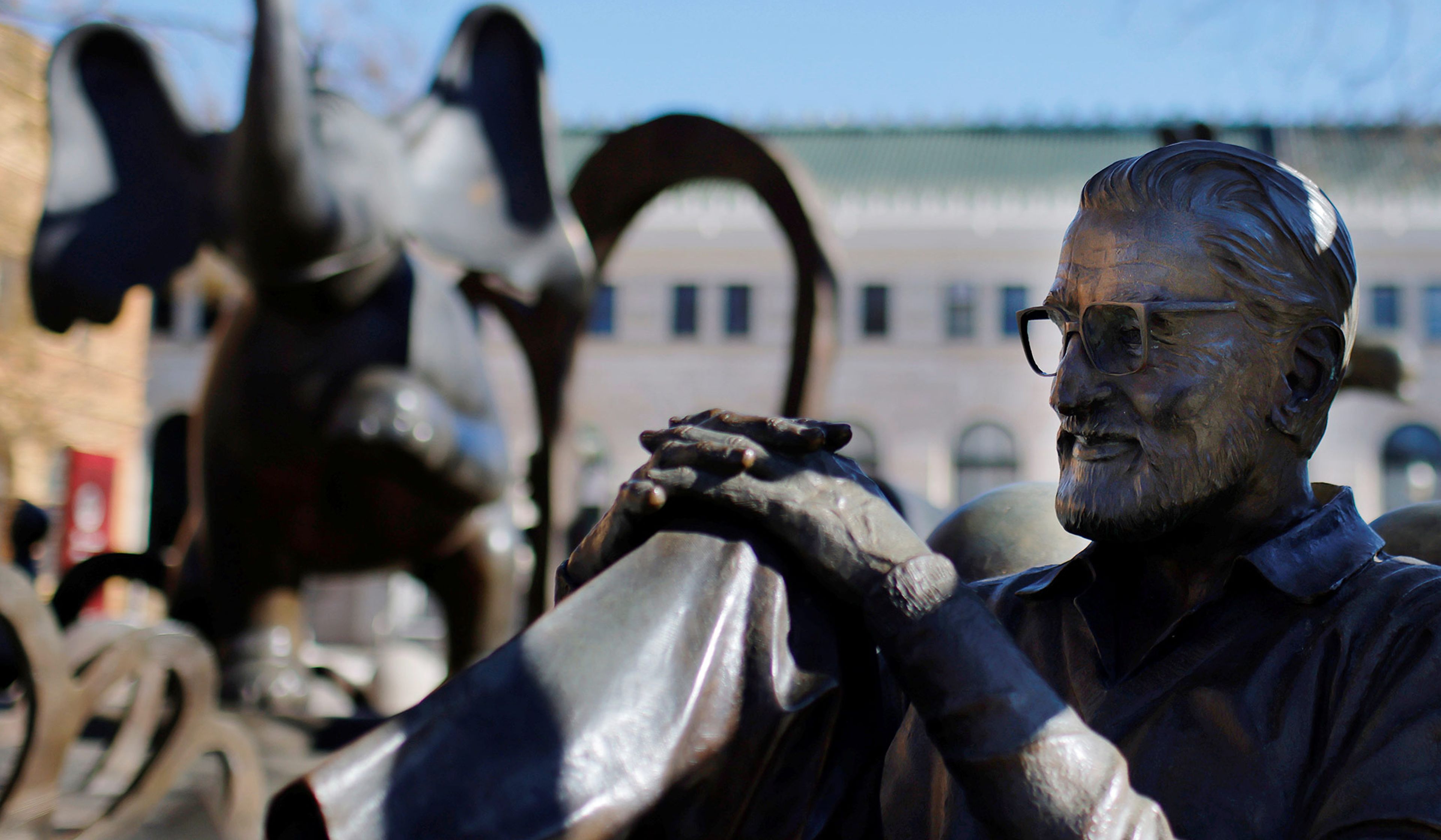
A customer looks at books by Dr. Seuss in a bookstore in Brooklyn, N.Y., March 2, 2021.
Brendan McDermid/Reuters
• Pepé Le Pew, the famously amorous cartoon skunk, has been canceled from the forthcoming remake of Space Jam. Commenting on the recent wave of cancellations, New York Times columnist Charles Blow alleged that the Gallic Looney Tune “normalized rape culture.” Pepé, you’ll recall, is always on the hunt for the object of his affection, Penelope, a black cat that he mistakes for a she-skunk. But Pepé is not the type of skunk you’d bring home to Mom: He’s odorous, a ridiculous lothario, and so full of himself that he doesn’t know that Penelope isn’t the least bit interested. Moreover, as a wannabe Don Juan, he’s a constant failure. Not only does Pepé not “normalize rape culture,” he teaches kids that if you act like Pepé, you’ll be a cad, a laughingstock, the butt of every jest — and you won’t get the girl. Only a humorless scold could miss the joke.
• No surprise, foreign-language publishers are in the market for translations of “The Hill We Climb,” the poem by Amanda Gorman, who recited it at President Biden’s inauguration. Victor Obiols had been commissioned to translate it into Catalan. No sooner did he submit his work than his publisher, Univers, rejected it, not on its merits but because his age, sex, and race were different from Gorman’s. “If I cannot translate a poet because she is a woman, young, black, an American of the 21st century, neither can I translate Homer, because I am not a Greek of the eighth century b.c.,” Obiols remarked. His work includes Catalan translations of Shakespeare and Oscar Wilde. He said he didn’t know whether the decision to remove him from the Gorman project originated with her agent. Earlier, a Dutch translator, Marieke Lucas Rijneveld, resigned after criticism that a black woman hadn’t been hired for the job. Translation, a high art that demands deep linguistic insight and intellectual agility, is supremely indifferent to the demographic identity markers of the practitioner. How can we know the translator from the translation? We can’t. To ask the question is to misunderstand what literature is.
• Roger Mudd, handsome, poised, with the lightest of Virginia accents, had a distinguished career with CBS News, covering the civil-rights movement and politics and subbing as anchor for Walter Cronkite. After the suits gave Cronkite’s job to Dan Rather, Mudd went on to NBC, PBS, and the History Channel. He endowed a professorship of ethics at his alma mater, Washington and Lee. His footnote in history came in November 1979, when he interviewed Senator Ted Kennedy on the cusp of his challenge to incumbent president Jimmy Carter for the Democratic nomination. Mudd began with a simple question: “Senator, why do you want to be president?” Kennedy’s rambling, fumbling answer, born of entitlement and perhaps unprocessed guilt over his responsibility for the death of Mary Jo Kopechne at Chappaquiddick, sank the interview. Kennedy, who had been leading Carter in the polls, struggled on hopelessly until the convention. Lesson to journalists: Never overlook the obvious. Dead at 93, R.I.P.
The Biden Crisis That Dare Not Speak Its Name
Biden officials don’t want to call it a crisis, but the challenge, matter of concern, situation, or whatever euphemistic term they are applying to the border today, is running out of control.
DHS Secretary Alejandro Mayorkas has warned that the U.S. is on pace for the biggest border surge in two decades. The trend is especially pronounced among minors. The number crossing every day has tripled since the end of last year, and thousands are being detained at Customs and Border Protection facilities longer than is usually permitted.
Indications are that parents are sending minors — sometimes traveling with them up to the border and then splitting up — in the belief that they will gain entry into the United States and never leave.
This is a well-founded belief. Only about 4 percent of minors who have come to the United States in recent years have been returned home. They are released to relatives in the U.S., who are also likely to be illegal immigrants, and even if they are eventually ordered to be removed, we don’t have the resources or the will to see that it happens.
Bad court decisions, foolhardy practices, and at least one law with major unintended consequences made it almost impossible to keep Central American family units and unaccompanied minors from gaining entry to the U.S., never to leave. Even President Trump, who won election in 2016 in large part on a promise to control the border, saw the border get swamped in 2018 and 2019 when he wasn’t able to quickly return illegal immigrants home.
But the Trump administration eventually got a handle on the crisis. It tightened up the asylum rules that were being abused by bogus asylum-seekers. He worked with Mexico to create the Migrant Protection Protocols (MPP), or Remain in Mexico policy, which kept migrants in Mexico while their asylum claims were processed in the U.S. It forged so-called safe-third-country agreements with Northern Triangle nations to provide migrants claiming persecution in their home country an opportunity to claim asylum in another Central American country.
Even prior to the pandemic, the migrant flow had slowed considerably. Finally, with the onset of COVID, the Trump administration used the Public Health Service Act (U.S. Code Title 42) basically to exclude all migrants.
None of this, it is worth noting, involved the family separations that came with “zero tolerance,” a policy that was quickly reversed.
Now the Biden administration is turning its back on what worked. It has created an exemption from Title 42 for minors. This, of course, has provided an enormous incentive for minors to show up at the border. And it has ditched MPP, thus throwing away a tool for allowing only deserving asylum-seekers into the U.S. rather than waving everyone in regardless of the merits.
It is galling that, while deliberately undoing the successful Trump policies, the Biden team is claiming that the current crisis is a function of having to rebuild from scratch an immigration system supposedly trashed by Biden’s predecessor. There are all sorts of euphemisms that can be applied to this claim, but it isn’t remotely true.
Stimulating Government
President Biden signed a $1.9 trillion spending bill, which is being described as both “COVID relief” and “stimulus” legislation. It isn’t really either one: Much of it has little to do with COVID, and the case that it would rescue a depressed economy is not strong. Since the bill narrowly passed the Senate, a third purpose for it has come to the fore. Having sold the legislation as a necessary response to a public-health and economic crisis, its fans are now saying that its great contribution to the commonweal is bringing back the New Deal. Supposedly its popularity will buoy Democrats in the midterms and its example will re-legitimate big government. The New York Times reports that there has been “a realignment of economic, political and social forces, some decades in the making and others accelerated by the pandemic, that enabled a rapid advance in progressive priorities.”
What is really happening is that progressives are building a — federally funded, over-budget — castle in the air. If Biden wants to spend even larger sums on infrastructure in future legislation, he will not have the helpful context of his first weeks in office and a continuing pandemic. And even in this bill, they were unable to secure an increase in the minimum wage, losing the votes of eight Senate Democrats and all the Republicans. (They can’t blame the filibuster for that.) Its biggest-ticket items, money for state and local governments and checks to households, will do little to expand the federal government on a permanent basis.
Meanwhile, polls continue to suggest that most Americans do not believe the federal government should grow larger and do not trust its competence. These are generalities, of course, and have in the past been compatible with public support for specific government interventions. But there is not much evidence the public is part of any grand “realignment.”
It may well turn out that voters will feel well-disposed toward the ruling Democrats over the next two years as we emerge from COVID-19. The Democrats are making a dubious bet, though, if they believe voters will be more inclined to credit them for any happy conditions because of this legislation. CNN found 61 percent support for it, yes. But CNN found 54 percent support for President Obama’s stimulus in February 2009. The Democrats still lost the House in the next election.











Comments