Although it has gone strangely unheralded so far, the United States just marked an energy milestone of great historical and strategic significance. In 2020, according to official figures, the U.S. exported more oil and petroleum products than it imported. This is the first time in generations that America has attained such qualified, but nonetheless meaningful, “independence from foreign oil.” It would have been considered impossible barely 15 years ago, when imports peaked. The transformation has greatly benefited the American economy and enabled much more foreign-policy flexibility. It is also a powerful asset for the U.S. in its competition with China.
The Biden administration should be mindful of the economic and strategic advantages that America enjoys from its new energy profile. As Team Biden charts its policy on climate change, it should be careful not to sacrifice these gains in a headlong rush toward an ambitious green agenda.
The data documenting America’s new status as a net petroleum exporter come from the U.S. Energy Information Administration (EIA), the Department of Energy’s statistical office, which reports a U.S. surplus of about 600,000 barrels per day for 2020 in international petroleum trade. Separately, trade statistics from Comtrade, the U.N.’s authoritative international-merchandise database, show the U.S. generated a trade surplus from petroleum of about $19 billion last year.
America had not experienced a surplus from petroleum trade in a very long time. The EIA was established in 1949 and at no previous point in its history did its annual estimates for overall U.S. exports of petroleum — i.e., crude oil, liquefied natural gas (LNG), and other petroleum products — ever surpass imports. According to EIA numbers, America had run an uninterrupted petroleum deficit for at least seven straight decades, from 1949 through 2019.
Earlier energy statistics for the U.S. are spottier and not wholly comparable to the EIA’s numbers, which track total physical volume. Historical U.S. trade data on petroleum, which extend back to 1882, are instead given in dollars. The EIA keeps annual physical data back to 1920 on the U.S. trade in crude oil, but crude is only one component of the petroleum business (most recently accounting for just over a third of U.S. petroleum exports in 2020).
In 1943, at the height of World War II, the U.S. exported more crude than it imported, but that was the country’s last trade surplus in crude. We have to go back to the Great Depression (1933–39) to find a peacetime period when America registered both a physical surplus in oil trade and a dollar surplus in petroleum trade — and we have to go back more than a century if we are looking for both of these in a “normal” peacetime year. Our modest 2020 petroleum trade surplus, in other words, is not completely unprecedented. Nevertheless, America’s petroleum profile in 2020 marks a symbolic departure from a much more dependent past — one with implications for the future that should not go underestimated.
Given the COVID-19 pandemic and the attendant worldwide economic crisis, 2020 was of course an annus horribilis. In that sense, it seems, like the surplus in 1943, to be an aberration. But America’s emergence as a modest net petroleum exporter is not a one-off, a black swan, or an asteroid strike. On the contrary, it is only the most recent manifestation of a steady trend — a trend that has not necessarily reached its culmination. America’s net dependence on foreign-petroleum supplies had been dropping swiftly and regularly for a decade and a half (see figure 1).
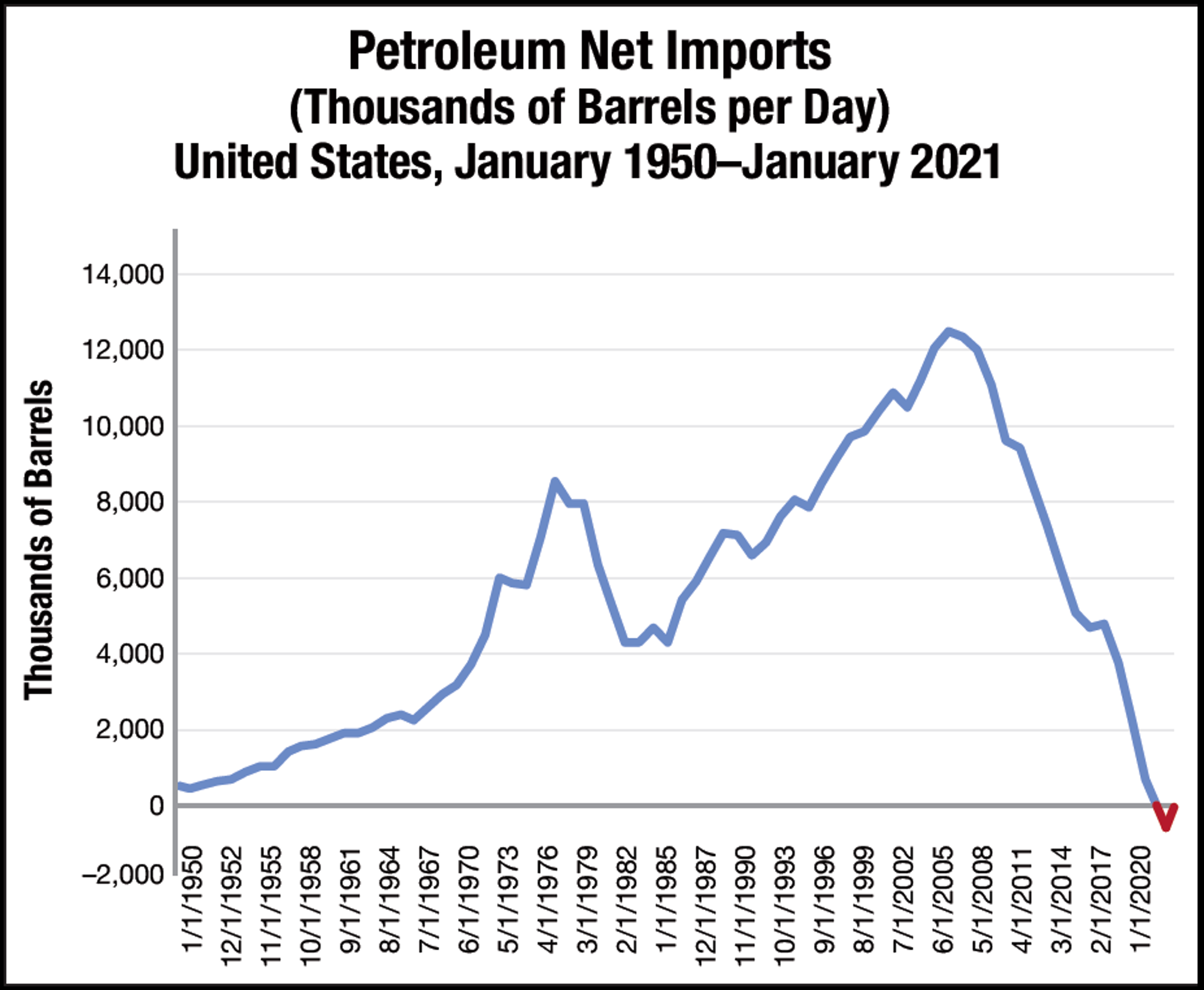
In 2005, net petroleum imports hit an all-time high of 12.5 million barrels a day. Since then, net imports have been plummeting. The trajectory for petroleum trade closely parallels that of the U.S. energy market as a whole: By the metric of BTUs of power, according to the EIA, America became an overall net exporter of energy in 2019, and added to its surplus in 2020. And given that the U.S. recovery in 2020 appears to have been more rapid than that of the world economy — thereby causing the merchandise trade deficit to expand — it is possible that the pandemic may actually have depressed America’s 2020 petroleum-trade surplus.
The saga of erasing America’s long-standing petroleum-trade deficit entails two separate but intertwined story lines. The first — the more immediate and obvious — is the remarkable surge of U.S. exports of petroleum since roughly 2005 (see figure 2).
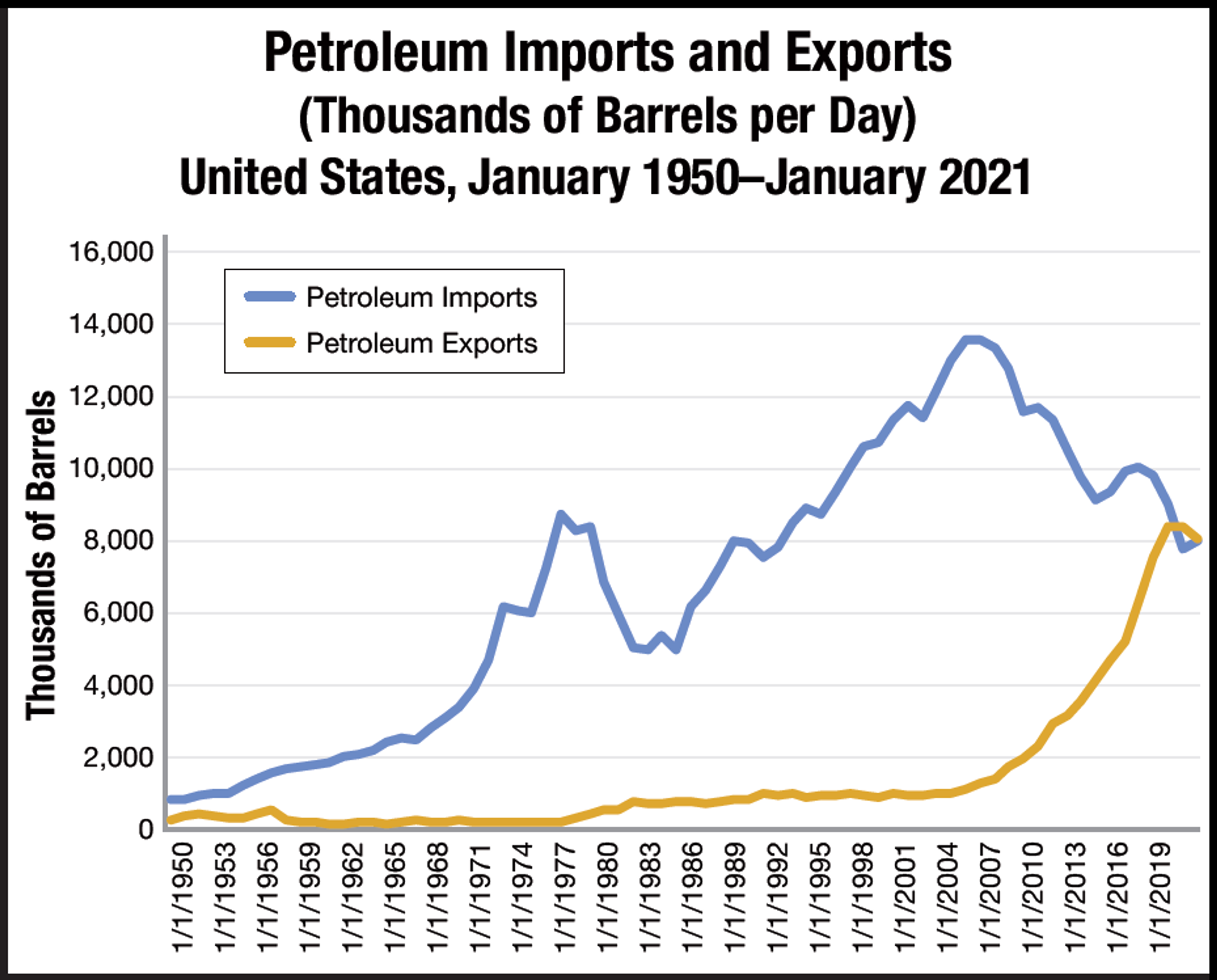
Before 2006, according to EIA data, America never registered annual petroleum exports of as much as 1.2 million barrels a day. By 2019, America was shipping nearly 8.5 million barrels a day abroad — a sevenfold increase in just 14 years. (Even in the 2020 global slump, America sold well over 8 million barrels a day overseas.) In 2004, according to Comtrade, the U.S. ranked 19th in global petroleum sales; by 2019, it had vaulted up to No. 3, behind only Russia and Saudi Arabia.
The EIA shows the surge in domestic petroleum production to be almost entirely driven by the rise of horizontal drilling and hydraulic fracturing (“fracking”) in the Permian Basin of West Texas and New Mexico, and to lesser extents in the Gulf Coast and Northern Great Plains. For dry gas in particular, shale has become the predominant source, with production increasing by more than a factor of ten from 2006 to 2020.
But the upswing in production did not eliminate America’s petroleum trade deficit all by itself: Petroleum imports fell too, and at the same time. The reasons are both the declining intensity of oil use and the higher production that enabled more exports. After reaching a zenith of nearly 14 million barrels a day in 2005, overseas purchases dropped by roughly a third — over 4.5 million barrels a day — by 2019. The January 2021 import tempo is about a million barrels a day below 2019’s and 40 percent below 2005’s, though the U.S. has not yet fully rebounded from last year’s shock.
Just to be clear: These dramatic changes in the petroleum trade do not catapult the U.S. into “independence from foreign oil” of the bumper-sticker variety. This is not autarky. The U.S. is not just an active participant in international energy markets but a top player and will likely remain one of the world’s biggest buyers of international supplies for the foreseeable future. International sourcing occurs because it permits more-specialized and more-economical use of fuel. Indeed, the U.S. still imports crude on a net basis, but those imports are more than offset by exports of liquefied gas and related petroleum products.
If trade patterns provide the arithmetic details of how America finds itself — at least for now — a net exporter of petroleum, the deeper driver is the U.S. market economy. Over the long term, this is even more important than the shale and fracking revolutions in explaining our unprecedented new energy-security situation.
Simply put: The U.S. has become vastly more energy-efficient over the past 40 years, producing more with ever less energy input. Thanks to our ongoing revolution in energy efficiency, American petroleum consumption peaked over a decade and a half ago; although our real GDP is substantially larger today than in 2005, we use a smaller absolute amount of petroleum to produce it.
The breathtaking changes that have taken place in the efficiency of petroleum use — changes still very much under way — are illustrated in figure 3, which compares petroleum consumption per dollar of U.S. GDP in the post-war era (“intensity”) with the baseline of petroleum consumption per dollar of U.S. GDP in 1970.
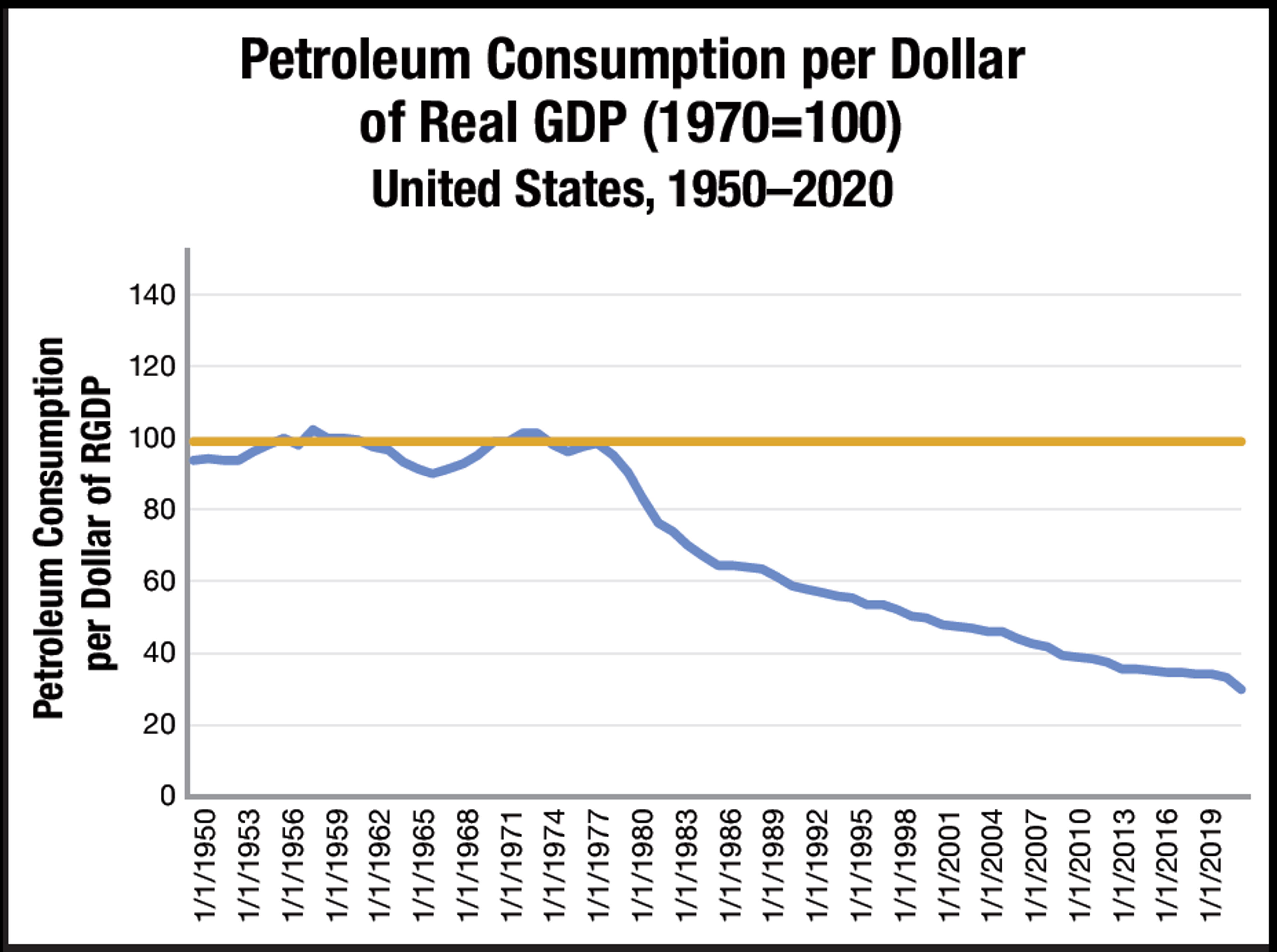
As can be seen, the U.S. experienced basically no improvement in petroleum efficiency in the 1950s and 1960s: An era of almost dirt-cheap oil offered no economic rationale for conserving fossil fuels, and environmental consciousness back then provided scant constraint on energy use. Indeed, by the first OPEC oil embargo, in 1973, the U.S. was somewhat less petroleum-efficient than it had been two decades earlier.
For several years after the initial “oil shock,” U.S. petroleum intensity remained unchanged. The shift began around 1978. The turning point was wrenching at the time, born of a sudden radical increase in energy costs, geopolitical uncertainties about future fuel supplies, and a coalescing public consensus for a cleaner environment. But the pivot was decisive. The U.S. began to economize on petroleum use and has grown ever more economical over the past 40-plus years.
On the eve of the COVID-19 crisis, in the first quarter of 2020, the U.S. required only a third as much petroleum to crank out a dollar of inflation-adjusted GDP as was needed in 1977. Over those decades, the economy doubled its petroleum efficiency roughly every 25 years. Energy-efficiency requirements, such as auto fuel-economy standards, and the arrival of imported vehicles that were more fuel-efficient played an important role. Among new personal vehicles, average fuel economy has nearly doubled since 1975.
And the transformation will continue, for two reasons. First, new and more-efficient capital, residential, and rolling stocks are still replacing existing homes, businesses, and transport fleets. Second, the U.S. is moving ever farther from the resource-intensive production of goods and toward the production of knowledge and the skills-intensive production of services.
Consider this counterfactual: If the U.S. economy had remained as petroleum-intense as it was in 1970 (or even 1977), it would have taken almost 60 million barrels of petroleum a day to churn out the country’s GDP in the first quarter of 2020. In the real world, it actually required less than 20 million barrels a day to do so. For reference, total global petroleum production in late 2019 and early 2020 was about 100 million barrels a day.
At Carter-administration levels of energy efficiency, America would have required well over half of the world’s current oil and gas output to reach its current GDP level. Nowadays, we take ongoing improvements in energy efficiency for granted. It’s worth reconsidering how truly transformational they have been — and are on course to be — in the years immediately ahead, even without new initiatives to promote additional increases in energy efficiency.
Moreover, these new patterns have effected major and highly auspicious shifts in the U.S. macroeconomy and international financial ledgers. Between 2005 and 2008, America’s net overall trade deficit in fossil fuels was running between $275 billion and $420 billion in current dollars, between 2 percent and 3 percent of overall GDP. Today, both fossil fuels and their petroleum subcomponent generate a small credit rather than a large debit in our current-account balance. Freeing up 2 to 3 percent of GDP counts as a considerable shift in resources to America’s advantage. To put that in perspective: It’s like getting an extra year of economic growth over the last ten or so years.
In addition to their sizeable economic and environmental benefits, American improvements in energy efficiency have altered the geopolitical landscape in ways that comport with U.S. interests and strengthen our global position.
The dimensions of these strategic changes are seen in the fossil-fuel trade deficits of the world’s top importers in 2019, the most recent year for which such data are generally available (see figure 4). These totals, we should emphasize, cover all supplies of hydrocarbons — coal, coke, peat, and lignite among them — not just liquid or liquefied fuels such as oil, LNG, and other petroleum products. In practice, however, these numbers provide a good proxy for the petroleum trade balance for the world as a whole and most countries in it; Comtrade reports that global coal imports accounted for less than 6 percent of global fossil-fuel imports in 2019 (about $130 billion of more than $2.3 trillion).
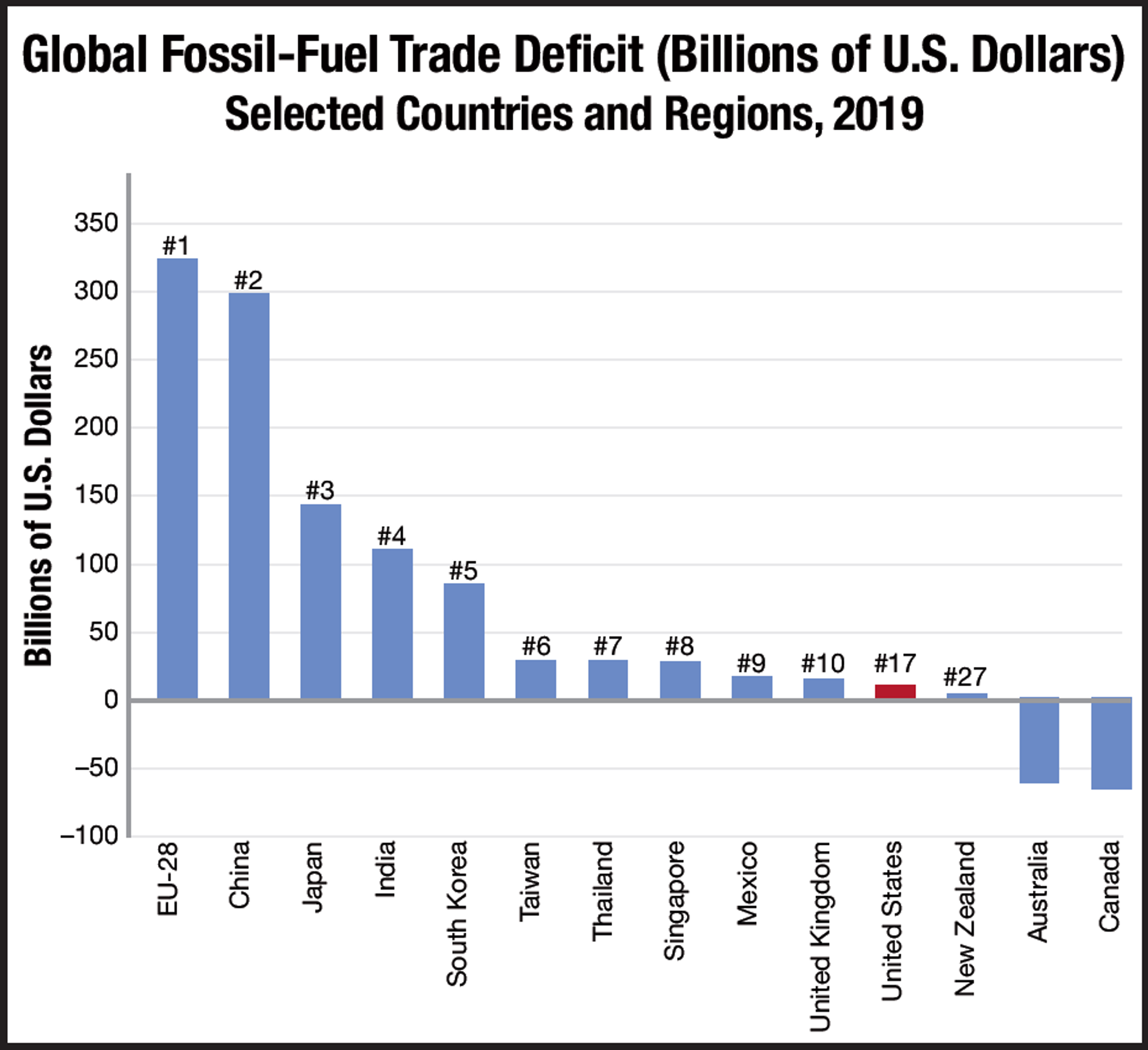
Note that the U.S. did not figure among the world’s top ten net fossil-fuel importers in 2019 — it was far down in the rankings, in 17th place, just behind Chile. (It would have been 22nd if the EU countries were counted individually.) In 2019, the U.S. still ran a deficit in the fossil-fuel trade, but it amounted to $10 billion — less than one-thirtieth of the European Union’s; less than a twenty-fifth of China’s; less than a tenth of India’s and Japan’s; and well under a sixth of South Korea’s. And those numbers predate America’s current net-petroleum-exporter status.
Regardless of whether the U.S. is a slight importer or exporter, its current petroleum profile has fundamentally changed the geopolitical facts. The strategic importance of Middle Eastern oil exports for U.S. national interests has suffered a major-league downgrade. The biggest loser here may be the House of Saud, with which Washington now has far less need to make any devil’s bargains. Between 2006 and 2019, the volume of U.S. crude-oil imports from the kingdom fell by 60 percent. Any prospective Iranian petro-leverage over the U.S. has also been quashed. The tired insinuation that U.S. policy in the Middle East is grounded in oil covetousness looks more detached from reality than ever. Needless to say, the U.S. still retains important interests in the Middle East, but whatever the American role in the Middle East should be, it no longer must be primarily driven by oil.
With respect to Europe, America’s new energy profile eases the global commercial competition for oil and gas but in other ways exacerbates the continent’s dependence on Washington. Already, NATO suffers from unresolved structural problems, as Uncle Sam’s aging and demographically shrinking treaty allies in Europe grow less willing and able to provide a common defense. Diverging energy-security futures compound these all-too-familiar asymmetries.
Estimates from Eurostat, the EU’s statistical arm, reckon the EU-28 to have been 95 percent “dependent” on foreign oil in 2018 — meaning that net imports accounted for 95 percent of overall EU petroleum consumption. By that same metric, the U.S. was 3 percent dependent on foreign oil in 2019 — and not dependent at all in 2020. Europe is thus exposed to far more risk from volatility in petro-plentiful countries but possesses limited force-projection capabilities by which it could assure safe passage in sea lines of communication in the Persian Gulf, much less in more-distant regions. Those capabilities, for now and the foreseeable future, would probably have to come from the U.S. No matter who is in the White House, such a mismatch in vulnerability and power can hardly help but tilt Europe’s “political terms of trade” toward the United States (even if it also foments European resentment and helps establish foundations for anti-Americanism).
Intriguingly, the energy-security profiles of America and its Anglophone “Five Eyes” allies are decidedly more auspicious than that of the EU. Post-Brexit Britain, with a Eurostat-estimated 29 percent oil dependency in 2018, is currently far less vulnerable to interruptions of petroleum supplies than are its continental neighbors. Australia and Canada are both net energy exporters. (The exception is tiny New Zealand, long the least invested member of the five.) New energy realities may offer America interesting opportunities for collaboration and maneuver with these old friends.
At the end of the day, of course, the U.S. shares important values with the democracies of oil-dependent Europe, just as it does with energy-insecure Japan, South Korea, and Taiwan in East Asia. No such affinities define the increasingly contentious Sino–American competition. Energy security is one aspect of that strategic balance definitively not moving in China’s favor. While the U.S. has moved toward an oil trade surplus, the People’s Republic of China (PRC) has become by far the world’s largest importer. Its crude exports are trivial, and its 2020 imports were the largest in world history, surpassing America’s peak in the mid 2000s. The PRC’s dependence on the import of crude oil exceeds 70 percent, although part of the crude is refined and used in China’s increasingly exported oil products.
China unofficially became the world’s largest natural-gas importer in 2020, with import dependence at 45 percent and rising. (By comparison, EIA data indicate that the U.S. exports roughly twice as much natural gas as it imports.) China is the world’s largest coal producer by more than a factor of four but still imported 300 million tons in 2020. American coal imports, meanwhile, are negligible.
Energy acquisitions were a driving force of Beijing’s initial “Going Out” global-investment program, which later begat the Belt and Road Initiative. China National Off-Shore Oil Corporation tried but failed to acquire Unocal in 2005; it would have been the PRC’s largest acquisition by far. Since then, energy investment and construction have led the PRC’s activities overseas, outside of trade. Fossil-fuel investment of all types since 2005 is near $350 billion in value, with oil receiving the largest share. Beijing also sponsors the building of oil refineries, gas pipelines, coal mines, and the like.
But China’s commercial investment in overseas output does not automatically make it a secure, reliable source of imports. Local instability or hesitance during a crisis can interrupt supply at the source, regardless of who actually owns a facility. Furthermore, other than those in Russia, China’s top suppliers of crude oil and liquefied natural gas must ship their product by sea. Ensuring access to these supplies in a crisis would require extensive capability to project international air and sea power. Consequently, China remains beholden to the U.S. and its allies for guaranteeing the safe passage of Chinese oil imports through international waters — and may so remain for some time to come. While the U.S. has gradually reduced its dependence on foreign oil, China remains dependent on both foreign oil and American naval power for its energy security.
Like Europe, China lacks the military capacity to protect energy imports on the scale it needs (not to mention the imports of metal ores and food on which it also depends). It has so far struggled to gain a foothold beyond its sole overseas naval base, in Djibouti, severely hindering its ability to project naval power outside its immediate backyard. The PRC is working to improve its capability to project power globally, but its military budget is constrained by an outstanding credit burden already similar to America’s even as China reports annual per capita disposable income at only $4,700 and America reports it at $53,000 (on an exchange-rate basis). Those worried about the Sino–American military balance focus on areas along the PRC’s perimeter. In light of its own energy needs and the new American energy autonomy, Beijing does not have the luxury of such a parochial perspective.
Fortunately for President Biden, he has inherited an economy that has already grown ever more petroleum-efficient over the past four decades and is on track to continue to do so, barring any egregious policy blunders. These advances, and the “petroleum independence” they have begotten, were accomplished without an expensive and administratively expansive “Green New Deal.” And these ongoing improvements in petroleum efficiency have saved the country trillions of dollars over time.
The petroleum trade balance that the Biden administration has inherited would have seemed positively Panglossian just over a decade ago. Its economic benefits include greater productivity, enhanced growth, and a more favorable balance of payments. Strategically, America enjoys the windfall of reduced dependence on autocratic petro-states, along with other geopolitical dividends from greater energy security. This reversal of petro-fortune would have been impossible without domestic fracking technology and the massive rise in production it unlocked in the South and the Great Plains.
The Biden administration has proclaimed that “tackling the climate crisis and driving a green energy revolution” will be top priorities for both its domestic and its foreign-policy agendas. But implementing such a vision will require trade-offs, as real-world policy-making always does.
Because its green plans are still full of unanswered questions and missing details, the new administration’s environmental aspirations are introducing enormous new uncertainties about the future of U.S. energy security. The U.S. is now the world’s No. 1 petroleum producer. How much of America’s newfound role as a global petroleum powerhouse will the administration be willing to trade for the prospect of attaining certain climate objectives, say, 30 years hence?
One of the key fault lines for such green policy-making runs through China. If fracking is curbed, either our petroleum independence will vanish or our domestic green-energy output must soar. The latter option will be much more difficult, protracted, and expensive if the PRC’s heavily subsidized green-energy industry is not allowed to participate meaningfully in our domestic market. But large-scale Chinese participation would subject American green-energy firms to anticompetitive practices and risk dependence on China, of all countries.
Plainly stated, an aggressive but inept climate policy risks disadvantaging the U.S. in its competition with the PRC without appreciably slowing climate change or enhancing global climate adaptation. Unilaterally restricting American economic productivity and hobbling our international competitiveness, inadvertently reducing U.S. energy security, and unintentionally creating dependence upon Beijing are among the possible adverse outcomes from a Green New Deal. Some on Team Biden may regard environmental goals as deserving absolute primacy, but the rest of us should want to weigh costs and benefits carefully. Among the many important matters in the balance is whether America’s current petro-independence, and all the benefits it brings, prove to be merely a fleeting historical moment.
— Mr. Eberstadt holds the Henry Wendt Chair in Political Economy at the American Enterprise Institute, where Mr. Scissors is a resident scholar and Mr. Abramsky is a senior research associate.














Comments