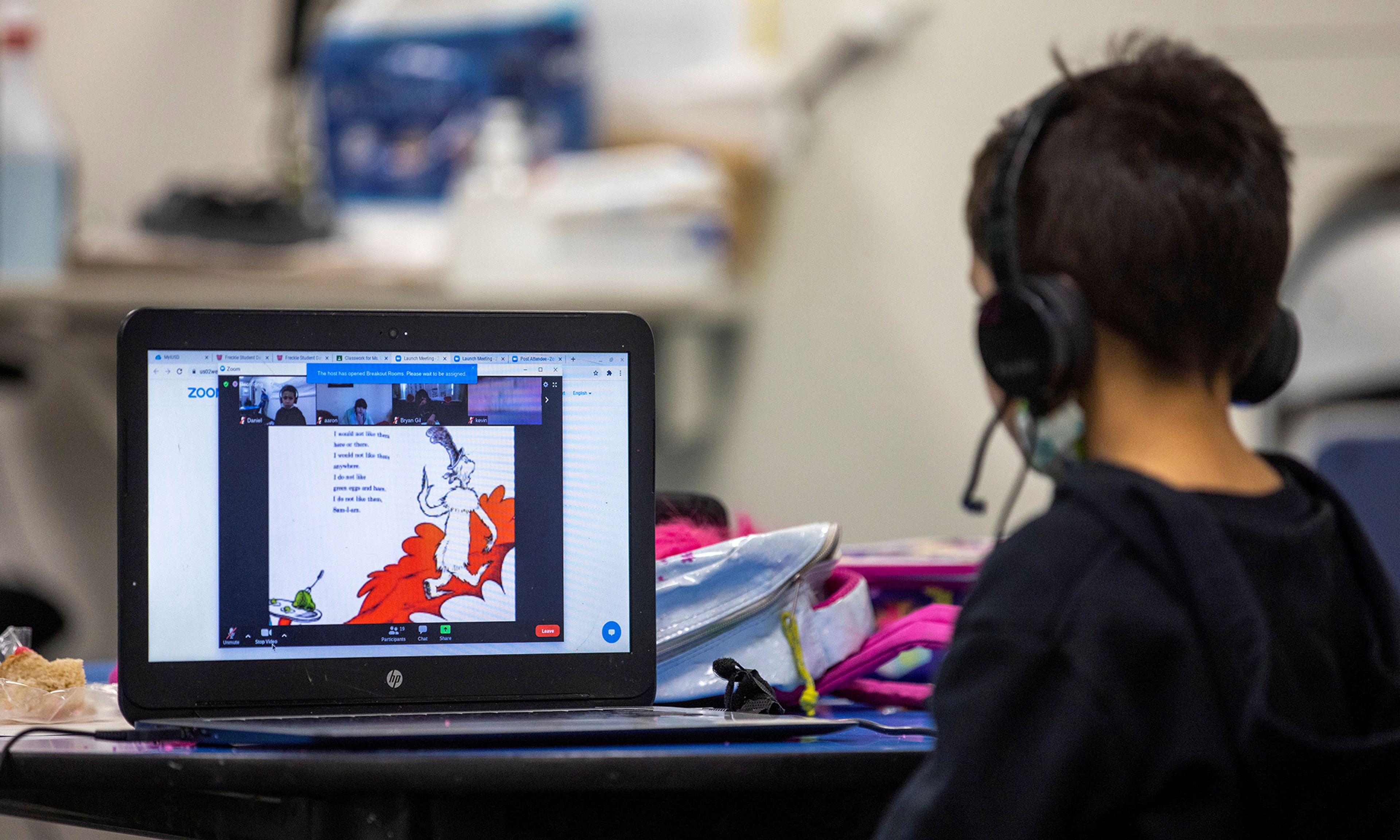
While the kids are away, the progs will play. In the midst of ongoing school shutdowns — maintained largely at the behest of the teachers’ unions — the California State Board of Education has unanimously approved the nation’s first statewide ethnic-studies curriculum for K–12 students.
Reading through the model curriculum is like sitting through a graduate course on critical race theory. Education officials charged with determining what children in the Golden State will study have decided that what is imperative, in a state in which just three in ten eighth-graders can read proficiently, is learning about “identity” and “systems of power.”
In districts that adopt the new ethnic-studies curriculum, students will learn to “critique empire-building in history and its relationship to white supremacy, racism and other forms of power and oppression”; they will “challenge racist, bigoted, discriminatory, imperialist/colonial beliefs and practices on multiple levels”; and they will “conceptualize, imagine, and build new possibilities for a post-racist, post-systemic racism society that promotes collective narratives of transformative resistance, critical hope, and radical healing.”
Students will, that is, be taught a neo-Marxist theory of intersectionality that sorts them into multiple categories according to race, gender, sexual orientation, and class, to determine how these designations interact to magnify either victimhood or privilege.
This will prepare students for the ethnic-studies course that is now mandatory in the California State University system, as a result of legislation signed into law last year by Governor Gavin Newsom.
If public education is now geared toward preparing young minds to filter everything through the lens of identity politics, perhaps the unions are doing children a service by keeping schools closed.
In all seriousness, California remains one of the most locked-down states in the country, with the lowest percentage of students in any state having access to in-person instruction. The “Return to Learn” tracker developed by the American Enterprise Institute rates California as the most cautious state in the country when it comes to reopening schools, with just 9.5 percent of school districts in the state operating fully in-person.
The teachers’ unions bear much of the blame. As researchers Corey DeAngelis and Christos Makridis recently found, there is a strong negative correlation between teachers’-union strength and school reopening. In states such as California with politically powerful teachers’ unions, districts are much less likely to offer in-person instruction. The Los Angeles teachers’ union has tied its opposition to an effort to extract political concessions — such as defunding the police and Medicare for all — that have nothing to do with education.
In San Francisco, the city sued the school district for refusing to provide in-person learning to children. Sadly, that suit was catalyzed by the high number of children in the city identified as suicidal, part of a disturbing nationwide trend. The Centers for Disease Control reports increases in the percentage of children admitted to the emergency room for mental-health reasons. Pediatricians are reporting weight gain among children, putting them at greater risk of diseases such as diabetes, because they’re exercising less and often eating more while at home, all while being in front of a screen for hours each day.
In California, most students have been out of school for over a year now. Imagine how consequential that would be for anyone at age 13, 14, or 15. It’s not just the academics; it’s the missed school sports, the potential for high-school athletes to miss out on college scholarships, and the lack of counseling, access to friends, conversations with teachers, homecomings, and proms. An estimated 3 million children haven’t shown up for in-person instruction or logged on to online classes since last March.
Before the pandemic, just 30 percent of California eighth-graders could read proficiently — a figure that falls to 19 percent for Hispanic students and 10 percent for black students. Math outcomes are no better, with 29 percent of California eighth-graders overall reaching proficiency — and just 15 percent of Hispanic students and 10 percent of black students.
In fact, things are so bad that in 2018, a group of teachers and students sued the state because the students hadn’t been taught how to read. They won their case, which resulted in a $53 million settlement to the state’s lowest-performing schools.
But additional funding is unlikely to rectify what ails education in California. Reported per-pupil spending exceeds $12,100, but that figure does not capture costs associated with capital expenditures or construction. The California Policy Center estimates that when all expenses are included, California is likely spending north of $20,000 per pupil per year.
Ever-increasing spending and the pivot to adopting an exceedingly woke curriculum suggests that California officials are not really interested in fixing the state’s deep-seated education problems. If they were, the legislature wouldn’t have put in place a law in 2019 that allows districts that can demonstrate financial distress to deny a new charter-school application. And it certainly wouldn’t have enacted what is effectively a charter-school moratorium last year.
The legislature passed a budget that freezes funding for charter schools in the middle of a pandemic, capping funding at 2019–20 levels, when many students stuck with virtual-only education have been looking for alternatives. As education analyst Larry Sand notes, “had the legislators not done that, charter school enrollments would undoubtedly be surging now.”
The state’s capacity to fail children year after year is a function of families’ having few if any alternatives.
Elsewhere in the country, state legislatures are collectively undertaking one of the biggest expansions of school choice in history. On March 29, West Virginia governor Jim Justice signed into law the most expansive school-choice program in the country, a universal education-savings-account option. Students will be able to use their state per-pupil funding for tuition at private schools, for online programs, to hire private tutors, to purchase textbooks and curricula, and for a host of other education services and products.
Kentucky followed suit the same day, when the legislature overrode Governor Andy Beshear’s veto of a bill creating the Bluegrass State’s first school-choice program — a tax-credit-funded education savings account (ESA). Students from families with incomes below 175 percent of the federal poverty line will have access to the new ESAs.
An unprecedented 29 states have already introduced similar measures this year, working to create or expand vouchers, tax-credit scholarships, and ESAs. For families, these are lifelines to education opportunities foreclosed to them in their assigned public schools; they are tickets to schools that are safe, effective, and, critically, the right fit.
In California, school choice would break the power of the teachers’ unions, which, considering the subpar academic outcomes that persist, should have little say in education policy. Until California is willing to buck the unions, families will continue to play second fiddle when it comes to education.
On another level, school choice is anathema to California because it would undermine the goals of those who propound critical race theory. These adherents to identity politics, who define progress by growth in groupthink and expansions of the state, will remain impediments to policies that respect individual family choices and education freedom. After all, teaching students that they’re either an “oppressor” or one of the “oppressed,” that they have little capacity to determine their future because the color of their skin has already charted their course, or that they are privileged or victims owing to insurmountable societal structures — well, that all leaves little room for independent thinking, hard work, and individual aspiration.
In other words, the characteristics so many private schools are so good at fostering.











Comments