On February 2, before 7 a.m., police in Minneapolis carried out a no-knock warrant at the apartment of Amir Locke, killing him. Locke was not named in the warrant. He was a licensed gun owner who reached for his gun in the confusion of waking up on his couch to find a group of people in his house yelling and cursing at him. It’s absolutely right that much of the coverage of this story should deal with the wisdom of the no-knock warrant, a fairly recent invention by a congressional aide that has caused multiple innocent deaths, most prominently that of Breonna Taylor.
Both of these cases, as well as that of Philando Castile, who was killed during a regular traffic stop, involve black licensed gun owners who did what anyone else would do in their situation. Castile explained to the officer that he was a licensed gun owner to stave off any panic the officer might have felt, but was shot anyway when he reached for his wallet. In the case of Taylor, her boyfriend shot at what he assumed were home intruders during a no-knock raid that turned out to be based on an illegal warrant.
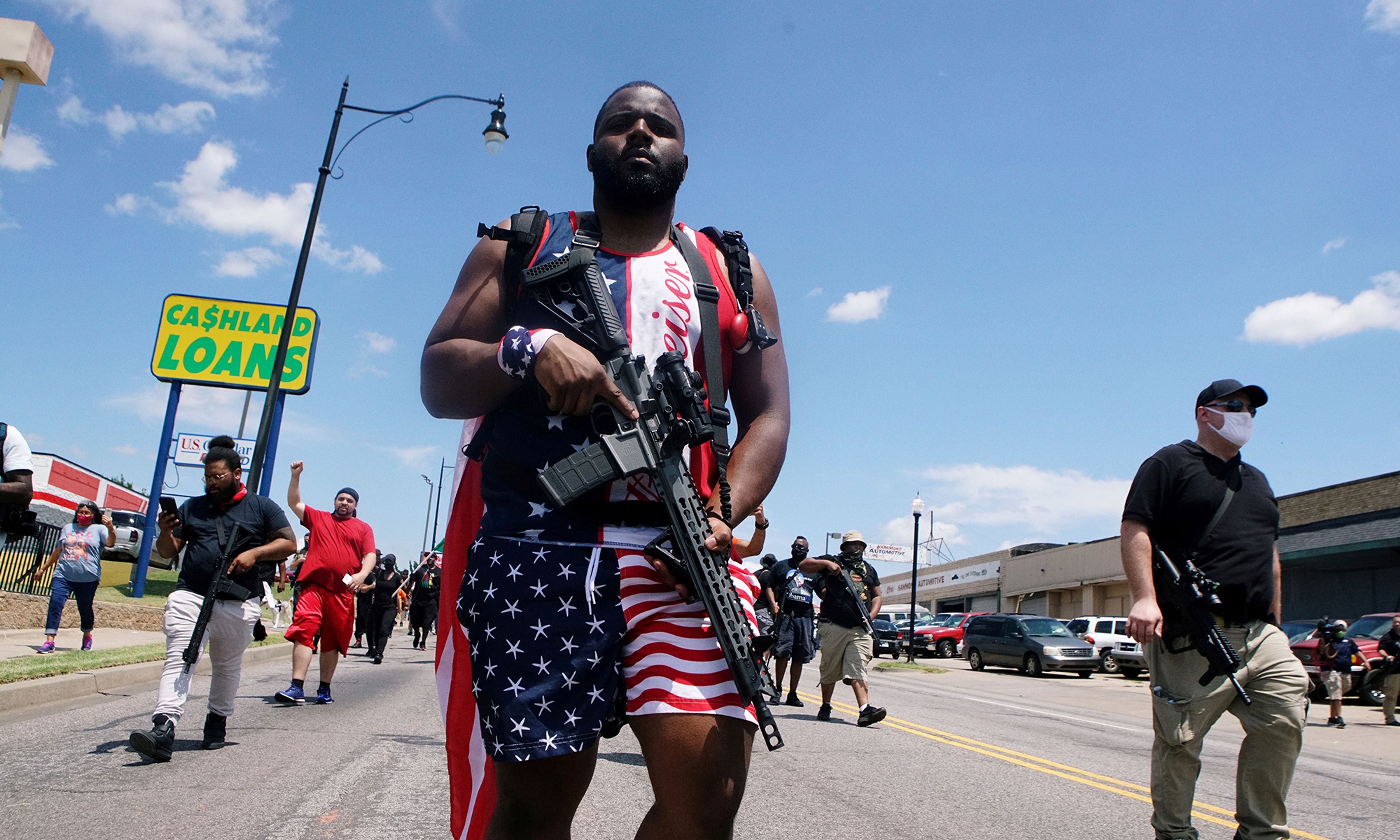
While all three cases ended tragically, they remind us that the right to bear arms is a distinctive part of American legal history and culture — and that black Americans have experienced the constant abrogation of this right throughout our history. During the Revolution, white men were required to own a gun for service in the militia. But as we explain in our forthcoming book Black Liberation Through the Marketplace, black men — even free ones — not only were not required to do so, but were often banned entirely from gun ownership. After emancipation, laws prohibiting black gun ownership joined “pig laws” (under which the theft of a single farm animal was considered grand larceny), vagrancy laws, and other trumped-up or overblown restrictions that allowed law enforcement to gather up black laborers for work in mines and on farms under the convict-leasing program. The fact that practically all white males and many white females were armed in the late 19th century did not stop thousands of black men from being arrested for this “crime” and sentenced to hard labor and, in many cases, death by malnutrition and disease.
Although the right of all citizens to bear arms is enshrined in the Second Amendment, the mere appearance of armed black men attempting to protect either their own property or other black people from lynching has often aroused their white neighbors to murderous rage. When armed black men showed up to protect Dick Rowland from being lynched in Tulsa, Okla., in 1921, the white townspeople reacted by massacring hundreds of their neighbors and burning down Greenwood, the wealthy black part of town. Two years earlier, in the Red Summer of 1919, black World War I veterans took up arms to defend their neighborhoods after several race massacres had occurred across the country. It may be impossible today to ascertain the number of lynchings or full-blown massacres that were prevented because the black population was effectively armed and made sure the aggressors knew it. The best-known example is the case of North Carolina’s Robert F. Williams, who in the late 1950s organized a chapter of the National Rifle Association to resist the terror of the KKK at the height of the civil-rights movement.
Ida B. Wells, a prominent black journalist, recorded the story of a white business rival of the black main owner of People’s Grocery in Memphis. In 1892 he used racial tensions in the city as an excuse to storm into the store and accuse one of its clerks of hiding a “black mob.” He continued to harass the store and its owners, both socially and legally, until they became alarmed enough to post security guards outside the store. When armed and recently “deputized” white civilians approached the store, shots were fired, causing a few injuries. Whites not only called this a “bloody riot” in the press but looted the store, arrested 30 black men, and killed three of the store’s owners, gouging out the eyes of one of them in the process. The courts disbanded the all-black militia.
The point of reviewing such stories is not only to draw attention to the horrors of lynching, but also to see how black Americans developed their own business properties and attempted to protect them the only way they could, through force of arms. Wells wrote:
The City of Memphis has demonstrated that neither character nor standing avails the Negro if he dares to protect himself against the white man or become his rival. There is nothing we can do about the lynching now, as we are outnumbered and without arms. The white mob could help itself to ammunition without pay, but the order was rigidly enforced against the selling of guns to Negroes. There is therefore only one thing left that we can do; save our money and leave a town which will neither protect our lives and property, nor give us a fair trial in the courts, but takes us out and murders us in cold blood when accused by white persons.
Nevertheless, black Americans never backed down. T. R. M. Howard hosted early civil-rights planning meetings in which the participants were heavily armed. As in the cases mentioned above, there was never any intention of committing unnecessary violence; the point was simply to establish that black people would not be intimidated into giving up their rights to security and legal justice. When Emmett Till’s family was traveling back and forth to court for the 1955 trial of his murderers in Mississippi, Howard protected them on his estate with armed security guards. Martin Luther King Jr. made a strong distinction between personal self-defense and the strategy of nonviolent political action: He had guns in his home and was often surrounded by armed men when in public.
The black nationalism of the Black Panthers — otherwise known as the “Black Panther Party for Self-Defense” — couldn’t be further from our own vision of building a future for black and white Americans together. But they weren’t wrong that law enforcement in certain cities was not trustworthy in 1966. When the Panthers started placing armed patrols in neighborhoods known for police abuse, the overwhelmingly white state legislature proposed the Mulford Act, named for Oakland assemblyman Don Mulford, which prohibited carrying loaded firearms in public spaces. The media dubbed it the “Panther Act” in spite of Mulford’s claim that it wasn’t racially motivated, and indeed, most of the examples cited in favor of the bill involved the Panthers, even though there were many armed groups at that time.
The Mulford Act, signed by Governor Ronald Reagan, opened the door to the federal Gun Control Act of 1968, which prohibited former felons, among others, from owning guns and introduced background-check requirements. The use of gun control as a way to oppress black men has now turned into a significant element of our mass-incarceration crisis, as black men are far more likely to have gun charges stacked onto other charges (whether or not the gun was involved in the crime) or be sent back to prison for owning a gun, even if no other crime was committed. Given the dangers many people face in destabilized neighborhoods, it is unsurprising that even well-intentioned citizens returning from prison may choose to arm themselves.
In 1962 Robert F. Williams found support from the NRA, but by 1968 the organization was supporting the Gun Control Act, and it has been silent when the gun rights of black Americans have clashed with police tactics. In contrast, Gun Owners of America reiterated its ongoing concerns that no-knock warrants are incompatible with the right to self-defense. Every American has the right to defend himself or herself against violent aggression, and conservatives need to defend this right consistently, no matter who the aggressors may be.
— Rachel Ferguson is a professor in the College of Business at Concordia University Chicago, where she directs the Free Enterprise Center. Marcus Witcher is an assistant professor of history at Huntingdon College and the author of Getting Right with Reagan: The Struggle for True Conservatism, 1980–2016. Their book Black Liberation Through the Marketplace: Hope, Heartbreak, and the Promise of America will be published this spring.












Comments