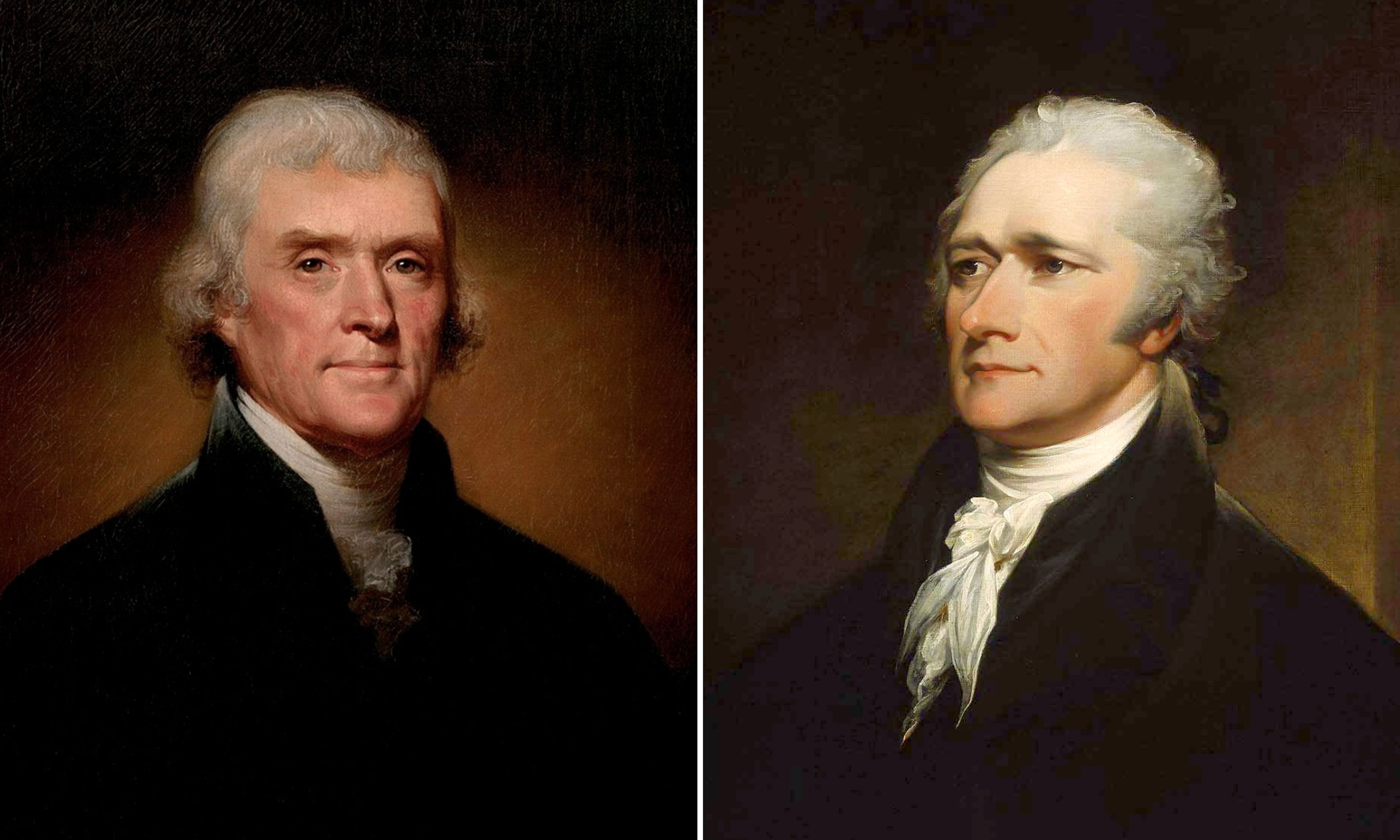
The American founding was a synthesis of two competing political visions: the nationalist, centralizing, and commercial scheme of Alexander Hamilton, and Thomas Jefferson’s devotion to freedom, states’ rights, and agrarian simplicity. As Jeffrey Rosen points out in his new book, The Pursuit of Liberty, America’s governing principles were forged in the heat of fierce partisan strife between Hamiltonian Federalists and Jeffersonian Democratic-Republicans. The tension between Hamilton and Jefferson, moreover, still haunts and invigorates American political life, their competing positions “like golden and silver threads woven throughout the tapestry of American history, sometimes side by side, sometimes crossing each other, and at critical moments, pulling so far apart that they threaten to snap.”
About half of Rosen’s book is devoted to the battle between Hamilton and Jefferson and between their immediate followers. The second half outlines the afterlife of this struggle, including a survey of the many invocations of Hamiltonian and Jeffersonian positions over the past 200 years of American history, as well as Rosen’s own interpretation of these events, ranging from the scholarly to the humorous. For example, Rosen calls “improbable” the suggestion by Bill Clinton that Jefferson would have supported a federal mandate for health insurance because “he cared a lot about his health.”











Comments