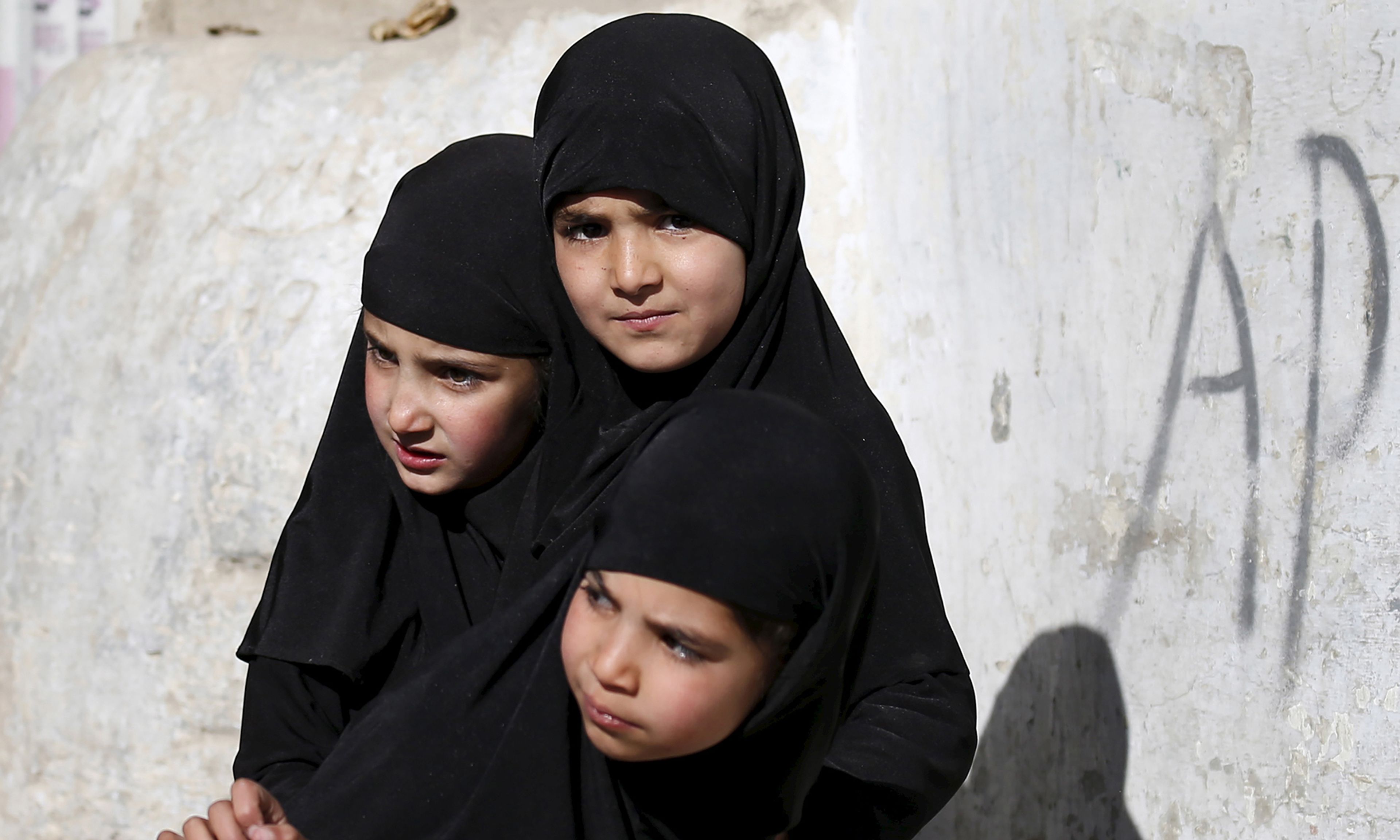
On Sunday, August 15, the Taliban entered Kabul, the capital of Afghanistan, and quickly took control of the city. Haunting images and videos depict the desperation of the Afghans trying to flee as the Taliban returns to power. There is grave concern for what the Taliban’s swift takeover will mean for the future of religious and ethnic minorities and especially for a whole segment of the population rendered vulnerable by their takeover –– women and girls.
Zabihullah Mujahid, a Taliban spokesperson, said in a press conference from Kabul that “the group would honor women’s rights and an independent media, but within the ‘frameworks’ of Islamic law.” He went on to promise that “there will be no violence against women” and that “women would be allowed to work and study.” Despite this lip service, the older generation of Afghans remember the oppressive conditions for females when the Taliban took control in 1996.
At that time, Taliban leaders declared an Islamic emirate, imposing a harsh interpretation of the Koran and enforcing it with brutal public punishment. They pledged to put Islamic values first and to battle corruption. During the Taliban’s reign of terror, women’s basic freedoms “were severely restricted, other human rights were limited and executions were carried out in public,” according to a news report in Axios. Women were barred from attending school, from working outside the home, and from leaving the house without a male chaperone. Widows couldn’t work and begging was their only means of survival. Underground schools formed for girls, as older women quietly defied the Taliban’s brutal oppression of women.
Not only is Afghanistan a dangerous place to be a woman, it’s also an extraordinarily dangerous place for Christians. According to Open Doors USA’s annual World Watch List, the second-most dangerous place to be a Christian in the world is Afghanistan, only very slightly less oppressive than in North Korea. It’s nearly impossible to live freely as a Christian in Afghanistan, as Christian converts must either flee or risk facing “honor” killings at the hands of their Muslim family. Sadly, the intense persecution of Christians has not diminished over the past 20 years. While Afghans were able to enjoy other types of liberty, religious freedom was not upheld or protected.
Another recent report from Open Doors details global trends regarding gender-specific religious persecution. The report found that “given the very weak role women play in Afghan society, women who convert to the Christian faith are prone to even more pressure and harassment than men. They can be sold into slavery or prostitution, forced to marry much older men, be deprived of food and water and healthcare, locked into rooms, beaten severely, burned or sexually mishandled.” Politicians and historians will debate the merits of the Afghan war for decades to come, but we should all agree that these women and girls deserve basic and fundamental rights and freedoms.
When the U.S. liberated Afghanistan in 2001, women began to enjoy newfound freedoms, and today’s generation has known only a life free of such harsh restrictions. These young women are in their late teens and early 20s, with their whole lives ahead of them. The spark of liberty had been introduced with America’s intervention, but now, with the Taliban retaking power, that flame has grown dim.
While the Taliban has publicly insisted that women will be allowed to work, recent actions have spoken louder. According to Reuters in July, Taliban forces “walked into the offices of Azizi Bank in the southern city of Kandahar and ordered nine women working there to leave.” The women were then escorted by the gunmen to their homes, instructed not to return, and informed that their male relatives could take their place.
Annie Pforzheimer, the deputy chief of mission at the embassy in Kabul in 2017–18, told journalists that the Taliban will now reimpose restrictions on women and that there “should be absolutely no illusion that they have changed.” According to a recently released report from the United Nations, the number of women and children killed and injured increased in May and June — the same time the Taliban began to gain control.
As a Christian woman, I am compelled by my faith to speak up on behalf of persecuted and vulnerable people (Proverbs 14:21). Scripture is explicit and clear: Every human is made in God’s image and has innate dignity and worth. Women are not second-class to men, rather they are intrinsically valuable and worthy to God. Right now, Afghan women are particularly vulnerable. We must follow the example laid out in Proverbs 31:8–9 and “open our mouth for the mute, for the rights of all who are destitute. Open our mouth, judge righteously, defend the rights of the poor and needy.”
Jesus’s interactions with women were countercultural as he repeatedly demonstrated the inherent value of women. Katie McCoy, the director of women’s ministry for the Baptist General Convention of Texas, has written that “Old Testament law restrained powerful men and defended vulnerable women. God’s laws express His values.” God cares deeply about women, and so must we. Our willingness to advocate on behalf of the most vulnerable and marginalized people speaks volumes to the watching world about who God is and what He cares about.
The essence of the gospel message is that we had nothing in ourselves to enable us to atone for our sins. By believing in the finished work of Christ on our behalf, we received the most precious gift — eternal salvation. As followers of Christ, we should seek to care for both body and soul of our neighbors, even those in faraway contexts. We, who have been entrusted with much, ought to freely sacrifice for the good of our neighbors. May we endeavor to pray for the souls of Afghan women, plead on their behalf to world leaders, and, in doing so, carry forth the good news of the gospel that motivates us.
Because Scripture so highly prizes women, we must endeavor to uphold their dignity and worth in every corner of the globe. May we pray for women and girls in Afghanistan, and around the world where women’s basic human dignity is degraded. May our voices be raised to speak up on behalf of Afghan women and little girls.
They are precious in His sight.





Comments