What Ukraine Can Teach a Conservative
Written by Cole S. Aronson
Gleanings from a visit to a country under siege
Share this story
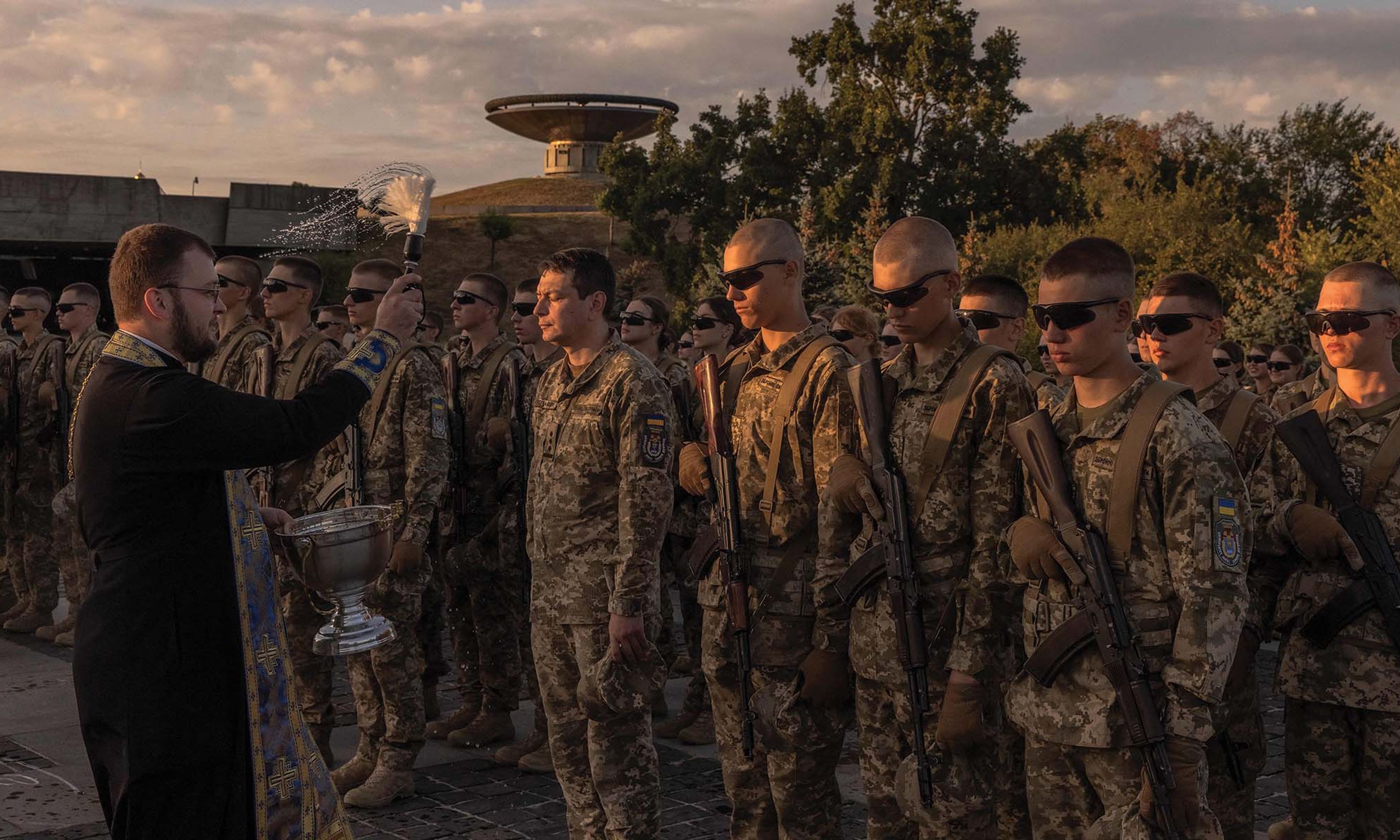
Ihave just completed two months’ travel in Ukraine, where I saw much for an American conservative to love. Ukrainians are a traditional people of many ethnicities and religions, yet more and more they speak one language. Ukrainians want a decent, self-governing society, rather than a vassalage of a tyrannical nation that, while sharing much with them, has never respected them. Western arms enable Ukraine to repel Russia’s invasion only because enough of Ukraine’s ordinary men are willing to bear arms in battle, and because their friends and families are moved to assist their sacrifices.
How the American and Russian governments talk about the present war seems almost designed to lessen Western conservative support for Ukraine. President Biden and other Democratic officials say that aiding Ukraine supports “democracy” against “authoritarianism.” They are right, and would find more eager allies if the same language weren’t so often used just to praise liberals and damn conservatives for things that have little to do with democracy and authoritarianism. Vladimir Putin and Patriarch Kirill of the Russian Orthodox Church follow almost the opposite strategy, summoning the revealed will of God to defend the invasion.
Supporters of traditional states should not abandon Ukraine, and not only because if the Ukrainians lose Kyiv, Americans may be called to defend Warsaw or Riga. The Ukrainian people themselves, through their principles and in their examples, would forward conservative aims in Europe and in America’s ranks of allies.
Two ubiquitous symbols in Ukraine are the flag and the cross. The former appears on numerous buildings and most of the graffiti in Odesa, a once-Russified city whose churches and port have been bombed in recent months. The first advertisement I noticed after entering from Moldova depicted Mary holding baby Jesus and surrounded by doves next to the national flag. The grandest buildings in every city are churches; in Lviv the elegant jewelry merchant in the center of town has Christian depictions on the outside and a handsome case of crosses right at the front.
[slideshow slideshow="1540693" /]
Vladimir Putin and his colleagues say Russia wants to save Ukraine from secularism. But Ukrainians go to church at much higher rates than Russians do, have become more religious in recent years, and are more religious the farther they live from Russia. Russian Orthodoxy is effectively a state creed, but Ukraine’s own religious tradition is conservative and patriotic and ecumenical all at once. The Ukrainian Greek Catholic Church, with many believers in the western regions of Galicia and Volhynia, produced nationalist heroes and kept liturgical Ukrainian alive when the Soviets forcibly submerged Ukrainian Christianity in the Russian Orthodox Church. Together with the larger Orthodox Church of Ukraine, the UGCC has sent hundreds of priests to the front lines. The Catholic university in Lviv has become one of the country’s foremost institutions of learning, a testimony to Ukraine’s openness and traditionalism.
Kyivan Christianity was born in 988, at the baptism of Prince Volodymyr in the Pochaina River. The 1,035th celebration of the baptismal anniversary, held in Kyiv just a few weeks ago, was the most eclectic event I have ever attended. Hip-hop artists, high-school students, and other locals raised money for an army battalion and celebrated the extension of Christendom into Slavic lands. Hymns were sung and speeches given by Orthodox Ukrainian priests. Theirs is a large and a national church, but it is not a state church. And indeed, as one of the priests, the Orthodox theologian Cyril Hovorun, tells me, “it would not be good to have a monopoly.”
Pluralism does not mean religion-lite. The All-Ukrainian Council of Churches and Religious Organizations -- which includes the Orthodox, the Catholic Church, Protestant denominations, Muslims, Jews, and others -- opposed the Istanbul Convention, a basically benign requirement for joining the European Union, because it included the metaphysically suspect term “gender.” That Council also opposes legislation to establish civil partnerships for same-sex couples. “Same-sex partnerships are not the final point, the final point will be the persecution of Christian churches,” says Archbishop Yevstratiy Zorya of the Orthodox Church of Ukraine. “The very words of the Bible, of God’s expression, will be proclaimed as prohibited hate speech.” Whatever their theological convictions, many Ukrainians share Yevstratiy’s wariness -- 42 percent are opposed and over 30 percent are indifferent to the idea of civil partnerships for same-sex couples even without adoption rights, according to the Kyiv International Institute of Sociology.
Russia’s total war -- civilians everywhere bombed, children in occupied villages kidnapped and Russified -- has elicited a total Ukrainian response. Out of many, one Ukraine is forming. Ukrainian is becoming the national tongue, instead of the language of state business and ethnic Ukrainians. Ukrainians from Russian-speaking regions in the east who have moved to Kyiv tell me that among young adults it is socially unacceptable to speak Russian. Parents more and more speak Ukrainian to their children instead of Russian or a Russian-Ukrainian pidgin. Steelworkers in Kryvyi Rih, the Soviet-built industrial city where Volodymyr Zelensky grew up, tell me that they’ve forbidden their kids to listen to Russian music and read Russian books. The Ukrainian wing of the Russian Orthodox Church has lost 1,500 parishes to the Ukrainian Orthodox Church over the past few years. As one prelate tells me, Ukrainian Christians want to pray and confess sins in their national language rather than in the Church Slavonic used by Moscow, and they want to do it in churches independent of a patriarchate violently pressing claims against their homeland.
Tocqueville famously remarked that when Americans confront a problem, they form a voluntary association to solve it. The most important problem in Ukraine now is the equipping and funding of the army, and civilians have responded enthusiastically. The baptism anniversary I attended in Kyiv doubled as a fundraiser for an infantry battalion. Kyiv’s electronic-dance-music scene raises thousands of dollars each week to buy jeeps and motorbikes and sundries for soldiers at the front. A back room in a club named “Closer” hosts a start-up that on 3-D printers makes parts for drones for a unit in which one of the founders serves. Such crowdfunded shops often send gear right to the front, without consulting the (rather busy) weapons-acquisition bureaucracy. In response to this explosion of patriotic entrepreneurship, the government started Brave1, a program to fund tech groups helping Ukraine defeat Russia in what one official termed the “war of robots.”
Behind every weaponized robot is a human being, often someone close to a danger. The bravery and success and skill of Ukraine’s military are astonishing, given how many fighters are not professionals. Ukraine’s is truly a citizens’ army. I recently spoke to a few infantrymen on leave from a battalion stationed near Bakhmut. They were attending the Kyiv baptism anniversary with wives and girlfriends. One was six-foot-four, awkward, and stooped. Another had a wicked potbelly, and a third was diminutive. All worked office jobs in Kyiv and were united only, as one said, “by our readiness to protect our families.”
Americans are currently exchanging taunts and worries about whether men and masculinity traditionally understood can be useful in a modern society. Ukraine is reminding its Western allies that every polity stands or falls by whether men will fire weapons and risk death in its defense. “Glory to heroes” is the response to the national greeting “Glory to Ukraine!” As in every violent conflict, the glorious heroes are mostly fathers, sons, and brothers, impelled by duty and by honor, to give their lives so their mothers, wives, sisters, and children can live well. I spoke to Michael, a high-school senior in Kyiv, about whether he’d sign up to fight on his 18th birthday. “I love my country,” he said. “I love my family. I love my girlfriend,” around whose shoulder he put his arm. “All men, if you can do it, you must, you should do it, because you can.”
At the center of this war is one man, Volodymyr Zelensky, the unlikely president. Commanding Ukraine’s campaigns from its besieged capital city has earned him comparisons to Winston Churchill. I cannot judge whether Zelensky has mobilized the Ukrainian language and sent it into battle, as Edward R. Murrow said Churchill did with English. What Zelensky has done -- often by exposing himself to harm -- is gotten his countrymen to resist, and to believe they can defeat, an enemy everyone thought was stronger than the country it had attacked.
And there is another similarity between Zelensky and Churchill, though this one is harder for Americans simply to admire from a distance. It’s a theme with both men that the independence of European nations depends on America’s strength. That was true during World War II, and it was true after the peace when in Fulton, Mo., Churchill warned Americans that Russia would respect Europe’s freedom just to the extent that it feared the military power enforcing that freedom.
Then as now, Europe needs American help to keep the Russians out. Eight months ago, Zelensky told a joint session of Congress that “everything depends on us, on Ukrainian armed forces, yet so much depends on the world. So much in the world depends on you.”
American nationalists have good reasons to support Ukraine, which is now keeping our second-most powerful adversary from menacing a continent full of our allies and trading partners. There is another reason -- while American nationalists demand that America’s business be left to Americans, that principle will suffer if the same demand made by other countries is not enforced. Someone must do the enforcing. The similarities between America and Ukraine should matter to conservatives because this difference between America and pretty much every other nation should matter to conservatives: America can -- when America chooses to -- help other nations achieve stability and independence rather than suffer under foreign, savage domination. A Ukraine under Russia would be violent, poor, and depressed. But if the Ukrainians win, America will have helped save a decent nation and gained valuable and well-armed friends -- at the cost of about 1 percent of the annual federal budget.
With America, the Ukrainians can win; without America, the Ukrainians will almost certainly lose. All American conservatives should join the coalition trying to ensure the former result.

About the Author
Cole S. Aronson is a journalist in Jerusalem.
Featured Tags
Advertisement
Advertisement
Comments