Revisiting the Buckley–Rothbard Feud
Written by Daniel J. Flynn
Recent online spats point to a shift in conservative clashes over time from logos to pathos.
Share this story
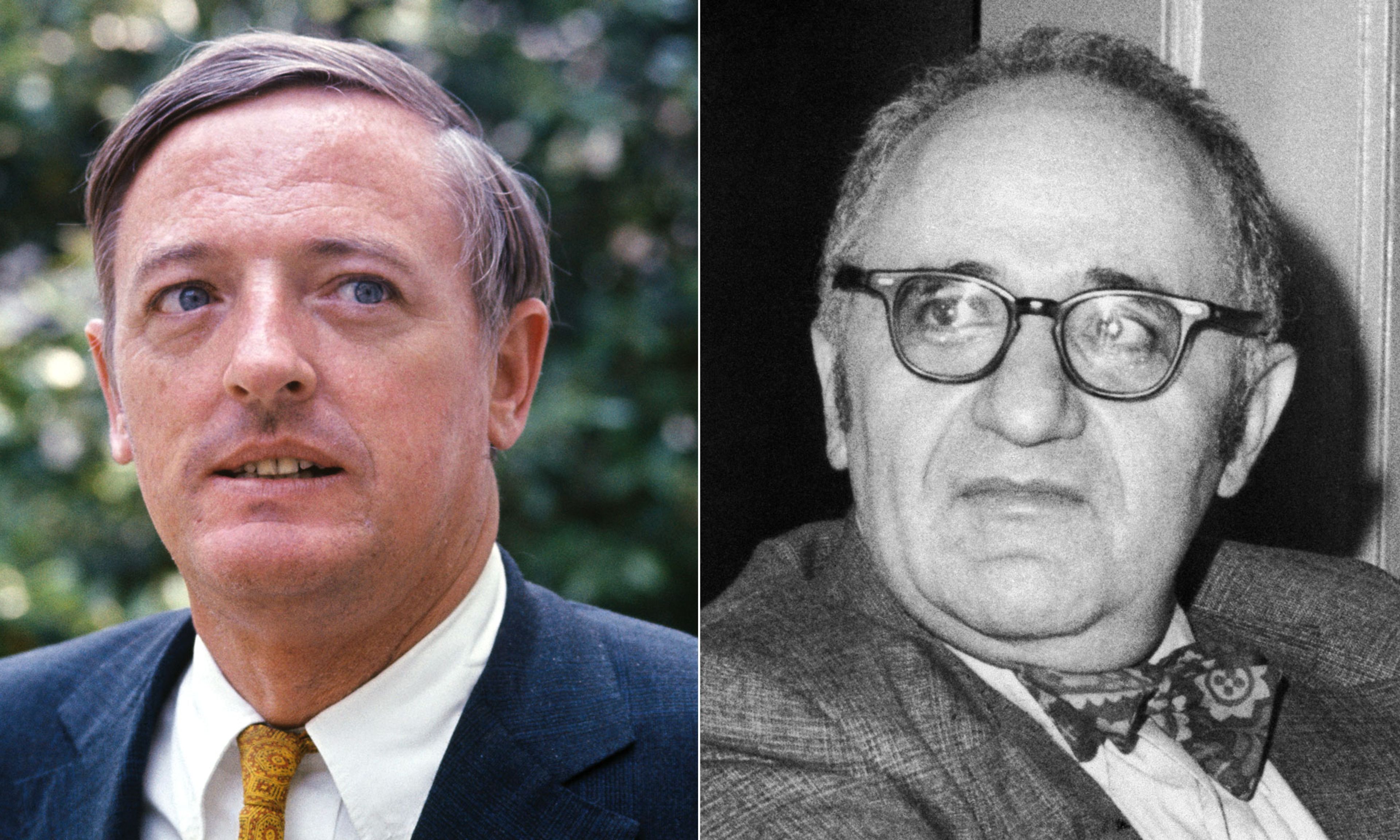
Personages on the right now use such words as “deranged traitor,” “moron,” and “freaking snake” to describe other personages on the right. The promiscuous use of insults that conservatives once rarely wielded even against progressives signals a decline in decorum. But it does not necessarily point to a conservative crackup. Conservatives often clash, especially during times when their movement appears ripe for redirection or redefinition. Right-wingers of the past just did so with more intelligence and civility than they do now.
The March centenary of Murray Rothbard’s birth evokes illustrations that buttress this notion as based on something firmer than nostalgia.
Upon Rothbard’s 1995 death, William F. Buckley Jr. offered condolences to his family but not to the movement that he had launched. Buckley cited Rothbard’s “defective judgment” and invoked the economist’s 1959 applause of Soviet dictator Nikita Khrushchev as his motorcade passed in his New York City hometown as a means to specifically bolster that general point. The uproar over the obit called into question its conclusion that Rothbard died “with about as many disciples as David Koresh had in his little redoubt in Waco.”
But Rothbard and Buckley, who entered the world in the same city roughly three months apart, once championed one another’s endeavors.
In 1956, when Dwight Macdonald penned a taunt disguised as an article regarding National Review for Commentary, Rothbard wrote a three-page, single-spaced letter in defense of the fledgling publication in which he called Macdonald’s work “a dull smear.”
The exclamation point on the spirited epistle comes in the postscript. There, Rothbard divulged what Macdonald did not, i.e., that NR senior editor James Burnham and his critic Macdonald had once worked alongside one another as disciples of Leon Trotsky (who contrasted the “educated witch doctor” Burnham with Macdonald, whom he dismissed as “a bit stupid”). “Surely it misled the reader not to inform him of Dwight Macdonald’s personal vendetta against some of the staff of NR,” Rothbard wrote. “What were the relationships between Macdonald and William Schlamm within the Luce empire? And what of the famous dispute between Macdonald and Burnham when the latter first broke with the Trotskyist movement?”
Long before Buckley wrote his obituary of Rothbard, he once wrote a glowing recommendation for the student of Ludwig von Mises. Buckley described Rothbard as “congenial and imaginative” and “young and brilliant” in a November 27, 1957, letter to Peter Hoguet of the Econometric Institute. He noted the collapse of the Princeton Panel, which would cease employing Rothbard in another month. He urged Hoguet to hire Rothbard.
But one month later, Rothbard lashed out at National Review because of Whittaker Chambers’s scathing critique of Ayn Rand’s Atlas Shrugged. “The most outlandish error is the linking up of Miss Rand and Adolf Hitler,” Rothbard wrote Buckley on December 28, 1957. Rothbard eventually joined Chambers in depicting Rand as totalitarian in, among other works, “The Sociology of the Ayn Rand Cult.” But in late 1957, the ex-communist’s review widened the chasm between Rothbard and Buckley.
The relationship further deteriorated upon that 1959 visit to the United States by Khrushchev. Rothbard’s friend Frank Meyer, along with fellow NR senior editor Brent Bozell and Christopher Emmet, formed an unwelcome committee of sorts to greet Khrushchev. Buckley denounced the visit in a Madison Square Garden speech. National Review unsurprisingly discussed this first visit to the United States by a Soviet head of state in unflattering terms.
Rothbard wrote a letter in September of 1959 comparing the Russian dictator favorably to several of Buckley’s political heroes. “If you insist on a quantitative score, then Churchill probably would be responsible for more men killed than Khrushchev, and if you insist on your ‘moral calculus,’ then Mr. K is certainly no worse than hundreds of others,” he maintained. “Also highly humorous was the complaint in NR Bulletin that Mr. K might be sleeping in the sainted Lincoln’s bed; but this surely would be more than apt, considering that Mr. K’s deeds in Hungary were precisely equivalent to Mr. Lincoln’s Butchery of the South.”
Buckley responded succinctly. “National Review may be ambitious,” he explained, “but it is not so ambitious as to take on the job of educating you on how to make elementary moral distinctions.”
By the mid-1960s, Rothbard regarded himself, if for a time, as no longer a part of the American right. He co-founded Left and Right: A Journal of Libertarian Thought; joined the Peace and Freedom Party in 1968 along with Eldridge Cleaver, Bob Avakian, and others seemingly less committed to peace and freedom than Rothbard; and confessed to Frank Meyer exhilaration in response to antiwar campus disruptions at Columbia and elsewhere. He counted himself, Karl Hess, and Garry Wills as the three most prominent defectors from the American right.
“Incidentally, how come there has been in the case of Garry, whose defection is politically surely far more important than my own, no thundering from Bill about ‘Freak Houses,’ sinister Communist connections, etc?” he asked Meyer in August 1970. “Why the double standard of treatment?”
In a New York Times piece the following year, Buckley invoked Rothbard’s proposal for private lighthouses as an example of how adherence to pure theory over practical knowledge acts as a dim guide over dark and rocky seas. Buckley offered the cartoonish picture of “the lighthouse keeper zooming out to collect a dollar from any ship which can be proved to have treated itself to a bearing drawn from the private stock of the owner’s electricity.” The sailor returned to this anecdote in that 1995 obituary, in which he pegs as the dispositive event in their professional break a 1962 speech delivered to an Intercollegiate Society of Individualists audience, in which he joked that Rothbard’s plan to privatize lighthouses might persuade audiences “less of the advantages of the private sector than of the disadvantages of knowing nothing about lighthouses.”
Buckley bristled in that 1995 memoriam at a 1992 Rothbard piece, which had dubbed him “the prince of excommunication.” But after l’affaire du phare, Rothbard, a staple in the late 1950s and early 1960s of Meyer’s literary section in which he reviewed titles by Baldy Harper, Robert LeFevre, and Mises, returned to NR’s pages just twice in 33 years. This seemed to both confirm l’affaire du phare as rupture and undermine the notion of a formal purge.
It also raises questions about most “purges” owing less to excommunicatory edicts than to the realization that a lack of a common cause obliterates any notion of future collaboration. And in terms of the Rothbard–Buckley relationship, the anathematizing language came earlier and, if not exclusively then more often, from Rothbard. As early as 1952, Rothbard wrote that “we congratulate ourselves for treating the Buckley Boom on the intellectual Right with considerable skepticism.” He described his fellow 25-year-old as a “totalitarian socialist,” i.e., not a member in good standing of any individualist or libertarian movement, because his anticommunism compelled him to favor taxation to support foreign crusades.
Their exchanges from the 1950s into the 1990s certainly pained some readers who learned from both America’s Great Depression and McCarthy and His Enemies. The disputes nevertheless found expression on an intellectual level because scribes on the right envisioned themselves as participating in a conversation centered on big ideas and not big personalities or big emotions. The unexpected introduction of “micropenis” as a moniker attached to one conservative pundit’s name by another and the tacit thumbs-up from one Republican senator in response to political violence perpetrated against another indicates a movement shifting in emphasis from logos to pathos.
About the Author
Daniel J. Flynn, the author of The Man Who Invented Conservatism: The Unlikely Life of Frank S. Meyer, is an American Spectator senior editor, visiting fellow at the Hoover Institution, and YouTuber @RightWingWilderness.
Featured Tags
Advertisement
Advertisement
Comments