Originalist Masterwork Protects Ten Commandments Displays
Written by Andrea Picciotti-Bayer
This case is almost certainly bound for the Supreme Court.
Share this story
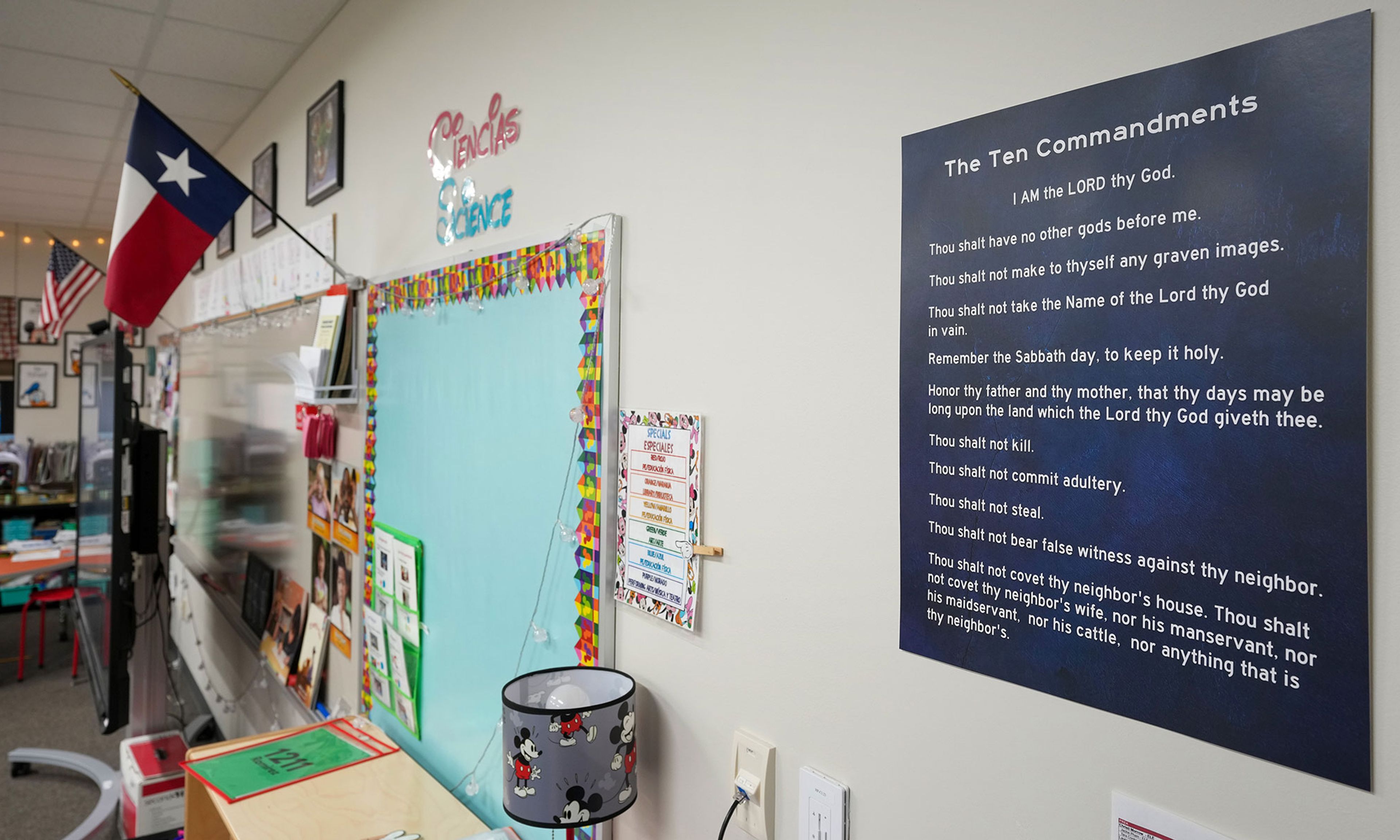
The Ten Commandments have been carved in stone for millennia. Now, thanks to a landmark en banc ruling by the United States Court of Appeals for the Fifth Circuit in Rabbi Nathan v. Alamo Heights Independent School District, they may finally be safe from the chisels of separationist litigants. That court rejected claims that a Texas law mandating passive displays of the Ten Commandments in public school classrooms violated the religion clauses of the First Amendment.
The opinion, authored by Judge Kyle Duncan of Louisiana, is a masterwork of originalist jurisprudence. Long before ascending to the federal bench, Duncan stood before the Supreme Court as counsel for Hobby Lobby, successfully vindicating the rights of a family-owned business under the Religious Freedom Restoration Act. His scholarship on the anti-Catholic Blaine amendments further established him as one of the foremost religious freedom minds of his generation. He knows this terrain as well as anyone who has ever worn a robe. The court, sitting with all active members, concluded that passive displays of the Ten Commandments in Texas public school classrooms raise no viable establishment clause or free exercise clause concern.
To understand why Duncan and his colleagues are right, one must reckon with how badly the law went wrong -- and for how long. In Lemon v. Kurtzman (1971), the Supreme Court erected a test that effectively exiled religion from public life. The result was decades of jurisprudential chaos. Stone v. Graham (1980) -- which struck down a Kentucky law requiring Ten Commandments displays in public school classrooms -- is Lemon's direct offspring.
The Fifth Circuit properly recognizes that this lineage is extinct. In Kennedy v. Bremerton School District (2022), the Supreme Court abrogated Lemon, replacing it with an analysis grounded in the nation's history and tradition. As Professor Mark David Hall of Regent University and I explained in "Ten Commandments in the Public Square and Public Schools," Stone is no longer good law. Duncan summed things up perfectly, “With Lemon extracted, there is nothing left of Stone.”
Following the Court’s direction in Kennedy, Duncan carefully explains why the Texas law “looks nothing like a historical religious establishment.” It “does not tell churches or synagogues or mosques what to believe or how to worship or whom to employ as priests, rabbis, or imams”; it “punishes no one who rejects the Ten Commandments, no matter the reason”; it “levies no taxes to support any clergy”; it “does not co-opt churches to perform civic functions.”
The history underlying these displays makes the case plainly. In the mid-1950s, Minnesota Judge E. J. Ruegemer formed an interfaith committee -- clergy of several faiths included -- to craft a version of the Commandments not identifiable to any single religious tradition. He partnered with Cecil B. DeMille and the Fraternal Order of Eagles to place monuments bearing that text across the country. The Supreme Court upheld that very text in Van Orden v. Perry (2005), finding a Ten Commandments monument on the Texas state capitol grounds constitutionally permissible.
Critics have nonetheless persisted in arguing that the text displayed in Texas, Louisiana, and Arkansas classrooms is distinctively Protestant. That claim is without merit. In a commentary published in First Things this past January, Professor Hall and I were joined by Rabbi Stuart Halpern of Yeshiva University to demonstrate, through careful textual analysis, that the version of the Commandments at issue -- created through deliberate interfaith collaboration and recognized as nonsectarian by the Eighth Circuit -- favors no denomination over another.
Duncan recognizes this and adds two important considerations. First, that the prohibition on “denominational discrimination” which prevents the government from “privileg[ing] certain religions over others when imposing burdens or granting benefits . . . has no application to government use of religious language or symbolism.” And second, entertaining the plaintiffs’ arguments would require the judges to “make a theological judgment wholly unsuited to a federal court.”
A poster on a classroom wall simply does not constitute religious coercion. The contrast with genuine coercion illuminates how far such an argument misses the mark. In Mahmoud v. Taylor (2025), the Supreme Court held that Montgomery County, Md., school officials’ refusal to offer parents any opt-out from LGBTQ+-themed books in public elementary school curricula violated the free exercise rights of objecting families. There, the government actively deployed the classroom as an instrument of ideological formation. A Ten Commandments display asks nothing of any student. It does not require belief, recitation, or assent. As Duncan noted, “Yes, Plaintiffs have sincere religious disagreements with its content. But that does not transform the poster into a summons to prayer.”
States should retain the latitude to acknowledge the moral and legal inheritance that shaped this nation's character. “Thou shalt not kill.” “Thou shalt not steal.” “Thou shalt not bear false witness.” These are not confessional demands -- they are the bedrock of ordered liberty. Their religious origins do not disqualify their civic significance.
This case is almost certainly bound for the Supreme Court, which will have the opportunity to set a clear post-Lemon path forward. Judge Duncan’s opinion will be an essential guide. The Lemon test lasted barely five decades before collapsing under the weight of its own contradictions. The Fifth Circuit has read the Constitution as it was written. The Supreme Court should follow.

About the Author
Andrea Picciotti-Bayer is director of the Conscience Project and recipient of the Religious Freedom Institute’s 2025 Religious Freedom Impact Award.
Featured Tags
Advertisement
Advertisement
Comments