Exiled to Paradise
Written by A. M. Juster
Foxglovewise: Poems, by Ange Mlinko (Farrar, Straus and Giroux, $27)
Share this story
Ange Mlinko, perhaps best known for her work as poetry editor for The Nation, began attracting attention as a poet about 25 years ago, and rightly so. Even her earliest work displayed erudition, intelligence, creativity, and a broad range of poetic styles. That range, though, was a curse as well as a blessing because she sometimes seemed to be trying on techniques and ideas rather than speaking confidently in her own voice.
With her 2010 book, Shoulder Season, her publisher, Coffee House Press, unintentionally put its finger on that problem by including a blurb that described the poet as “half John Ashbery, half Harriet the Spy.” I am sure the Ashbery comparison was meant as a compliment, though for many readers it must have come across as a way of describing her poetry as long on lush surfaces but short on content. I assume that the Harriet the Spy comparison was intended to praise Mlinko’s formidable powers of observation, but the cutesiness strikes me as unclear and patronizing.
Once Mlinko moved to Farrar, Straus and Giroux with her 2013 book, Marvelous Things Overheard, her work became more marvelous. She moved in the direction of James Merrill in his prime -- with a dash of Anthony Hecht’s passion for deliciously obscure words. She dropped much of the free verse and prose poetry popular with our overbearing literary establishment and began using traditional metrical techniques more frequently and inventively.
She had always employed some rhyme, but with Marvelous Things Overheard she seemed to revel in acrobatic and surprising rhyme reminiscent of Merrill and Auden -- as she herself put it in “This One and That One,” she “took satisfaction in things that click.” Among her contemporaries perhaps only Aaron Poochigian has been taking such satisfaction in inventive rhyme. For example, in “The Grind” she included a jarring couplet of not quite rime riche that pairs “pain” with “paint.” She also seemed to be more comfortable with humor, and in the same poem she made a hilarious joke about being less groomed than her rescue dog.
This shift in direction continued in her 2017 book, Distant Mandate, in which her language was more daring yet more under control, and greater introspection enhanced her considerable powers of observation. There does not seem to have been some mystical insight, just progress made by crafting wonderful poems one after another.
In her 2022 book, Venice, Mlinko’s work became even more formal, and for the first time she focused primarily on two subjects -- poems of place from Italy and Florida. She had led a nomadic existence for much of her life, including time spent in unsettled places such as Lebanon and Morocco, but those days were over. In 2014 she settled in Gainesville to teach at the University of Florida, and five years later received tenure. I usually view acceptance of tenure as the beginning of the end for a poet, but in her case greater security seems to have trumped the enervating influences of the academy.
Mlinko’s new book, Foxglovewise, is the culmination of her shift in approach to form and topics over the past 15 years. It is her finest work to date, work worthy of Pulitzer and National Book Award consideration. As with Venice, many of the poems are set in Florida, and she seems pleased, if still bemused, to be there:
How good it smells, this
orange blossom. If anything could
freeze time into crux of possibility and fruition
at once, it’s this cluster of citrus
amid florets. I’ve been exiled to Paradise,
it seems . . .
(“Voluptuous Provision”)
Though there are poems that appear to be set in her adopted hometown of Gainesville, she seems to achieve “fruition” most intensely when dwelling in the Florida Keys, as did Wallace Stevens:
We drove the car over the Keys
as the Preludes and Fugues played.
Music sluices through time;
nothing can hold the harmonies
just as the tide can’t be stayed
though it can turn on a dime.
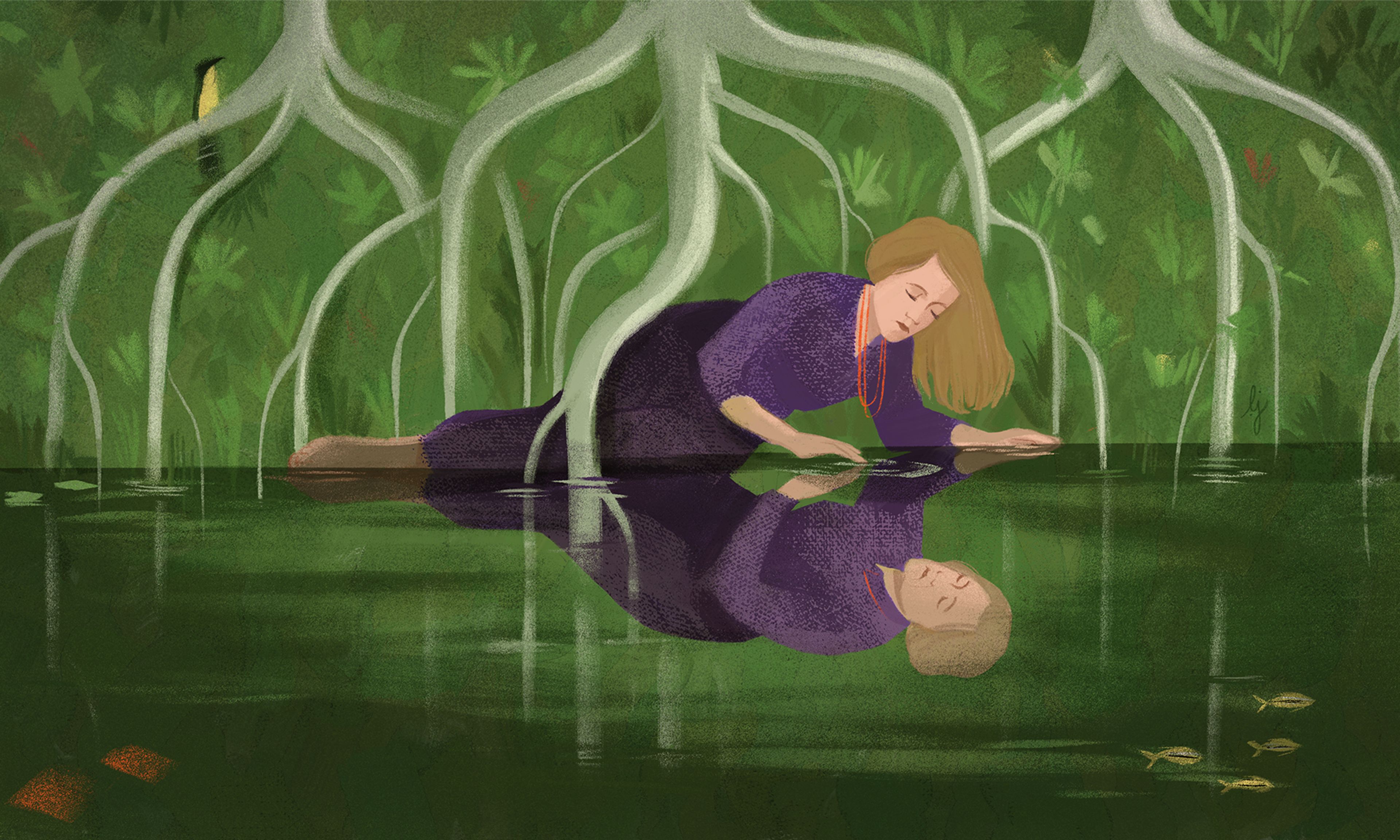
(“Mermaids and Mangroves in Key West”)
Mother and son share a kayak. They bump
and bumble into the mangrove swamp
and barely keep up with the tour guide.
“Life starts here,” he’s saying, “the tide
brings animals and fish to incubate.”
Unsynchronously paddling the strait,
Mother hissing, son throwing a backward glare,
they pantomime a mismatched pair.
(“Chekhov in the Gulf of Mexico”)
The cannon face the rolling breakers,
aimed at the line where sky and sea collude.
What do they defend? The wild enclosure,
which for two centuries has lived on rain.
Sixteen million bricks encircle sixteen acres.
There are no nymphs where there’s no plenitude
of springs, although the sand’s quite pure
that can’t take the imprint of pain.
(“The Missing Nymph at Dry Tortugas”)
The other location that ignites Mlinko’s imagination in Foxglovewise is Greece, both the Greece of today and a gauzy fusion of ancient and modern Greece:
or rather, he spoke in circles, as rhymes do,
a sermon on water. That little of its flow
was in English, some diverted into Greek,
excited me like screams to the angelic orders.
(“Tarpon Springs, Epiphany”)
I’m in two foreign countries at once, by turn
testing on my tongue the umami of these sounds,
iron-laced water like blood-anointed spear tips
and the tangy granite in the skirling burn.
(“The Iliad in a Scottish Cemetery”)
I don’t know if I have ever tasted lines as much as these.
In addition to the maturing vision, the way that Mlinko arranges her lines either to draw attention to or muffle a rhyme is impressive. She accomplishes effects in part by often using supple stanzas where the rhyming words bridge two stanzas, usually ABC ABC, but sometimes ABCD ABCD. The unconventional distance between the end rhymes avoids a clanging effect, and so an off-rhyme in stanzas such as those that I have quoted is almost unheard. On the other hand, these stanzas still provide plenty of opportunity for multisyllabic rhymes (faces/multistasis, mothers/druthers) that, in her word, “click,” often with Audenesque wordplay. No wordplay in this book is more brilliant (and sad) than the punning in the closing line of the title poem, which uses the phrase “off-peak single” to describe a ticket; one slowly realizes that it is also a way to describe an aging, lonely person’s life.
The pandemic colors many of this book’s poems, both directly and indirectly. “Easter Mass Vaccination” captures the weirdness of our new rituals, sidesteps rhetoric, and closes with a quiet and usually overlooked moral message. In “Voluptuous Provision,” the sense that time in the pandemic has slowed and thinned forces Mlinko to confront her disbelief about her mother’s mortality and her own:
Oh well,
when the pandemic is over, I imagine
nothing will have changed that much.
Her cake and cookie clippings will
all have remained aspirational,
gesturing at kitchen research.
And we will both have grown old.
How strange that the child who lay
in her mother’s arms can play
at their being contemporaries, as the cold
creeps south.
Many of the poems tinged by the pandemic seem to be starting to say farewell to a beloved world in the vein of Prospero’s “Now our revels are ended” speech in Shakespeare’s The Tempest, a sense that Mlinko reinforces in “The Open C”:
You stare into it for days, all your life,
as if waiting for a curtain to rise. As if
a production of Ariel and Prospero
were pending in the ocean’s void . . .
These farewells avoid sentimentality and self-pity, and often include Mlinko’s dry wit.
The time is right for you to take this trip to Florida and wherever else Mlinko wants to take you.

About the Author
A. M. Juster has published poems and translations widely. He is the author of a children’s book, Girlatee, and a new translation of Petrarch’s Canzoniere.
Featured Tags
Advertisement
Advertisement
Comments