Baseball Is the Ultimate Modern Game
Written by Christian Schneider
The national pastime continues to regenerate itself and excite younger fans.
Share this story
When the Milwaukee Brewers were a mere minor league team in the early years of the 20th century, pitcher Ralph Cutting’s contributions to the team were not limited to striking out batters. Cutting would bring his pet goat to the ballpark, where the animal would roam the outfield and eat the grass as the players shagged fly balls during practice. Not only did Cutting win 21 games in 1913, he and his goat likely spared the team the cost of a grounds crew.
This has long been the picture of baseball in Americans’ minds: a pastoral sport with no time limits that serves more as a leisure activity than a hard-hitting sport like football. Goats can wander the outfield, fans can put their feet up and enjoy encased meats. A version of baseball, softball, is enjoyed by men and women on fields across America every summer, as participants suck down beers. Further, the stakes are low: If your starting pitcher has a bad game, don’t worry — there are 161 other chances for your team to win.
But this is also why some contend that baseball is past its prime; its modern critics say that it’s too slow, too wed to analytics, and simply doesn’t have the cultural cachet of professional basketball or football. (It doesn’t help that it is known as the “national pastime,” with the word “past” right there in the moniker.)
The conventional wisdom goes something like this: Baseball is dying, the kids don’t care, and the sport is a relic of a simpler time when men wore wool uniforms and chewed tobacco and didn’t have smartphones to distract them.
The obituaries get written every few years. This week, my friend Matthew Hennessey wrote this in the Wall Street Journal’s Free Expression newsletter, bemoaning how modern baseball players are “lab-grown supermen”:
Baseball was once played by damaged men with interesting habits. They drank and smoked. You watched your favorite team and thought to yourself, ‘those guys aren’t so different from me.’ It was the professional sport that discouraged athleticism. Sluggers were warned to stay out of the gym, lest they injure themselves. Some had beer bellies.
Here’s the thing, though: the conventional wisdom is wrong. Not a little wrong. Substantially wrong. Baseball isn’t a dying sport desperately clinging to its past. It’s one of the most modern entertainment products in America — and it’s been hiding in plain sight.
Start with the most obvious point, which somehow nobody makes loudly enough: baseball is a clip machine. Football gives you a handful of genuinely huge moments per game — touchdowns, big hits, fourth-quarter drama. Baseball gives you something different and, in the current media environment, arguably more valuable. A 470-foot bomb. A 102 mph fastball that just ate someone alive. A diving catch that makes you gasp. A manager who loses his mind at an umpire in a way that would get any normal person fired. A reliever with a mustache so bewildering he looks like he sells bait at a Bass Pro somewhere in rural Georgia.
Baseball features speed and violence that is unknown in other American sports — it just does it in shorter spurts. A wayward 100 mph pitch can end a life, and a double play broken up at second base can start fights.
All of that is infinitely clippable. Infinitely shareable. MLB reported that its social engagement during the 2024 World Series was way up year over year, with huge growth in video views and Instagram and TikTok engagement. In 2026, you don’t need to watch all nine innings to feel like a baseball fan. You can follow the sport entirely through highlights, arguments, and memes, and you’ll miss nothing essential — and that’s not a bug, it’s a feature. That’s exactly how younger audiences consume everything now.
Then there’s the data angle, which is genuinely underappreciated. If you sat down and tried to design a sport for the analytics era — for the kind of person who enjoys arguing at dinner about underlying metrics and model-based projections — you would invent baseball. The sport now tracks launch angle, exit velocity, spin rate, barrel percentage, expected batting average, sprint speed, and, yes, actual swing mechanics in real time.
Statcast has turned every at-bat into a data event. Baseball isn’t just watched anymore; it’s measured, modeled, visualized, and argued over like a Silicon Valley product that happens to involve men throwing things at each other very hard. In baseball, a fan can casually say something like “his underlying contact profile is still strong even though the results haven’t shown up,” and nobody calls the authorities. That’s remarkable. That’s a sport that has made advanced analytics part of its cultural vocabulary.
And the game itself has actually been fixed — a point that the “baseball is dying” crowd consistently ignores because it complicates the narrative. The legitimate complaint for years was that the sport had too much dead time: pitchers wandering around, batters stepping out, games dragging past three hours. MLB responded with the pitch clock, larger bases, and restrictions on extreme defensive shifts.
The result: shorter games, less standing around, and more action. Average game time in 2025 was 2 hours, 38 minutes, marking the first time since 1985 that the average game time had been under 2 hours, 40 minutes for three consecutive seasons. In 2025, there were only three nine-inning games that lasted more than 3 hours, 30 minutes; in 2021, there were 391.
That’s a league that actually identified a problem and iterated on its product, which is more than you can say for most institutions in America.
Here’s the counterintuitive piece: baseball actually works well with modern attention spans, not in spite of its pace but because of it. The assumption is that younger audiences want constant sensory assault — that everything needs to be a Mr. Beast video with no pauses, no breathing room, no moments where you might think about something other than what’s on screen. But that’s not really true. A lot of people — including a lot of younger people — actually want something that has rhythm and atmosphere and room to talk to the person next to you without missing anything catastrophic.
Baseball fits the second-screen lifestyle perfectly: you watch the game, track your fantasy team, scroll highlights of other games, argue in the group chat, and glance up whenever something seems to be happening. It’s modular entertainment.
The star system has also modernized in ways that don’t get enough credit. Baseball used to market itself like a Hall of Fame museum with organ music. Now it has Shohei Ohtani, who is a genuine global superstar and also does things that have never been done before in the sport’s history — a fact that never stops being astonishing. It has Aaron Judge, who looks like someone commissioned a comic book superhero and then made him real. It has Elly De La Cruz playing shortstop like a force of nature that learned the rules of baseball recently and is still figuring out which ones apply to him. It has Paul Skenes, who throws a baseball with the kind of velocity that makes you briefly wonder if he’s from planet Earth. These aren’t just good players. They’re content ecosystems. They’re reasons for people who don’t traditionally watch baseball to pay attention.
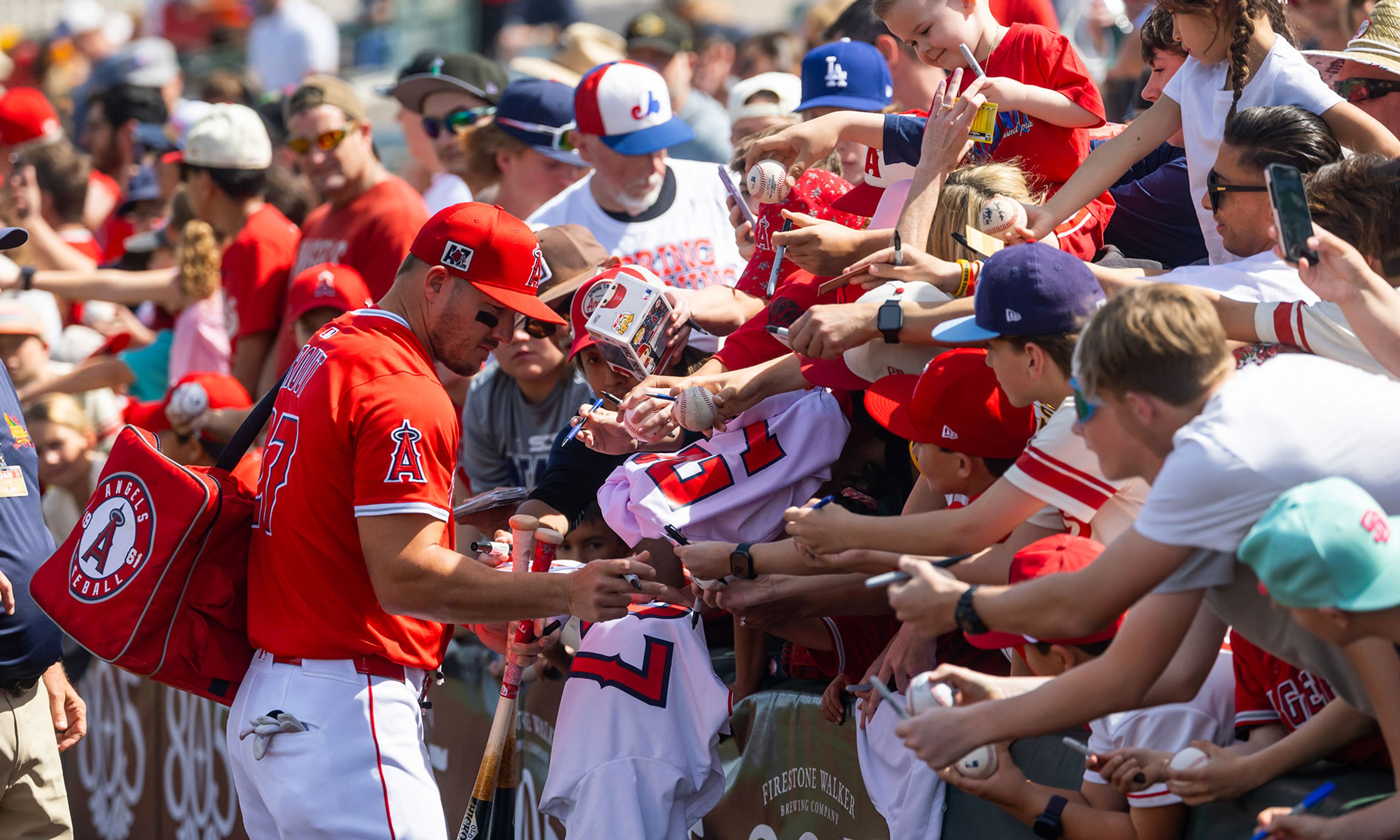
The audience demographics, meanwhile, are moving in better directions than the stereotype suggests. Attendance in 2024 was the highest it had been since 2017. MLB’s own data show that the percentage of ticket buyers ages 18 to 35 has risen in recent years, the median age of ticket purchasers has dropped, and the average age of new digital accounts has fallen sharply since 2019. This doesn’t mean baseball suddenly became Coachella with pine tar. But the “baseball is only for retirees” line is increasingly a cliché that the data don’t support.
Further, baseball still feels like it belongs to specific places. In a world where everything is global, algorithmically identical, and curated for maximum inoffensiveness, baseball gives people regional identity, summer ritual, and city-specific obsession. The Cubs are a specific thing. The Red Sox are a specific thing. Even the Royals, bless them, are a specific thing. That’s not a weakness in the streaming era — that’s a competitive advantage. People are hungry for things that feel rooted and communal and not mass-manufactured for everyone everywhere. Baseball is one of the few big cultural products left that can still credibly claim to belong to a place.
And increasingly, those places are areas outside the United States. One need only watch a few innings of the recently completed World Baseball Classic to soak in the joy exuded by teams from places like Venezuela, Japan, and the Dominican Republic. These games featured world-class players fighting for national pride, and generated World Series–style excitement in March. One could not behold the electricity in the stands at these games and still believe it’s a dying sport. Quite the opposite.
Baseball is not outdated. It just isn’t trying to be the NBA. And as it turns out, that might be exactly why it’s still working.

About the Author
Christian Schneider is a National Review contributor and writes the Anti-Knowledge newsletter. He is a co-host of the podcast Wasn't That Special: 50 Years of SNL.
Featured Tags
Advertisement
Advertisement
Comments