Australia and New Zealand’s Self-Inflicted Fuel Crisis
Written by John Gustavsson
Empty pumps down under.
Share this story
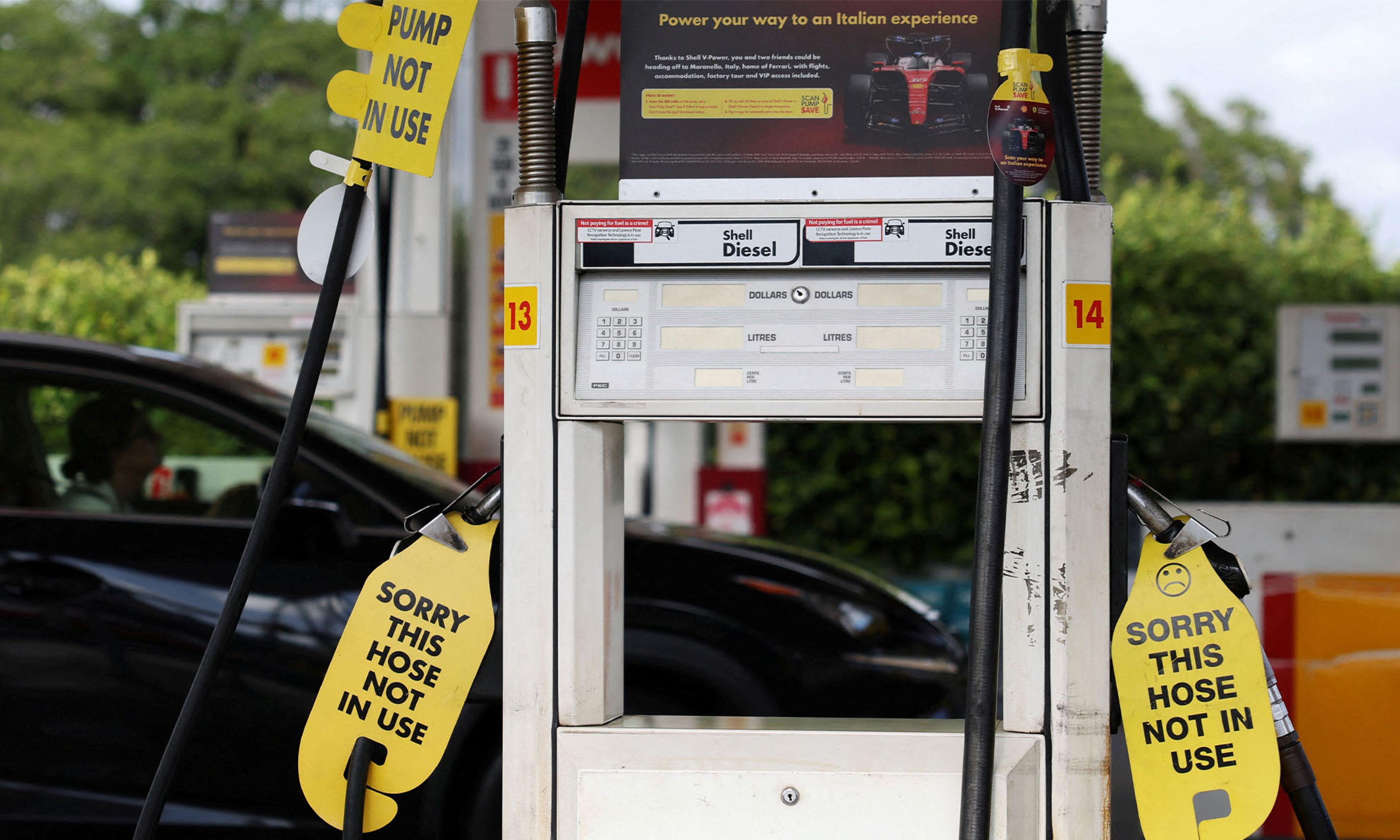
As Americans wrestle with $4-per-gallon gas, on the other side of the world, two countries are rapidly sliding into a genuine crisis. In Australia and New Zealand, the closing of the Strait of Hormuz has already created a fuel shortage, with rationing now openly discussed by both governments. In Australia, hundreds of gas pumps have gone dry and the government has declared a national fuel crisis. While the crisis is in part due to these countries’ unique, isolated geography, it must also be viewed as the bitter harvest of decades of reckless environmentalist policies.
Like America, neither Australia nor New Zealand import much oil or petrol from the Middle East. Instead, they rely on imports from Asian countries, including South Korea, Singapore, and Malaysia. As global supply is choked, these countries prioritize their own needs, and Australia and New Zealand are forced to compete with countries that, until recently, were supplied by the Middle East.
While the global supply shock cannot be blamed on local politicians, import dependency is another matter. In the year 2000, Australia had eight refineries. Today, only two remain, fulfilling less than 20 percent of the country’s needs. While the Australian government argues that the shutting of refineries was the result not of policy but of the private decisions by the businesses operating them, this misses a key point: Businesses, in Australia and elsewhere, were made to understand that refineries would soon be “stranded assets” in the future “net-zero” economy, and they acted accordingly.
As for New Zealand, its only refinery closed in 2022 under Prime Minister Jacinda Ardern and was converted into an import terminal. Prior to that, in 2018, the same government had introduced a ban on oil and gas exploration, a key part of its plan to transition the nation to a “carbon-neutral future.” The ban was repealed last year, but it was too little, too late to prevent the current crisis. While New Zealand’s only refinery was not built to handle the kind of oil found in the Taranaki basin, it could — albeit inefficiently — nevertheless have produced enough fuel from such oil during an emergency such as this one to keep ambulances, fire engines, and food distribution trucks running in perpetuity.
While Australia does not ban such exploration outright, stiffening climate regulations (both federal and local) have made it increasingly difficult, and domestic oil production has dropped 90 percent since the year 2000 to a pitiful 69 million barrels (equivalent to what Texas produces in eleven days).
Sadly, while both countries weaned themselves off domestic oil and refineries, this did not translate to weaning themselves off oil as a commodity.
Those who defend the record of Labour governments in Australia and New Zealand claim that it would not matter if the refineries had stayed open, since even if they had, they would need oil to produce fuel. This, however, overlooks the role those governments played in choking domestic oil production. It also ignores that crude oil can be stored easily and indefinitely, whereas petroleum and other fuels tend to deteriorate within just a few months, meaning that reserves must be constantly replenished.
While the International Energy Agency recommends keeping 90 days’ worth of fuel in reserves, for Australia (according to the latest official estimates prior to this crisis), reserves were only 36 days for petrol, 32 for diesel, and 29 for jet fuel. New Zealand is doing somewhat better, though it is still far below targets. Ironically, several smaller, poorer nations in Oceania are doing much better.
This lack of preparedness is uncharacteristic for both Australia and New Zealand. Both nations pride themselves on being major agricultural exporters with the ability to keep their people fed indefinitely even if cut off from the world, as happened during World War II, which Australia and New Zealand both made it through without the type of draconian food rationing introduced in Britain. Yet in the end, agriculture runs on fuel, not on virtue.
Already during the pandemic and in its aftermath, consumers throughout the West received a stark lesson in the shortcomings of just-in-time philosophy: Instead of storing months’ worth of goods in massive warehouses, shops and manufacturers today tend to keep minimal inventory and instead use computer systems to place automatic orders when stocks fall below a specific threshold. This saves storage costs but at the expense of leaving consumers vulnerable to sudden supply or demand shocks.
It should come as no surprise that, in the increasingly unstable world of the 2020s, just-in-time logistics has lost a significant chunk of its prior popularity. For two advanced economies such as Australia and New Zealand to deliberately weaken their domestic fuel production yet continue to run their supply on precarious just-in-time logistics is nothing but a masterclass of incompetence, and one for which both political sides share blame: As late as 2024, the current (right-wing) New Zealand government scrapped plans to build a public diesel reserve.
The current crisis is not just a story of environmental policies misfire but of two countries that stubbornly refuse to accept that the “end of history” post–Cold war era has long since come to an end.
On March 30, Australia’s government announced that excise taxes on fuel would be cut in half. While well-intentioned and understandable, considering soaring prices, this could backfire by increasing demand at a time when supply remains fragile. Like New Zealand, Australia has announced a four-stage plan in which the later stages would introduce rationing. Both governments emphasize that they are optimistic that the crisis won’t come to that, but the mere prospect of future rationing could conceivably encourage hoarding.
While Australia and New Zealand have acted in a particularly reckless manner, they are not alone in that — and soon, they won’t be alone in their troubles. The current situation has been likened to Covid-19 in February 2020, when many were still confident that the virus could be contained to Italy and other early hotspots. As we now know, it was already too late.
While Americans are unlikely to suffer actual fuel shortages thanks to its country’s domestic energy production, in Europe, it’s a different story. Already, Germany’s Minister of the Economy Katherina Reiche is warning that Europe could face an energy supply crisis later this month or in May if the blockage of the Strait of Hormuz continues. Her colleague, Minister of Finance Elisabeth Svantesson of Sweden, has echoed these warnings, going as far as to suggest that rationing may become necessary.
With the crisis intensifying, a political reckoning is already underway over how best to restore energy security. Environmentalists see the shortages as proof they were right all along, and they’re already calling to double down on net zero in Europe and the Pacific. That would be utter folly, especially considering that green substitutes rely heavily on Chinese imports that could be held hostage at any time, much like the Strait of Hormuz is now.
The current crisis is a just-in-time disaster caused as much by Tehran as by an environmentalist ideology that has provided virtue without security, sheltered by the long-discredited fantasy of the “end of history.” Now, reality has returned — and it runs on fuel, not virtue.
About the Author
John Gustavsson is a writer from Sweden and holds a doctorate in economics. He is a former adviser to the Sweden Democrats in the European Parliament.
Featured Tags
Advertisement
Advertisement
Comments